Audemars Piguet Royal Oak Double Balance Wheel Openworked 15407ST
- Make
- Audemars Piguet
- Reference
- 15407ST
- Model
- Royal Oak
- Variants
- 15407OR, 15407BA, 15407BC
- Production
- 2016–present (in production)
- Case diameter
- 41 mm
- Calibre
- 3132
- Case material
- Stainless steel
- Water resistance
- 50 m (164 ft)

AI-generated illustration.
In the mid-1970s, as quartz was about to gut the Swiss industry, Audemars Piguet went the other way and went back to cutting its movements open. Régis Meylan, foreman of AP's workshop from 1974 to 2018, remembers it as the place where "the art of openworking was revitalised in 1975, at the dawn of the quartz crisis" (AP Chronicles). Hand-skeletonising a calibre is slow, expensive work that a machine can't finish. The earliest openworked Royal Oak wristwatch in AP's archive dates from 1986, and an openworked "Jumbo" followed in 1992.
The Audemars Piguet Royal Oak Double Balance Wheel Openworked 15407ST is where that tradition picked up an engineering idea. Launched at the SIHH in Geneva on 18 January 2016, it put two balance wheels and two balance springs on a single staff, a geometry AP patented as "Dualbalance" and called "a new world-first" (AP press text, via WorldTempus). The skeleton was there to show the mechanism off, and the mechanism was there to make the watch keep better time. The 15407 is the first watch to use it, and ten years on it's still the reference the whole double balance family hangs from: the 37 mm models, the frosted gold, the ceramic, the 2024 two-tone steel.
It's also a watch I'd like to own one day, so everything here comes from the record and the auction photographs.
Where it came from
AP's openworking story starts well before the Royal Oak had anything to do with it. Two specialist accounts, which read like they share AP's own press material, say the company had explored opening up movements in the 1930s, and that in the early 1970s a group of watchmakers pushed to revive it. Then-CEO Georges Golay set them a target of 100 openworked versions of the ultra-thin calibre 2120, at about 150 hours of work each. The first watch, a model 5442, sold in late 1973, and by 1978 the workshop was turning out 300 openworked pieces a year (Fratello, Wristcheck). Meylan's memory puts the revival in 1975, two years after that first sale. I'd read the gap as the difference between a first watch and a working department, but no source says so.
The Royal Oak itself, Gérald Genta's steel octagon from 1972, has its own history, which I covered in the 15500ST article. The two lines met in 1986. AP's archive records the perpetual calendar reference 25636, launched in yellow gold with an openworked calibre 2120/2800, as the watch that gave the Royal Oak a sapphire caseback "for the first time" so the movement could be seen from behind (AP Chronicles). AP sold 313 of them between 1986 and 1997. In 1992, for the Royal Oak's 20th anniversary, came the 14789: an openworked version of the Jumbo's ultra-thin movement in the 39 mm case, without the date (AP Chronicles). You'll read elsewhere that the first openworked Royal Oak was a 1996 reference 25829. AP's own archive says otherwise, and I'd go with the archive.
The 15407's direct ancestor is the 15305, the Royal Oak Openworked Selfwinding. AP's press text for it is dated November 2010 and describes a new calibre 3129 that broke with the traditional approach to skeletonising (WorldTempus). It sat in a 39 mm case, and Monochrome called it one of the boldest models in the range, "alongside the classical 15400 and the ultra-thin 15202" (Monochrome). When the regular time-and-date Royal Oak went to 41 mm with the 15400 in 2012, the openworked model was left a size behind. The 15407 brought it up to 41 mm, and while AP was at it, changed what was inside.
The problem two balances solve
AP framed the double balance as an answer to an old problem. Its launch text lists what a wristwatch has to put up with: it must "defy gravity, remain impervious to motion, resist changes in temperature and withstand all manners of shock". The answer was "fixing a second balance wheel and balance-spring assembly on the same axis. The new 'Dualbalance' patented geometry involves a very complex manufacturing procedure, but the payoff is huge: greatly improved precision and stability" (AP press text, via WorldTempus).
The clearest explanation of how it's supposed to work came from AP's Gilles Pellet, then head of product quality, in a launch video that Monochrome wrote up. The two hairsprings are made of the same alloy and set 180 degrees apart, so their errors tend to cancel. Each balance carries eight inertia blocks for regulation, and the weight is spread evenly across the staff, which reduces friction and spreads it better than hanging a second spring on one balance would (Monochrome).
Jack Forster, writing in 2023, adds two useful points. First, the doubled oscillator mass "should mean better resistance to the rate varying because of external disturbances". Second, it's distinct from the other multi-balance watches you might think of. Philippe Dufour's Duality and Greubel Forsey's Double Balancier use two balances that oscillate on their own and average out through a differential. AP's are two balances on one staff, driven by a single escapement, and Forster calls it unique "as far as I know" (1916 Company).
The fair objection is that the payoff is still a claim. AP says "greatly improved precision" and Forster says "should", but in everything I read, AP never published rate figures that compare the 3132 with a single-balance version of the same movement. What it did publish is the cost. The single-balance calibres the 3132 descends from run about 60 hours, and the 3132 runs 45, a drop both Forster and SJX point out. My read is that's the price of keeping a second balance swinging.
Who invented it is undocumented. AP says the geometry is patented, but no source I found gives a patent number, a filing date or the name of an engineer, and nobody is credited with the openwork layout either. Monochrome mentions that AP's then-CEO François-Henry Bennahmias tells "the fun story" of how the watch came about in that same video, but the story never made it into print.
Launch
The 15407 launched in two metals: steel as 15407ST.OO.1220ST.01 and 18k pink gold as 15407OR.OO.1220OR.01 (aBlogtoWatch). The steel was US$44,100 and the gold US$76,800, or €44,000 and €77,000 in Europe (Time and Watches, WCL). I couldn't find a Swiss franc price.
The watch
AP's description of the case is a single line: "Stainless steel case, glareproofed sapphire crystal and caseback, screw-locked crown, water-resistant to 50 m" (AP). The table takes the rest from the same page and its 2017 archived copy.
| Spec | Value |
|---|---|
| Reference | 15407ST.OO.1220ST.01 (steel, 2016); 15407ST.OO.1220ST.02 (steel, 2024) |
| Case | Stainless steel, octagonal bezel, screw-locked crown |
| Diameter | 41 mm (AP doesn't say whether that includes the crown) |
| Thickness | 9.9 mm (steel); 10.1 mm (pink gold) |
| Crystal and caseback | Glareproofed sapphire, both sides |
| Water resistance | 50 m |
| Dial | "Slate grey openworked dial", pink gold applied hour markers, Royal Oak hands with luminescent coating |
| Movement | Calibre 3132, self-winding, openworked |
| Functions | Hours, minutes, centre seconds |
| Frequency | 3 Hz (21,600 vph) |
| Power reserve | 45 hours |
| Jewels / parts | 38 / 245 |
| Movement diameter | 26.59 mm (11¾ lignes) |
| Bracelet | Integrated stainless steel, AP folding clasp |
AP doesn't publish lug width or lug-to-lug, and I didn't find a measured figure I'd trust.
The thickness is worth a note because launch coverage got it wrong. Watch Collecting Lifestyle's launch-day post described "a case measuring 41 mm and 5.51 mm in thickness", and Professional Watches gave 5.57 mm. A Royal Oak with a self-winding movement inside can't be 5.5 mm thick; those figures almost certainly belong to the movement, and AP's own spec sheet has said 9.9 mm for the case since at least 2017. Even the movement height is muddled: AP's page now gives the 3132 as 4.4 mm, while the launch press said around 5.5 mm. I'd leave that one alone until AP explains it.
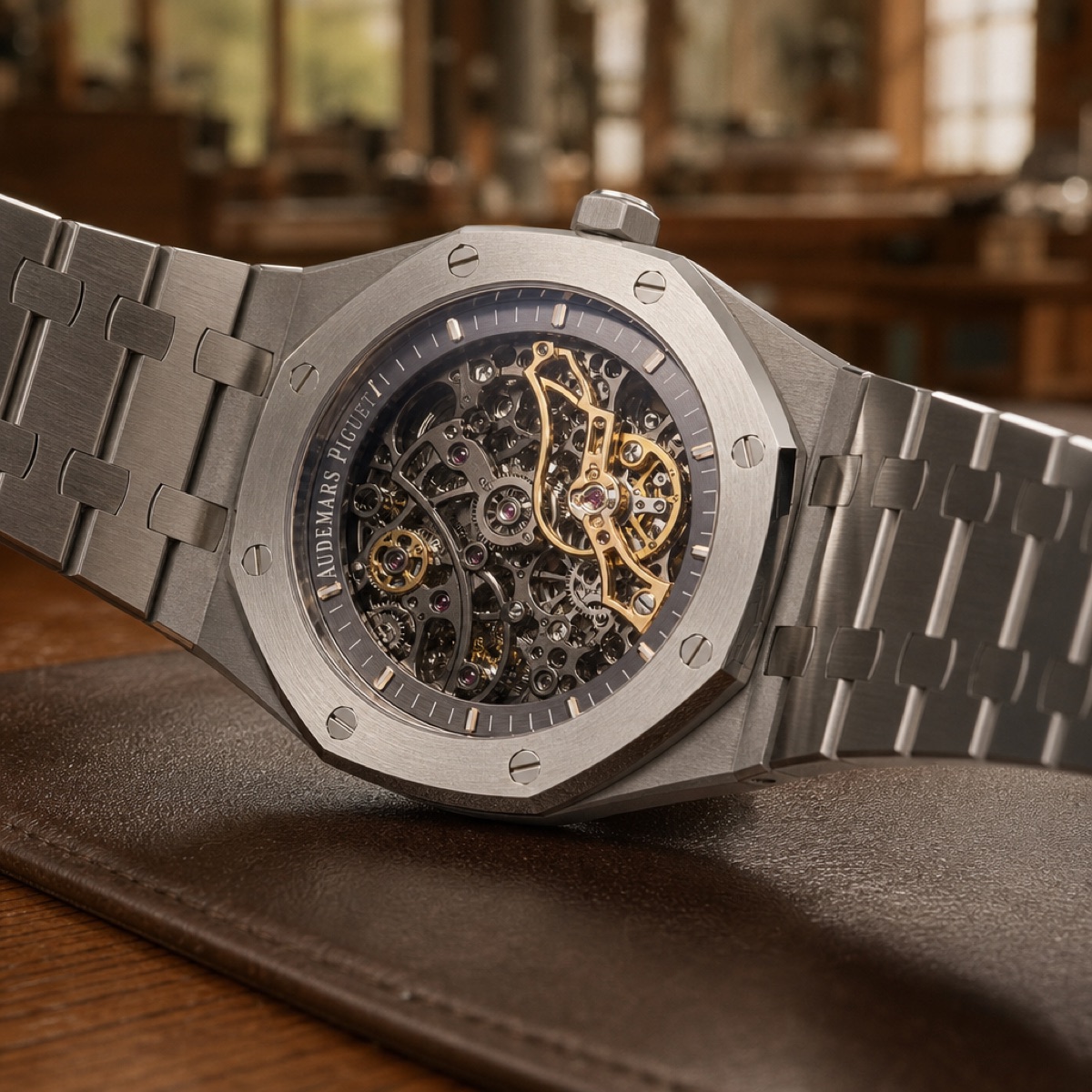
What AP calls the dial is the movement itself: its bridges, ringed by a grey inner bezel that carries the minute track and the applied pink gold markers. Phillips, describing two steel examples, puts the finish precisely: "all bridges ruthenium-coated giving the entire movement a gunmetal sheen, with the exception of its golden balance bridge", which is solid pink gold and hand-finished, with "matching pink gold hands" (Phillips, Phillips). That pink gold bridge, holding the double balance, is the one warm thing in a grey watch, and it's where the eye goes first.
AI-generated illustration.
AP is explicit that the openworking is done by hand. Its launch text says "filing, decoration and finishing are exclusively done by hand, for both aesthetic and technical reasons", because a milling machine can't produce the sharp interior angles, the inward-pointing V-cuts, that a hand-finished skeleton is judged on (Time and Watches, quoting AP). Those angles are what separate a properly finished skeleton from a stamped one, and on a movement that's mostly air, there are a lot of them.
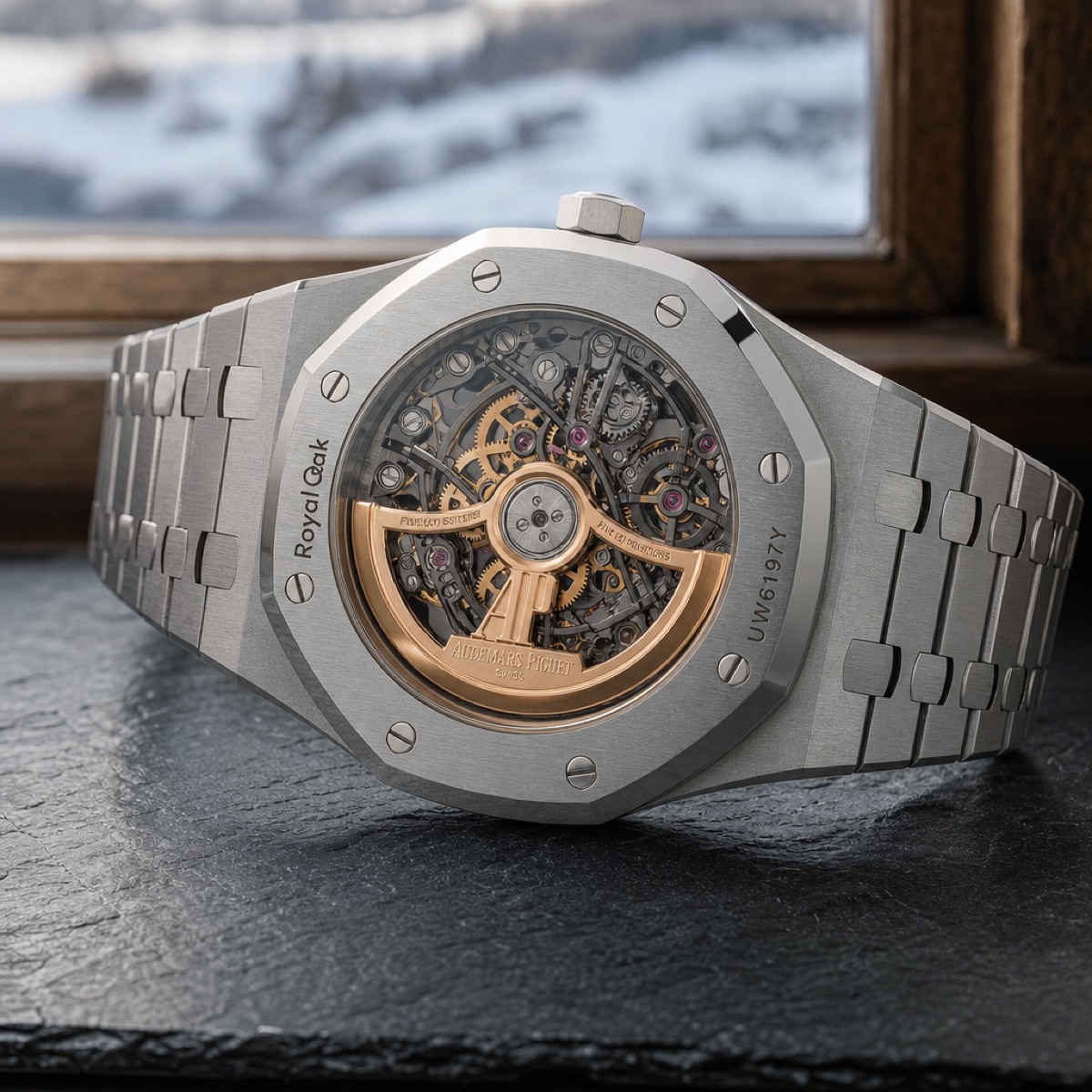
The movement shows from both sides. Through the caseback you see the same gunmetal bridges and a gold rotor, so the watch reads as a skeleton from either side.
AI-generated illustration.
How it changed
The steel 15407 has had two versions in ten years, and the family around it has grown faster than the reference itself.
| Year | Reference | Case | Movement and inner ring | Notes |
|---|---|---|---|---|
| 2016 | 15407ST.OO.1220ST.01 | 41 mm steel | Gunmetal bridges, pink gold balance bridge, slate grey ring | Launch |
| 2016 | 15407OR.OO.1220OR.01 | 41 mm pink gold, 10.1 mm | Ruthenium bridges, pink gold balance bridge | Launch |
| 2019 | 15407BC.GG.1224BC.01 | 41 mm hammered white gold ("Frosted Gold") | — | Year from one source |
| 2024 | 15407ST.OO.1220ST.02 | 41 mm steel | Pink-gold-toned movement and inner ring | CHF 66,500 |
| 2024 | 15407BA.OO.1220BA.01 | 41 mm yellow gold | Anthracite movement | CHF 88,000 |
Launch details come from aBlogtoWatch and Phillips's lot notes, the Frosted Gold from AP's page and webChronos, and the 2024 references from Fratello and Oracle of Time.
The original steel watch ran unchanged as the .01 for at least six years. Steel examples Phillips dated to about 2020 and 2022, and one Antiquorum dated 2022, all carry the same reference (Antiquorum). No source records a change to the case, bracelet or movement in that time. Looking at the auction photographs, I think the later watch carries an AP monogram on the rotor and crown that the earlier one doesn't, but that's my reading of two sets of pictures and nobody has documented it as a change.
The 2024 update is the only real change to the steel watch. AP describes the .02 as an iteration that "contrasts a stainless steel case with a pink-gold-toned openworked movement and matching inner bezel for a contemporary two-tone aesthetic", with white gold markers and pink gold bezel screws (AP). Oracle of Time called it "the first time that the double balance wheel has featured a golden skeleton dial". It arrived in July 2024 alongside the yellow gold 15407BA and a black ceramic double balance, which carries a different reference, 15416CE.
Whether the grey .01 is still made is the one question I couldn't settle. AP still serves a product page for it with no sign that it's been retired, and La Cote des Montres listed it at US$76,400 on a January 2025 tariff (LCDM). But AP keeps pages up for discontinued references too, and the .02 now fills the same slot at US$86,800 on a 2026 tariff (LCDM). Ask a boutique before assuming either way. Steel at launch cost US$44,100, so in ten years the price has roughly doubled.
The variations that matter
The two steel watches
Telling a .01 from a .02 is easy in a photograph. The .01 is grey all the way through: gunmetal bridges, a slate grey minute ring and pink gold markers and hands, with the pink gold balance bridge the only warm accent. The .02 turns that around. Its movement and inner ring are pink-gold-toned, the markers are white gold, and the eight bezel screws are pink gold, which Watch Collecting Lifestyle called the first steel Royal Oak with gold screws in place of white gold ones (WCL). Dealers sometimes list the .02 as a "salmon dial"; AP's word is pink-gold-toned.

AI-generated illustration.
Gold, and the neighbours
The pink gold 15407OR from 2016 shares the steel watch's look: Phillips describes it with the same ruthenium-coated bridges and solid pink gold balance bridge (Phillips). The case is 0.2 mm thicker. The 2019 Frosted Gold takes the 15407 number into hammered white gold, and the 2024 yellow gold 15407BA reverses the 2024 steel watch's colour scheme, with an anthracite movement inside a gold case.
The double balance has also moved into other reference numbers, which is where dealer listings start to blur. The black ceramic is 15416CE, the gem-set white gold 41 mm is 15412, and the 37 mm models are 15466 and 15467. SJX notes that the 37 mm only came with frosted or gem-set cases until July 2024, when AP added brushed-and-polished pink and white gold versions at US$98,100 each (SJX). They share calibre 3132 with the 15407 and carry their own reference numbers.
Special editions
I couldn't find any for the steel watch. There's no boutique edition, retailer co-branding, Only Watch piece or misprinted dial for the 15407ST in anything I read. One dealer lists a 15407RT "Create the Extraordinary" in pink gold and steel, limited to 39 pieces in 2025, but I couldn't confirm it with AP or any editorial source, so treat it as unverified.
Why it matters
The 15407 turned AP's openworking from decoration into a showcase for an invention. Before it, an openworked Royal Oak showed you a beautifully finished version of a movement AP also sold closed up. The 15407 shows you something you can't get in a closed-dial Royal Oak at all, and the skeleton exists to put it on display. That AP has since built the double balance into several reference numbers and two case sizes says it thinks the idea earned its place.
The case against it is fair and worth stating plainly. The precision gain is claimed, not demonstrated in published numbers. The cost in power reserve is real: 45 hours means a watch taken off on Friday evening may well have stopped by Monday. And at US$44,100 at launch, much of what you pay for is hand finishing, which you can see, and an accuracy improvement, which you can't.
The market has made its own judgement. Phillips sold a steel .01 from about 2022 for CHF 127,000 at its Decade One sale in Geneva in November 2025, against an estimate of CHF 50,000–100,000 (Phillips). Another, from about 2020 and with its full set, made HK$1,016,000 at the Hong Kong Watch Auction XXII in May 2026 (Phillips). Both are well above the steel watch's current list price.
My view is that the grey .01 is the better watch. The .02's two-tone look is handsome, but the .01's single gold bridge does exactly what an openworked watch should: it shows you where to look, and what you find there is the reason the watch exists.
What I'd check before buying one
- The suffix on the papers against the watch. A grey movement and slate ring is a .01; pink-gold-toned is a .02. Make sure it says 15407 and not 15416, 15412 or 15467, which are different watches with the same movement.
- Service history. A 3132 is a hand-finished skeleton with two balances. Antiquorum graded one 2022 watch "Overhaul recommended, at buyer's expense" in 2023 (Antiquorum), so ask for the paperwork and budget for a service if there isn't any.
- The full set. Both Phillips results above came with the warranty card, booklets and box, and auction houses grade on it.
- The finish. Look for crisp lines between brushed and polished surfaces on the case and bracelet, and clean, sharp angles on the bridges under a loupe. Soft edges on the case mean it's been polished.
- Fakes. I didn't find an authentication guide from a source I'd trust for this reference, so I'd buy from a dealer who takes returns, or have AP look at it.
Sources
- AP Chronicles, Royal Oak 25636
- AP Chronicles, Royal Oak 14789
- Audemars Piguet, Royal Oak Double Balance Wheel Openworked 15407ST.OO.1220ST.01, and the same page archived in April 2017
- Audemars Piguet, 15407ST.OO.1220ST.02, 15407OR.OO.1220OR.01 and 15407BC.GG.1224BC.01
- AP launch text for the 15407, reproduced by WorldTempus (February 2016)
- AP launch text for the 15305, reproduced by WorldTempus (November 2010)
- Monochrome, the 15407 explained by AP (2016)
- Jack Forster for The 1916 Company (2023)
- aBlogtoWatch, launch (January 2016)
- Time and Watches, SIHH 2016
- Watch Collecting Lifestyle, launch (January 2016) and the 2024 .02
- Fratello, 2024 variations and openworking history
- Wristcheck, AP openworking
- Oracle of Time, 2024 releases
- SJX, 37 mm double balance (July 2024)
- webChronos, openworked Royal Oaks
- La Cote des Montres, 15407ST .01 and .02 price listings
- Phillips, Decade One, lot 180, Hong Kong Watch Auction XXII, lot 830 and 15407OR lot
- Antiquorum, Monaco, July 2023, lot 210