Casio G-SHOCK GA-2100MNG
- Make
- Casio
- Reference
- GA-2100MNG
- Model
- G-SHOCK
- Variants
- GA-2100MNG-7A, GA-2100MNG-2A
- Production
- 2024–present (in production)
- Case diameter
- 45.4 mm
- Calibre
- 5611
- Case material
- Carbon / bio-based resin
- Water resistance
- 200 m (656 ft)
AI-generated illustration.
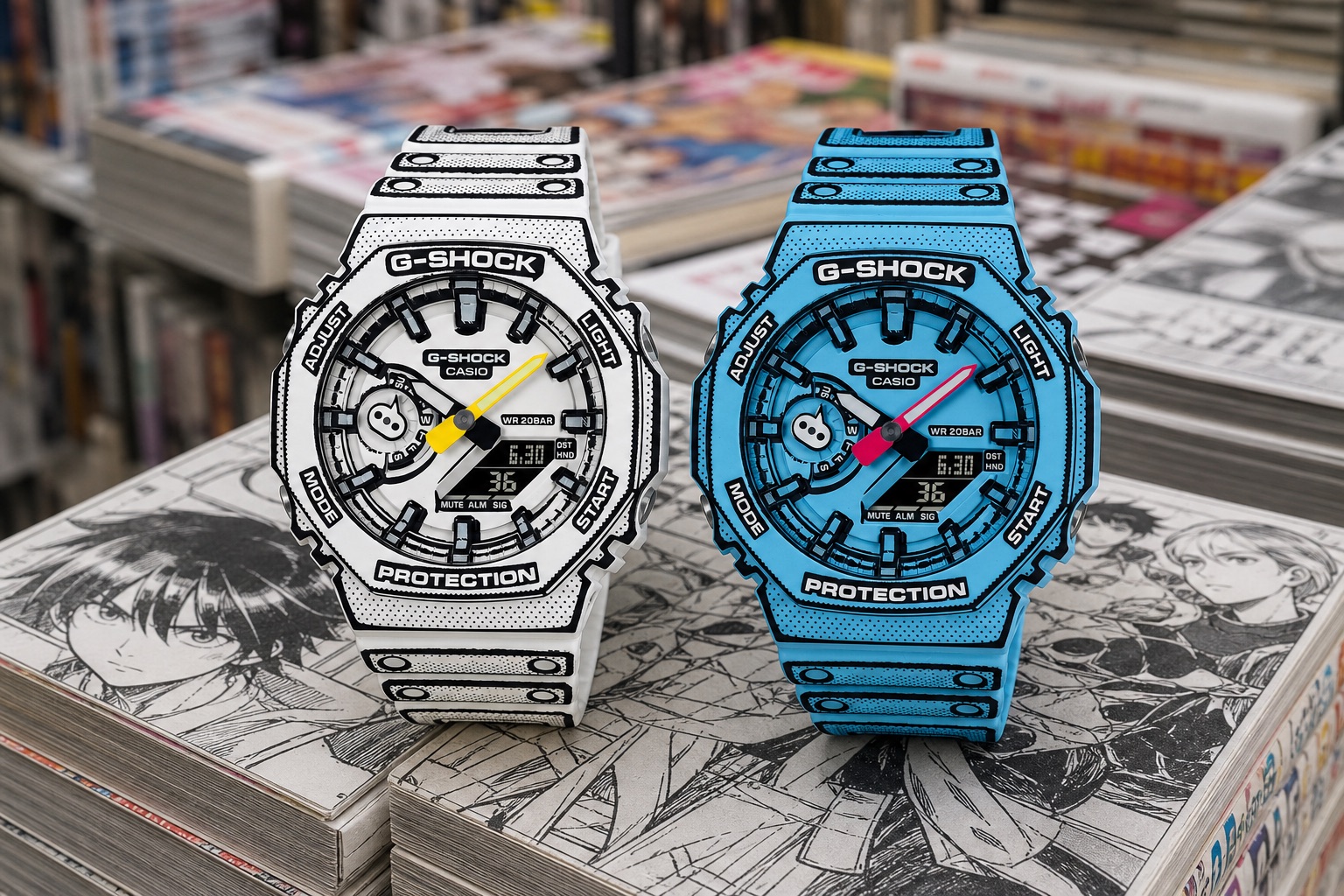
G-SHOCK began as a dare. In 1981 Casio formed a group it called Project Team Tough to build a watch that wouldn't break when dropped, and after about two years and more than 200 prototypes it had one: the DW-5000C of 1983, a square resin watch with an octagonal face (Casio). Thirty-six years later Casio went back to that octagon for the GA-2100, an analog-digital watch 11.8 mm thick that collectors promptly renamed the CasiOak. In May 2024 Casio dressed it as a comic book. The Casio G-SHOCK GA-2100MNG prints the bezel, band and dial in the dot shading manga artists use, turns the day indicator into a speech balloon, and engraves a sound effect on the case back.
It came in two colours, which Casio calls "sky blue or classic white": the GA-2100MNG-2A and the GA-2100MNG-7A. I have both. The case, module and every function are a standard GA-2100's; what makes the MNG worth writing about is that so much of the design sits in the printing, and that each one comes out a little different. Casio's own pages now list both as an "Old Model" (Casio), so these were a one-season release that you now buy second-hand.
Where it came from
The square watch came first. Casio's history credits the DW-5000C with the hollow case that started it all, a module held at a few points inside a resin case wrapped in urethane, and it follows that watch with the DW-5600C of 1987, which kept the original DW-5000's shape and, by Casio's account, sold strongly for nine years (Casio). Kikuo Ibe led the design team. The breakthrough, as nippon.com tells it, came while he watched a group of children playing with a rubber ball: he could protect the module by suspending it in something like the ball, instead of armouring it. His target, in the telling nippon.com got from him, was a "triple 10": survive a 10 m drop, resist 10 bar of water, and run 10 years on a battery (nippon.com).
The GA-2100 is that square watch rethought as an analog-digital. Casio's product copy says it "inherits the octagonal shape that was also used in the first-generation DW-5000C" and calls the result a minimalist design "inherited from the design concept of the first-ever G-SHOCK" (Casio, Casio). The thinness was the engineering story. The case is a "highly rigid fine resin containing carbon fiber", which is what let Casio get it down to 11.8 mm (Casio). G-Central called it the thinnest G-SHOCK in the range when it launched (G-Central).
That carbon-reinforced case belongs to what Casio calls the Carbon Core Guard structure. The GA-2100 didn't introduce it. Casio's timeline gives the "newly developed Carbon Core Guard structure" to the GRAVITYMASTER GWR-B1000 in 2019, and the earlier GA-2000 already used it (Casio, G-Central). The GA-2100 put it in a cheap, slim, everyday watch.
Casio announced the GA-2100 on 31 July 2019 and put three models on sale in Japan that August, at 13,500 yen before tax (G-Central). No source I found names its designer. The Royal Oak comparison came from collectors, who looked at an eight-sided bezel on a slim case and called it the CasiOak (Time and Tide, G-Central). Hodinkee, as Gulf News retells it, traces the name to a collector called Steven Davila in a Facebook group; I couldn't read Hodinkee's piece to check (Gulf News). The name stuck either way. By 2020 Time and Tide was calling the GA2100-1A "the CasiOak that everyone wanted", and G-Central was warning that the all-black GA-2100-1A1 had sold out in late 2019 and that fakes were filling the gap (G-Central).
Casio took the hint. Its brand history now picks out four models as the defining G-SHOCK shapes: the DW-5000C of 1983, the DW-6900 of 1995, the GA-110 of 2010, and the GA-2100 of 2019 (Casio). Within three years there was a smaller GMA-S2100, a GM-2100 with a steel bezel (Japan, August 2021), and a GA-B2100 with solar charging and Bluetooth (unveiled April 2022) (G-Central, Worn & Wound, Hypebeast). The GA-2100 itself became Casio's canvas for colourways and collaborations, which is where the manga watch comes from.
Manga before the MNG
G-SHOCK and manga had met before, outside Casio's catalogue. G-Central's launch story lists an illustrator Yu Nagaba collaboration with Beams on a DW-5600 in 2018 and a manga-styled GA-2100 custom by Shaka Builds in 2022 (G-Central). Neither was Casio's own manga watch. The GA-2100MNG was. G-Central broke the news on 30 April 2024, with a Japanese release in May at 25,300 yen including tax, Asia expected in June, Europe confirmed, and no word on the United States (G-Central, Watch Impress). I couldn't find a US release or a US price anywhere.
The watch
| Spec | Value |
|---|---|
| References | GA-2100MNG-7A (white), GA-2100MNG-2A (sky blue); Japan -7AJR/-2AJR, Europe -7AER/-2AER |
| Case (L × W × H) | 48.5 × 45.4 × 11.8 mm |
| Weight | 51 g |
| Case and bezel | Carbon / bio-based resin, Carbon Core Guard structure |
| Case back | Stainless steel, screwed down at four points, engraved |
| Band | Bio-based resin, fits wrists of 145 to 215 mm |
| Crystal | Mineral glass |
| Module | 5611 |
| Power | Two SR726W cells, about 3 years |
| Accuracy | ±15 seconds a month |
| Water resistance | 200 m |
| Analog display | Hour and minute hands (the minute hand steps every 20 seconds), day sub-dial at 9 o'clock |
| Digital display | Hour, minute, second, PM, month, date |
| Functions | World time (31 zones, 48 cities plus UTC), 1/100-second stopwatch, 24-hour countdown, 5 daily alarms, hourly signal, auto-calendar to 2099, hand shift |
| Light | Double LED (dial and digital display), 1.5 or 3 seconds, afterglow; Neobrite luminous paint |
| Made in | Japan |
| Japan launch price | 25,300 yen including tax (May 2024) |
All of that is Casio's spec sheet (Casio) except the launch price (G-Central). Casio gives the case as length, width and height, so the 45.4 mm width is the nearest thing to a diameter.
The numbers are the GA-2100's: same 48.5 × 45.4 × 11.8 mm, same 51 g (G-Central). That matters more than it sounds. Fifty-one grams on a slim case is why the GA-2100 wears like a much smaller watch than its width suggests, and the MNG inherits it whole.
The 5611 module is easy to underrate because it does nothing unusual. It's battery quartz with no solar and no Bluetooth, and the hands move out of the way when you need to read the digital window. The minute hand jumps every 20 seconds, a quirk of the module that you notice if you watch it. The two LEDs light the dial and the digital display separately. The one thing that sets the MNG apart in the table is the last-but-one row. Casio's feature list puts "Made in Japan" first (Casio), and the case back says the same.
How it changed
There isn't much of a run to tell. The MNG was a single release of two colours in 2024, and Casio didn't revise it before the pages went to "Old Model".
| Date | Event | Source |
|---|---|---|
| 30 April 2024 | Announced in Japan | Watch Impress, G-Central |
| May 2024 | On sale in Japan at 25,300 yen | same |
| June 2024 | Asia release expected; Europe also confirmed | G-Central |
| February 2025 | Reports that production had stopped | Notebookcheck |
| October 2026 | Both listed as "Old Model" on Casio's international site | Casio |
The February 2025 report needs care. Notebookcheck was passing on a claim from the fan site Great G-Shock World that production had halted, and it said in the same piece that Casio hadn't announced anything (Notebookcheck). The "Old Model" label is the only first-party word, and it doesn't come with a date.
Whether it was ever a limited edition is a separate question with a plainer answer: nobody has shown that it was. G-Central guessed it would be, from the Japanese manufacture, and said the guess was unconfirmed (G-Central). Casio's pages don't use the word.
The variations that matter
The interesting variation here is within a reference, between one watch and the next.
AI-generated illustration.
Dials and print
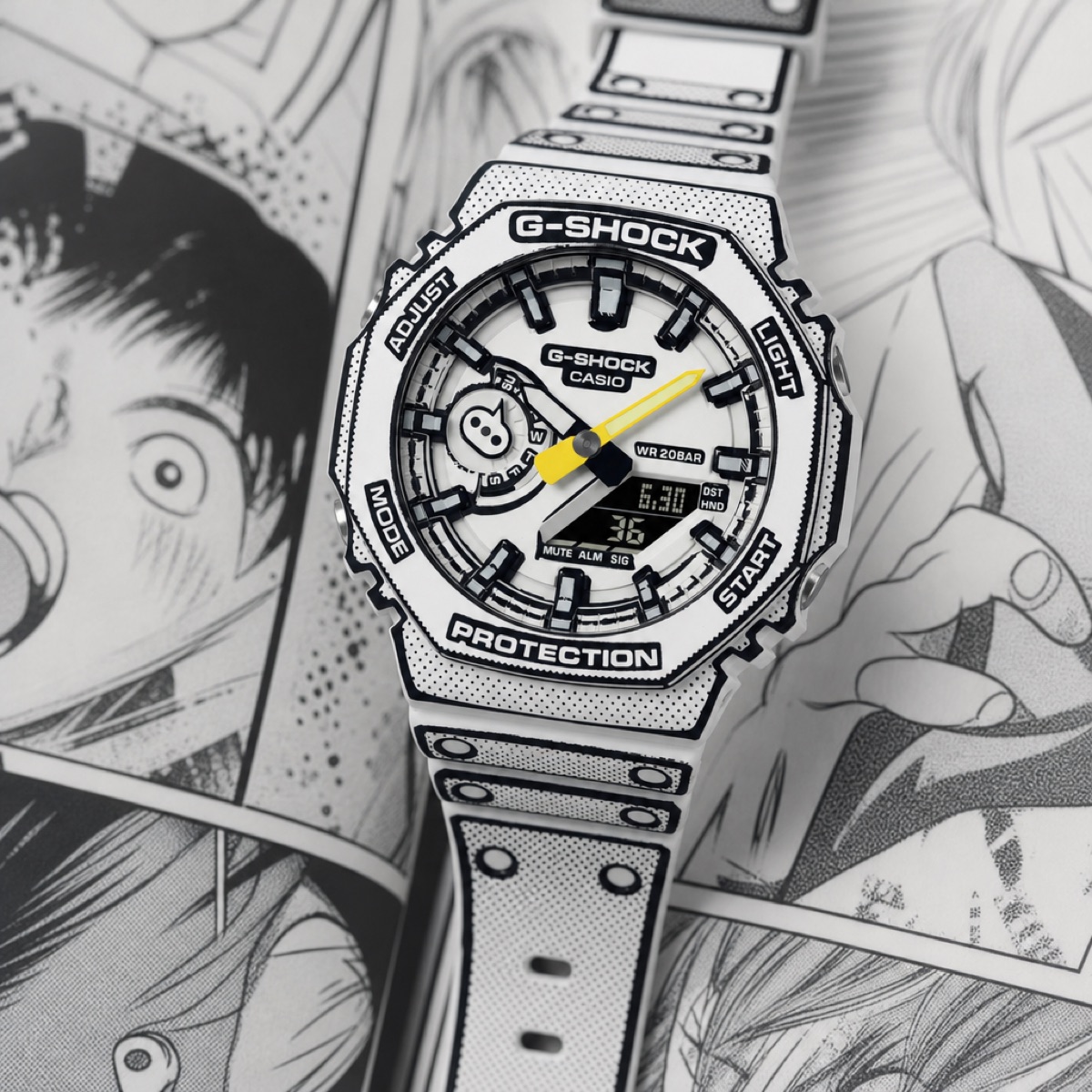
Casio describes the band, bezel and dial as "printed in the screentone technique used by manga artists to apply texture and shading" (Casio). Screentone is the dot pattern that gives black-and-white comics their greys. On the watch it shows up as fields of fine dots inside heavy black outlines, so the bezel, the band and the dial all look inked on. The case outline, the button guards and the band segments each get the same treatment, and the whole watch reads like a drawing of a GA-2100.
Then comes Casio's footnote: "The bezel, band, dial, frame, and other components of each watch are distinctive and unique. Because of this, a particular watch may not appear exactly as shown here" (Casio). Casio doesn't say what varies or by how much. My read is that it's covering the alignment of the print on each part, which is the kind of thing you'd only see by putting two of the same colour side by side. It does mean a pair of MNGs that don't match perfectly is to be expected, and that a print a little off from the product photo isn't on its own a sign of a fake.
The 9 o'clock sub-dial is the joke you notice second. It's the day indicator, and Casio shaped its pointer "like the speech balloons that appear in comic books" (Casio). On Casio's product photos it's a small white bubble with a tail, sitting over the day letters like a character about to say something.
The two colours
The colours do more than change the background. On Casio's photos the white -7A has black hands with a bright yellow minute hand, and the blue -2A has a pink-red minute hand (Casio, Casio); G-Central describes them as black and yellow and black and red (G-Central). Everything else, the bezel text, the digital window, the button labels, is laid out the same.
The white one is the purer version of the idea, because it looks most like a page: black line, white paper, dots, and one colour for the hand you read the time from. The blue one is the louder watch, and the pink hand on sky blue is the most comic-book thing on either of them.
AI-generated illustration.
Case back and box
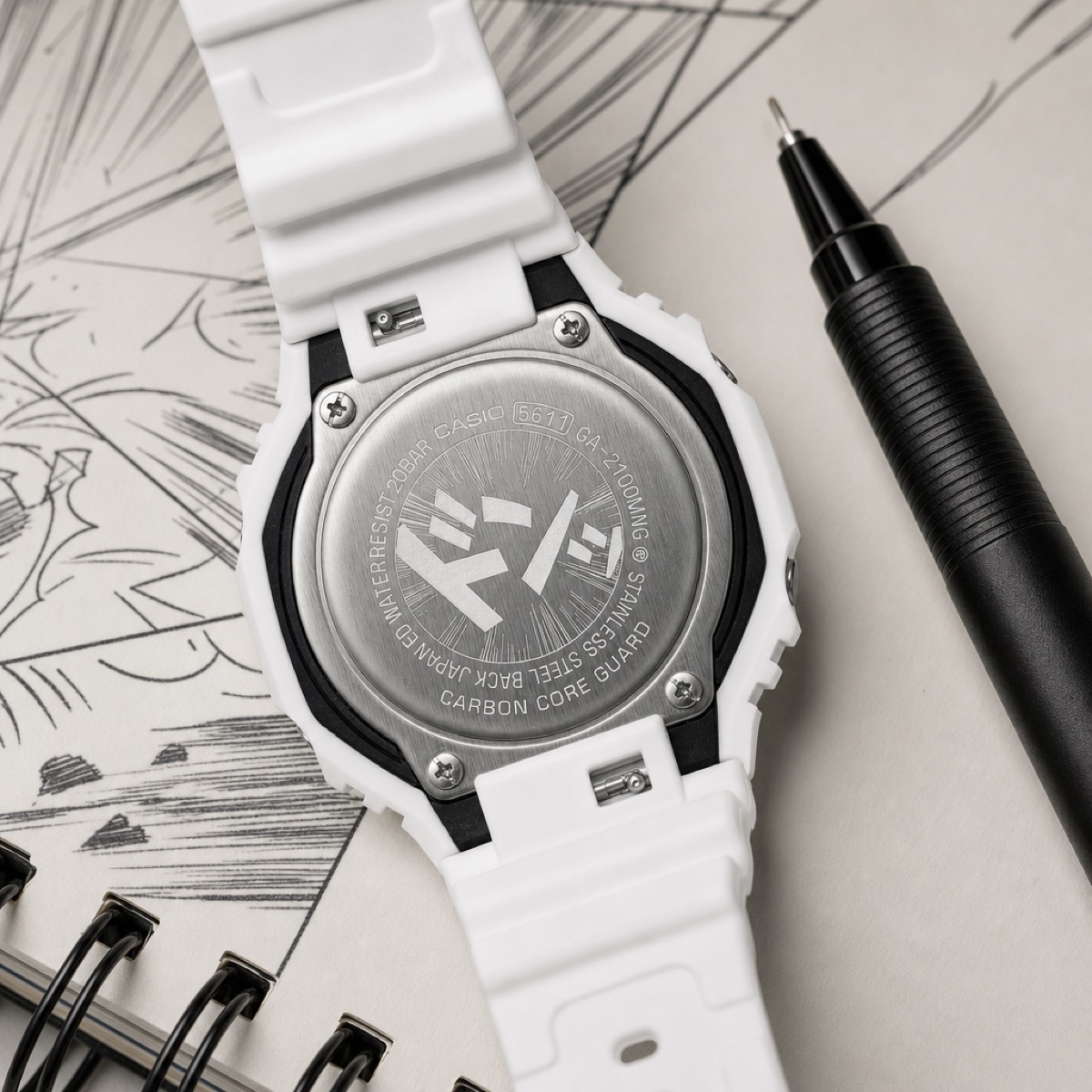
Turn it over and the steel case back carries the punchline. Casio calls the sound effect "Don!, the Japanese equivalent of 'Bam!'" (Casio). On the product photo it's the katakana ドンッ in large engraved strokes, inside a burst of speed lines, with the usual ring of text around it: the model number GA-2100MNG, the module number 5611, "CARBON CORE GUARD", "STAINLESS STEEL BACK", 20 bar water resistance and "JAPAN". The plain GA-2100 has no engraving like that, so it's the quickest way to tell an MNG from a standard watch with a printed strap.
The box is part of the set too. Both colours came in manga-themed cardboard packaging, which Casio photographs on the product page and G-Central describes as exclusive to the pair (Casio, G-Central). On a second-hand watch that has nothing else to prove where it came from, the original box counts for more than it would on a standard GA-2100.
Why it matters
The fair objection is that this is a 25,300-yen resin watch with a printed strap, and that writing about it at length is taking a novelty too seriously. I think it holds up better than that, for two reasons.
The first is the platform. The GA-2100 is the watch where Casio went back to the 1983 octagon, made it thin with a carbon-reinforced case, and found a shape that people outside the G-SHOCK world wanted to wear. The MNG keeps all of it. Under the print it's a Carbon Core Guard case, a 200 m resin watch that weighs 51 g and runs three years on its cells. You could wear the joke every day.
The second is that the design commits. My read is that most special colourways stop at new resin and new hands. The MNG changes how the watch is drawn: line, dot shading, a speech balloon, a sound effect on the back, a box to match, and print that Casio admits varies from watch to watch. It's a watch about a medium, made in the country that medium comes from, and the details are consistent all the way through.
The market noticed too. Notebookcheck reported in 2025 that the MNG was trading at more than twice its retail price on resale platforms, and in a later piece called it the original of a manga line, with leaked DW-5600 and DW-6900 models said to follow (Notebookcheck, Notebookcheck). Both reports are second-hand, and I haven't seen Casio confirm the later models.
What I'd check before buying one
Buying one now means buying second-hand, often from Japan or Europe, so check the things that a standard GA-2100 can't fake easily.
- The case back. The ドンッ engraving with speed lines, GA-2100MNG, 5611 and "JAPAN". A plain GA-2100 back on a manga-printed watch means the parts came from somewhere else.
- The hands. Yellow minute hand on white, pink-red on blue, per Casio's photos.
- The speech-balloon day pointer at 9 o'clock, and screentone dots on the dial as well as the bezel and band.
- The box, if the price assumes it.
- The price against the date. Resale figures move, and the only ones I found were undated or second-hand reports, so compare recent sold listings before you pay a premium.
Counterfeits are a known problem for the GA-2100 in general. G-Central was warning about fake GA-2100-1A1s in March 2020, without giving tells, and its advice was to buy from authorised dealers (G-Central). That isn't possible any more for the MNG, so the seller's record matters more than usual. I found no source describing MNG fakes specifically.
Sources
- Casio, GA-2100MNG-7A product page
- Casio, GA-2100MNG-2A product page
- Casio, GA-2100-1A1 product page
- Casio, Brand History of G-SHOCK
- G-Central, "G-Shock GA-2100MNG is a Japanese manga-inspired watch series" (30 April 2024)
- Watch Impress, GA-2100MNG announcement (Japanese)
- G-Central, GA-2100 launch (2019)
- G-Central, GA-2100 specs
- G-Central, the 2100 as one of G-Shock's four classic lines (2021)
- G-Central, GA-2100 counterfeits (2020)
- Worn & Wound, GM2100 (2021)
- Hypebeast, GA-B2100 (2022)
- Time and Tide, GA2100-1A hands-on
- Gulf News, GA-2100 review
- nippon.com, Ibe Kikuo and the development of the G-Shock
- Notebookcheck, Manga CasiOak production halt report (2025)
- Notebookcheck, new manga series leak