Orient
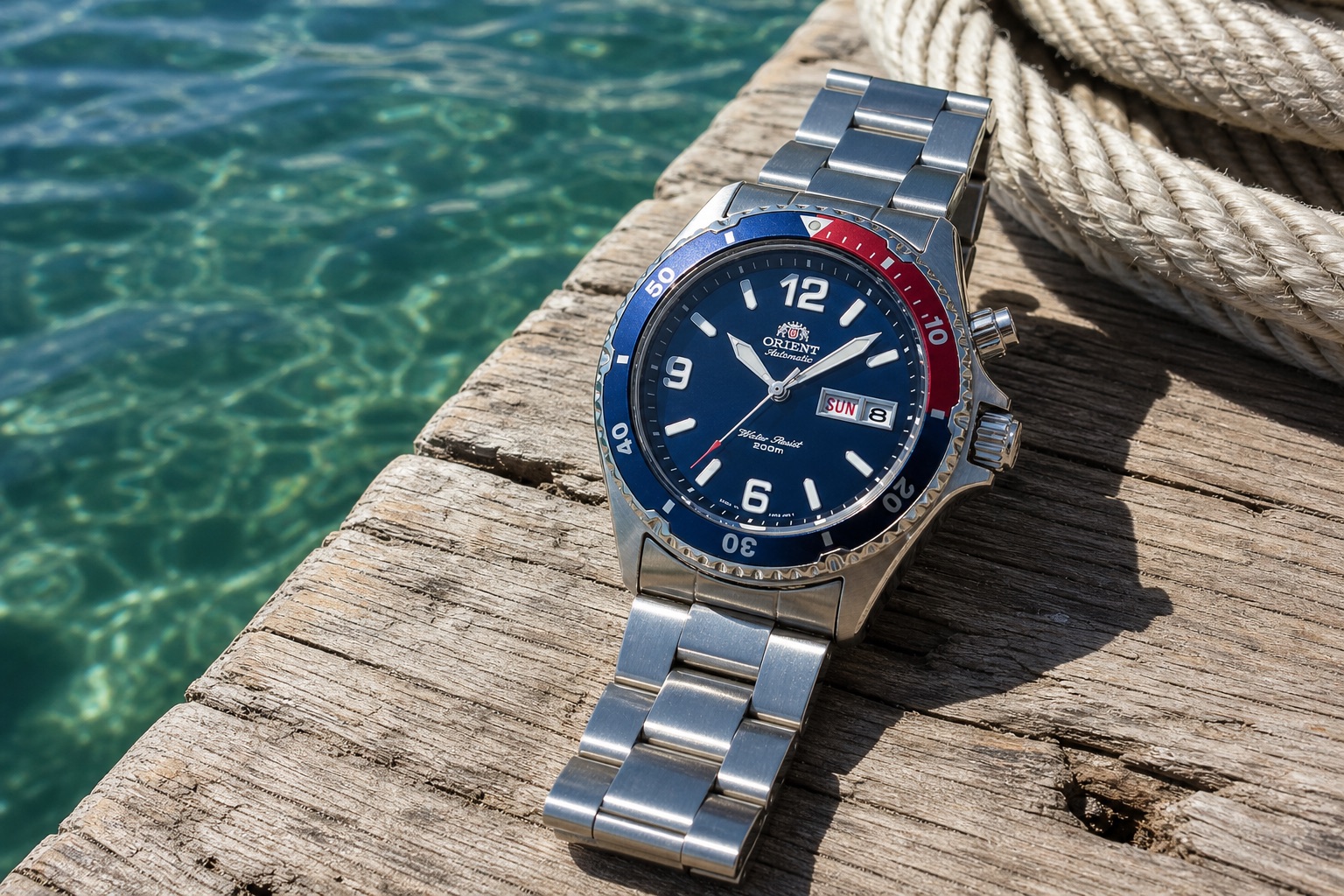
AI-generated illustration.
Orient Watch Co., Ltd. stopped existing on 1 February 2026. Seiko Epson, which had owned all of it since 2009, absorbed the company in a merger its board approved the previous November, and the notice records what was left to absorb: a holding company with no sales, no employees and net assets of about ¥850 million. The business had gone across to Epson in a company split in April 2017, and the shell had sat dormant since. The brand carries on inside Epson, which is why you can still buy a Bambino or a Mako for between $300 and $500.
That ending makes Orient an odd subject for a company history, and I think a good one. For most of its life Orient was the third watchmaker in Japan, behind Seiko and Citizen, and a Citizen business history records that in the 1960s "Ricoh and Orient gradually lost their status as watchmakers of consequence". It never had Seiko's money or Citizen's scale. What it had was a habit of making mechanical watches when nobody else in Japan wanted to, a calibre from 1971 that is still in every Mako, and a knack for watches that enthusiasts recommend to each other because they are cheap and don't let anyone down.
The history the company tells begins in 1950. The one below begins in 1901, runs through a wartime munitions plant and a strike that left a man dead on a factory floor, and spends its last twenty-five years inside a printer company. Two corrections up front, because the internet gets both wrong. Orient was never a Seiko brand: Seiko Epson is a separate listed company, Seiko Group owns 3.43 per cent of it and doesn't list it as an affiliate. And Epson didn't take Orient over in 2017. It took control in 2001.
Timeline
These are the best-supported dates I found. Where the maker's own pages disagree with each other, the era sections say so.
| Year | Event |
|---|---|
| 1901 | Shogoro Yoshida opens the Yoshida Watch Shop in Ueno, Tokyo, importing watches |
| 1920 | Toyo Tokei Seisakusho founded to make table clocks |
| 1932 | Toyo Tokei builds Ageo's first modern factory, in Saitama |
| 1934 | Wristwatch production begins |
| 1936 | Four-storey wristwatch factory completed at Hino, west of Tokyo |
| 1946 | Union federation formed, 2 July; the Ageo dispute ends in bloodshed in December |
| 1949 | The Hino factory is dissolved |
| 1950 | Hino employees found Tama Keiki, 13 July, renting the factory; the New Orient |
| 1951 | Renamed Orient Watch Co., Ltd. in April; first Orient Star |
| 1955 | T-type movement; first export contract, to China |
| 1958 | Royal Orient, the first water-resistant Orient; export contract with Iran |
| 1961 | Listed on the Tokyo Stock Exchange's second section; first Orient automatic |
| 1964 | Grand Prix 100; first diver, the Olympia Calendar Diver |
| 1965 | Weekly Auto Orient King Diver; Multi-Year Calendar |
| 1967 | Fineness, a 3.9 mm automatic |
| 1971 | Calibre 46, still the base of the range |
| 1976 | Touchtron LED watch with Sharp; automatic Multi-Year Calendar |
| 1986 | Akita Orient Seimitsu founded in Yuzawa; most watchmaking moves there by 1988 |
| 1991 | Mon Bijou, the first Orient skeleton |
| 1996 | First Orient Star with a power-reserve indicator |
| 2001 | Seiko Epson becomes parent, March; Orient leaves Hino |
| 2003 | Delisted after three years of negative net worth |
| 2004 | The Mako; Royal Orient revived on calibre 88700 |
| 2009 | Wholly owned by Epson, March |
| 2012 | The Bambino |
| 2017 | Company split, 1 April: the watch business moves into Epson |
| 2021 | Silicon escape wheel; 70-hour Orient Star Skeleton |
| 2026 | Orient Watch Co., Ltd. dissolved into Seiko Epson, 1 February |
A watch shop in Ueno and a factory in Hino, 1901–1945
Orient's own 2012 chronology, since taken down, opens with 初代吉田庄五郎氏, "the first Shogoro Yoshida", founding the Yoshida Watch Shop in Ueno, Tokyo, in 1901 to import and sell foreign watches. That 初代 is the only hint anywhere that the name passed to a successor; nothing I found gives Yoshida a birth date, a trade before watches or a death. A one-sheet flyer from the shop survives in a Hakodate library, advertising an enthronement-sale lottery on wrist and pocket watches and clocks, and the catalogue can't say whether it dates from 1915 or 1928.
The shop became a maker in steps. It made its own watch cases from 1913 (copies of the story say 1912), founded Toyo Tokei Seisakusho in 1920 to make table clocks, built the first modern factory in the Saitama town of Ageo in 1932, started wristwatches in 1934, and in 1936 put up a four-storey wristwatch factory in Hino, west of Tokyo, which the maker's 2012 chronology lists as the wristwatch factory of the Yoshida Watch Shop. The war turned it into a munitions plant. The Japanese page says the company 軍需産業に転換, converted to the munitions industry; the English one that Toyo Tokei "had to be engaged in the mass production of aerial weaponry". Seikosha appears to have held Japan's only military wristwatch contracts, so Toyo Tokei's war was ordnance.
Watchmaking resumed in 1945. What happened next is the part every English history skips.
A strike, a death and a new company, 1946–1952
The post-war Toyo Tokei was a big employer by the standards of its trade. When its workers federated their unions on 2 July 1946 they counted 3,105 members across seven sites, 1,284 of them at Ageo and 1,025 at Hino, in an industry that the trade association says had about 10,000 employees in all. The company was already in trouble: by October the unions had agreed to defer their wage claim because of its poor finances.
The Ohara Institute's Labour Year Book for 1949 gives the Ageo dispute a section of its own. The Ageo union had joined the communist-led Sanbetsu federation; the others were moderate. In November 1946 about 130 Ageo workers broke away. The union expelled them, forced their dismissal under a closed-shop clause, then marched on the breakaway group's base and carried several dozen of its leaders and company managers into the women's dormitory to extract a signed apology. The company shut the plant and dismissed the union's leaders; the union answered with production control, running the factory itself from 27 November. On the morning of 12 December some 700 to 800 men from the moderate federation and the breakaway group, with hired muscle from two local gangs the yearbook names, broke the bolt on the front gate. In the fighting that followed one man on the Sanbetsu side died, two were left critical, and more than a hundred were injured between the two sides, by their own counts. The affair produced its own literature, from a 1947 pamphlet titled, in part, "the truth about the Toyo Tokei bloodshed" to a 74-page company history published in 2001 by a society formed to pass on the company's history.
Orient's 2012 Japanese chronology admits all this in eight characters: 労働争議が長期化, the labor dispute became prolonged. Its English timeline says the company "fell into financial difficulties and was dissolved"; its US distributor's blog blames the post-war economy in one post and "management disagreements" in another. One German WatchTime piece blames a factory fire, and I found nothing else that mentions one. What the maker's own record says is 1949 日野工場解散: the Hino factory was dissolved. No source I read says the company went bankrupt, so I won't either.
On 13 July 1950 the Hino factory's employees formed Tama Keiki, "Tama Instruments", and rented the empty plant . That date stayed on Orient's incorporation papers to the end. The maker credits the employees; a Hodinkee Japan piece written for Orient Star calls them the reform faction; two English pages say Yoshida founded it, which sits badly with the union resolution of December 1946 demanding that "President Yoshida" answer for the violence. The first product, the New Orient of 1950, used a small movement designed in the Yoshida Watch Shop era. In April 1951 the company renamed itself Orient Watch Co., Ltd. and set about making wristwatches, alarm clocks and small bearings; the name, by the maker's own account, is simply the English of Toyo, the 東洋 in Toyo Tokei. The first Orient Star followed the same year, hand-wound with 10 or 15 jewels, blued hands and, until a new design arrived in 1952, a pre-war movement. The company bought the Hino factory outright in 1952, and took on Tamotsu Aoki, a Tokyo professor and the first chairman of the Horological Institute of Japan, as an advisor.
Exports and the jewel race, 1953–1970
The Hodinkee Japan piece describes the young company's position in one phrase: two makers already ruled the Japanese market, and Orient was 第3勢力, the third force. It quotes a former Epson designer on what that meant in practice. An Orient salesman couldn't get a shop to stock his watches unless they were more interesting than Seiko's and Citizen's, so Orient sold design and gadgets where the others sold precision. The company's own narrative, reprinted from Chronos Japan on its old history page, says the same thing in corporate language: differentiate by design and mechanism and hold the price.
The other answer was to sell abroad. Orient's own timeline, as published in Europa Star in 2007, dates its first export contract to China in 1955, Iran in 1958, and "annual export contracts for big amount to USA and Canada" in 1959, with a network of more than 70 countries by the 1960s and 70s. Taiwan and Brazil are on the maker's list of early markets, and it still says its overseas business is larger than its Japanese one. The 1965 figures in the Citizen history show why: Hattori and Citizen together made more than 80 per cent of Japan's watches. Orient listed on the Tokyo Stock Exchange's second section in 1961, a listing the financial press confirms without the year, and released its first automatic the same year, the N-type self-winder.
The watches from this stretch are the ones collectors chase. The T-type centre-seconds movement of 1955 went into the Orient Star Dynamic, which the maker dates to 1957 and WatchTime to 1955. The Royal Orient of 1958, on the larger N-type with 19 jewels, was the first Orient with a water-resistance rating and was read at the time as a challenge to Seiko's top line; the maker's own pages give its year as both 1958 and 1959. In 1964 came the Grand Prix 100, an L-type automatic with a hundred jewels, a Triostat regulator and Incabloc shock protection, built, in Orient's words, "to take the lead in the 'jewels competition' of the day". Seiko and Citizen stopped at about 39 jewels, according to the one Japanese book on Orient as quoted by Japanese Wikipedia, and most of the extra stones were decoration. It wasn't a world first. Waltham and Benrus had sold 100-jewel watches in the 1950s, with 83 of the rubies ringing the rotor. Orient only ever claimed to lead the Japanese race, and that claim holds.
The same year brought Orient's first diver, the Olympia Calendar Diver, 40 mm and rated to 40 m, with an automatic version the same year. Seiko says its 1965 diver was Japan's first. Both are true if a diver's watch is anything sold as one; Seiko's is true if it means a watch built for real diving, which a 40 m Orient was not. The Flash of 1964 lit its dial with miniature bulbs at the press of a button and was withdrawn because the case wasn't water resistant. The 1965 Weekly Auto Orient King Diver put a 25-jewel automatic in a 43 mm compressor-style case with an inner rotating bezel, a design Orient says was meant to look Swiss, with water resistance "roughly the same as an ordinary watch", 40 m. Chronos Japan calls it the watch that established the lineage of Orient divers, and it was the first model Orient reissued for its 70th birthday. The Multi-Year Calendar, hand-wound from the mid-1960s and automatic from 1976, printed a month of dates on the dial behind a rotating weekday window and needed one adjustment a month; it could show 1960 to 1981 and, the maker says, "was a big hit". Orient patented the mechanism in the United States in 1971 and again in 1978.
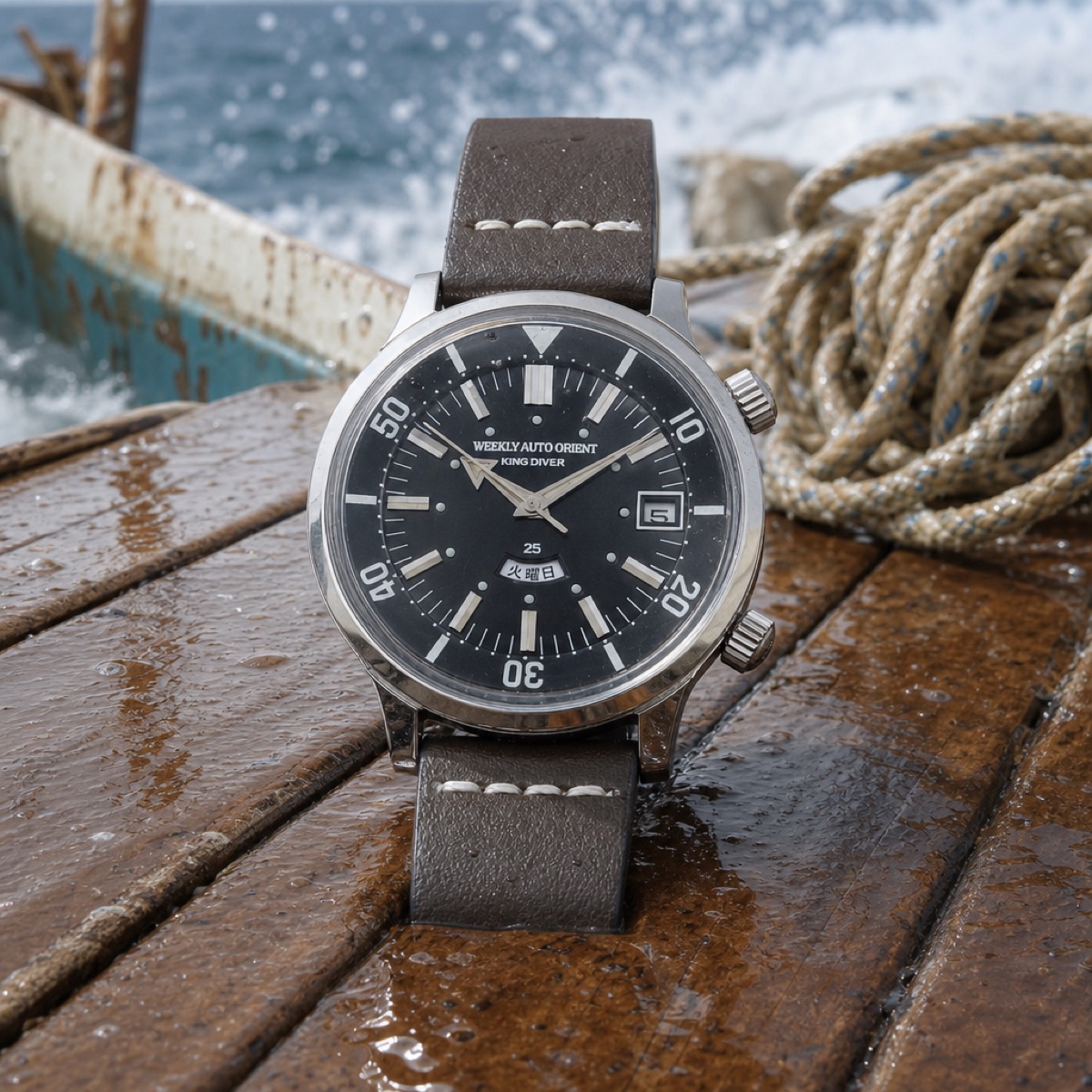
AI-generated illustration.
The Fineness of 1967 was the technical high point: calibre 3900, 3.9 mm thick, 35 jewels, in a one-piece case. Orient's English page calls it the thinnest day-date automatic in the world; its Japanese page says only that the thinness was groundbreaking; and the version Orient supplied to Europa Star in 2010 is the defensible one, "the thinnest automatic watch made in Japan until 1974", against a rival at 4.48 mm. A late-1960s King Diver 1000 claimed 1,000 m in a Swiss-made case; Japanese Wikipedia notes it had no screw-down crown and doubts the rating. The decade closed with the Tenbeat, a 36,000 vph automatic, and the Jaguar Focus, a two-tone gradient dial under a nine-faceted crystal, both 1970.
Calibre 46 and the quartz years, 1971–1990
In 1971 Orient introduced the movement that still powers most of what it sells. Its own narrative is candid about why: the L-type had grown too large and thick for current designs, and "ORIENT had also been using Seiko movements". Calibre 46 was smaller and thinner and wound through a magic lever. Europa Star's 2024 report adds the qualifier the maker leaves out: the 46 "owes its existence to a licence that Orient obtained from Seiko for the calibre 7006", with the Magic Lever also Seiko's. I found no second source for the licence, but the maker's own admission about Seiko movements makes it plausible, and it matters for how much weight "in-house" should carry when Orient uses the word.
The timing was bad. Seiko had sold the first quartz wristwatch in December 1969, Japan's makers agreed to restrain exports in 1972, and in 1975 the whole industry was designated for employment-adjustment subsidies. Orient went where everyone went. The maker says it "switched its pivot to manufacturing quartz watches", its 2007 timeline says it developed analog and digital quartz calibres through the 1970s and 80s, and Europa Star has its adverts from 1976, 1978 and 1980. The Touchtron of 1976 was the quartz-era curiosity: an LED module developed with Sharp that lit up when you touched the case. Orient's English pages call it the first such watch in the world, its Japanese page makes no such claim, and it misfired often enough that a button-operated Touchtron II replaced it.
Mechanical watches didn't stop. Orient kept the Multi-Year Calendar going as an automatic from 1976, and the sponsored Hodinkee Japan history offers the reason the company gives today: many of its export markets, which it names as the Middle East, South America and China, had trouble getting batteries, so Orient never stopped making mechanical watches. By 2008 the company was claiming more than 80 million mechanical watches made since the 1950s. I can't check the number, but the continuity is real, and it is the thing that made Orient useful again in the 1990s.
The financial record for these two decades is blank online. I found no revenue, loss or headcount figure for 1970 to 1990, and the dossier says where one would look. The shape is visible anyway. Toyo Keizai dates the decline to the mid-1980s, when the core export business stopped earning adequate profit under quartz price erosion and a rising yen. By 1988 Orient was filing patents on printer paper-feeding mechanisms jointly with Seiko Epson. The Epson relationship began here too: Europa Star dates it to 1985, and Epson says the two had "partnered for more than 20 years" before 2017. In 1986 Orient set up Akita Orient Seimitsu in Yuzawa, in Akita prefecture, and by 1988 most of its watchmaking had moved there. By the mid-1990s the Akita plant was also making print heads for Epson.
Delisting and Epson, 1991–2009
Nikkei's one-line verdict is that the downturn of the 1990s ruined Orient's management. The watches tell a happier story. The Mon Bijou of 1991, a gold-plated skeleton on calibre 48320, was the start of what Orient now calls a synonym for the brand. The mechanical Orient Star, which had disappeared in the 1970s, came back during the decade on the 46 series. In 1996 the first Orient Star with a power-reserve indicator appeared, on calibre 46F40, which Orient says let it offer "power reserve mechanical watches at accessible prices"; it patented the mechanism in 1998. SJX calls the fan-shaped reserve at twelve "almost synonymous with the brand", and I'd agree. For twenty years it was the cheapest way to get that complication on a new watch.
The company behind the watches was failing. Epson became its parent in March 2001, by its own corporate history, through a share issue; by the time of its 2008 tender offer it held 51.99 per cent. AdverTimes puts the cause plainly: Orient "fell into poor performance" and became Seiko Epson's subsidiary. The same year, by Japanese Wikipedia's account, it left Hino, its home since 1936. In 2003, with liabilities exceeding its assets, it was delisted from the second section and moved to the Green Sheet market. Toyo Keizai, behind a paywall, headlines a failed turn at financial speculation as part of the fall. By the year to March 2008, Japanese Wikipedia says citing Orient's own securities report, nearly 70 per cent of consolidated sales came from printer parts and electronics.
And yet 2003 and 2004 produced the watches Orient is proudest of. An Orient Technical Center opened in Akita in 2003, and in 2004 the Royal Orient came back as a 100-piece edition on calibre 88700, Orient's first 28,800 vph movement, entering regular production in 2008; the maker's archived page calls it "the greatest work of art produced by the former Orient Watch". The line was dropped without announcement in the mid-2010s. The same year brought the watch that paid the bills. The 2004 "Diver Design" was a 200 m automatic on the old calibre 46943, about 41 mm, with a pusher at two for the day. Buyers overseas mistook the dolphin on its case back for a shark and called it the Mako, and Orient adopted the name. Worn & Wound called it "the best selling Orient of the past decade" in 2014, and Monochrome put it next to the Seiko SKX in the cult of cheap divers.
On 24 September 2008 Epson announced a tender offer for the shares it didn't hold, at ¥130 a share, an 85.71 per cent premium on a ¥70 price and about ¥1.98 billion in all, citing a harsh business environment and price competition. A share exchange in March 2009 made Orient wholly owned, and the Akita subsidiary was renamed Akita Epson the following month.
A brand without a company, 2009–2026
What Epson owned from 2009 was a watch company again, the printer-parts businesses having been separated out, and for a while the watches came quickly. The Bambino arrived in 2012, a 40.5 mm dress watch with a domed crystal on the non-hacking calibre 48743, which Worn & Wound reviewed that year and WatchTime calls "an instant cult classic". The first Orient Star skeletons came in 2013 and the Modern Skeleton in 2014. A Mako USA in 2015 was designed with input from Reddit's r/watches, and in 2016 the F6922 finally gave the Mako and Ray hacking and hand-winding.
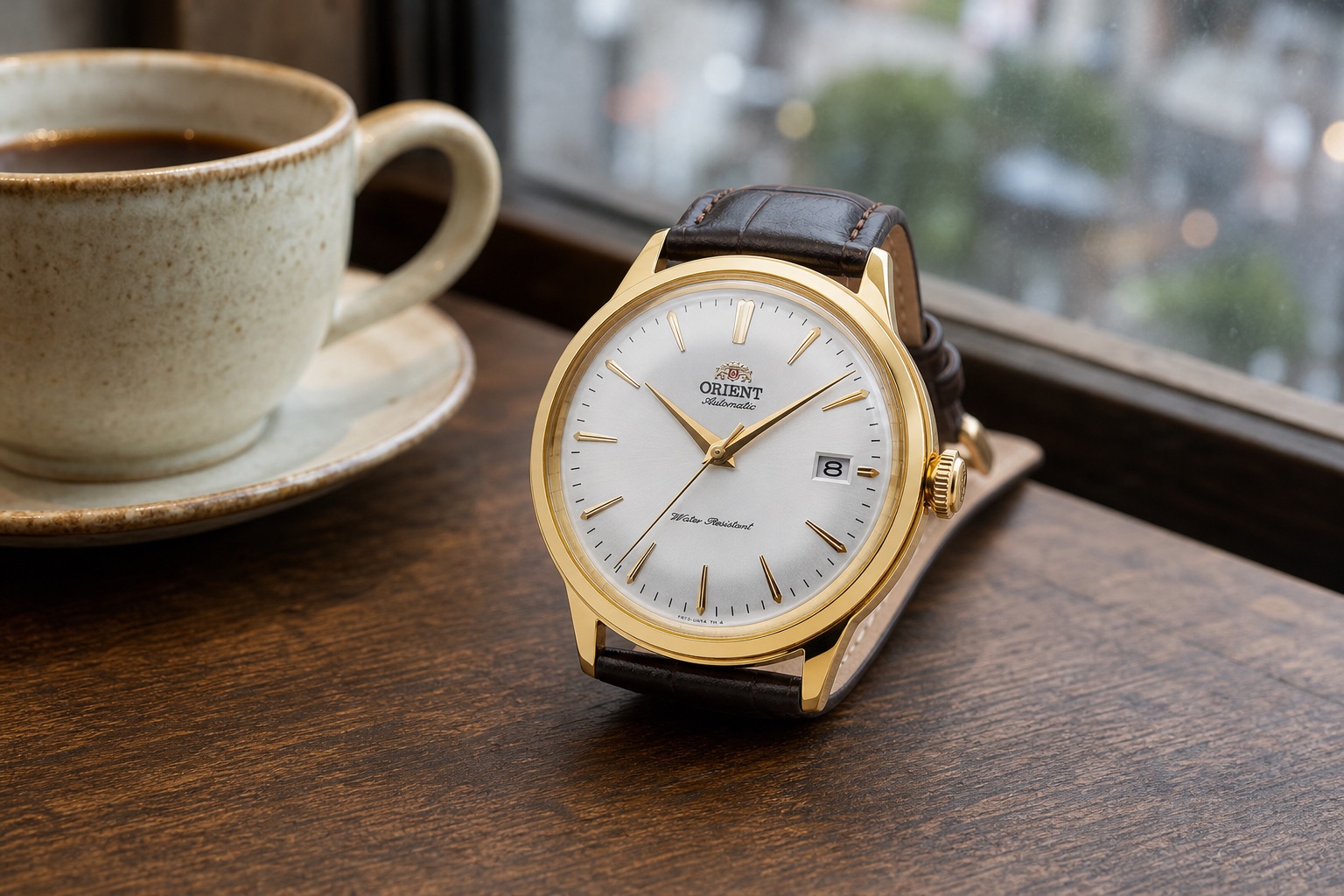
AI-generated illustration.
The numbers didn't follow. Epson's January 2017 filing gives Orient's last independent year, to March 2016: sales of ¥7.1 billion, an operating loss of ¥1.0 billion, 729 employees. Epson's board had resolved in September 2016 to restructure the subsidiary as part of its Epson 25 plan for a wearables business, and on 1 April 2017 a company split moved Orient's overseas watch sales into Seiko Epson and its domestic sales into Epson Sales Japan. Orient's own page calls this a "merger". The filing calls it 吸収分割, a split, and the company itself was left standing with nothing in it. Epson's investor deck that July listed the gain in one line: "Acquired mechanical movements with the absorption of Orient Watch". In January 2020, asked whether it would sell the watch business, Epson said it had "no intention", while conceding that "market conditions are challenging, especially for products on the lower end".
Under Epson the two brands pulled apart. Orient Star got the engineering: a first moon phase in 2017; a silicon escape wheel in 2021 made with Epson's semiconductor processes, which took the hand-wound skeleton's reserve from 50 to 70 hours and which Epson says made it the first Japanese company to use one; and in 2023 a reorganisation into M Collections named after Messier's star catalogue. Sixty-four technicians assembled and cased Orient Star movements at Akita Epson in 2021, about 70 per cent of them women, and Epson spent about ¥600 million in 2019 and 2020 consolidating watch production into one new building there. Orient got the revivals and the volume: the King Diver reissue of 2020, a 39.9 mm Mako 40 in 2023, a UK launch the same year under Epson's own name. In September 2024 Epson moved some Orient mechanical production to its factory in Thailand, a release its US distributor reprinted with the gloss that demand had outgrown capacity. Epson's June 2026 line that all Orient watches are made in "the company's own factories" is true and leaves the country out.
The company's end came as paperwork. On 5 November 2025 Epson's board resolved to absorb the dormant Orient Watch Co., Ltd., effective 1 February 2026, "to streamline and optimize the use of management resources". The 2026 anniversaries went ahead regardless. Orient Star's 75th brought a ¥1.1 million skeleton limited to 130 pieces on a new calibre with a 72-hour reserve, the first Mako GMT, and on 6 October the actor Masaki Suda as the brand's first ambassador for the Japanese market, announced by Epson Japan. AdverTimes caught the oddity in its headline: the parent that gave birth to the brand has vanished, and still it celebrates 75 years.
What Orient gave watchmaking
Less than its anniversary pages say, and more than its auction record suggests. There is no Phillips or Christie's Orient lot that I could find; the one major-house sale is a King Diver at Antiquorum Hong Kong in 2022, estimated at HKD 8,000 to 13,000. Nobody famous is known to have worn one. Its firsts shrink on inspection: the Grand Prix 100 led a Japanese race that Waltham had already run, the Fineness was the thinnest Japanese automatic for seven years, and the Touchtron's world first exists only in English. The 46 series, its one great movement, began as a Seiko licence if Europa Star is right.
What it did do matters more to buyers than to museums. It kept a mechanical production line running through the 1970s and 80s when its two larger rivals had gone to quartz, which is why, when the mechanical revival came, a Japanese maker could offer an automatic with a power-reserve indicator for a few hundred dollars. It patented the Multi-Year Calendar and the power-reserve mechanism, two complications it then sold cheaply. And in the Mako and the Bambino it made the two watches that the English-speaking enthusiast internet recommends first, with Seiko's divers, to anyone with $300 and an interest: Worn & Wound, Monochrome, Time+Tide and Fratello all put them in that company. The mod scene uses Orient's cases and leaves the modding to Seiko movements, by a parts vendor's own account; Orient told a collector blog in 2020 that its own automatic calibres stay exclusive to Orient, while Seiko Epson sells related calibres under its own name. Orient also brought Epson a family of mechanical movements, which is a gift to one company, and the reason the brand is still here.
Significant references
Vintage Orients carry no public reference numbers; the maker names them by model and calibre family, and collectors use case-back codes that vary by variant. Modern codes follow Orient's international style.
| Reference | Model | Years | Why it matters |
|---|---|---|---|
| No public reference (pre-war type, then the 1952 movement) | Orient Star | 1951– | The founding model; hand-wound, 10 or 15 jewels, blued hands |
| No public reference (N-type; Cal. 88700 from 2004) | Royal Orient | 1958–1960s; 2004–mid-2010s | First water-resistant Orient and a run at Seiko's top line; revived, then quietly dropped |
| No public reference (L-type) | Grand Prix 100 | 1964 | A hundred jewels, most of them decorative; won Japan's jewel race |
| No public reference (L-type, later Cal. 660) | Weekly Auto Orient King Diver | 1965–1970s | Started the diver lineage; the first model reissued, in 2020 |
| No public reference (hand-wound; Cal. 46 from 1976) | Multi-Year Calendar | 1965; 1976; 2009 reissue | Patented calendar needing one adjustment a month; "a big hit" |
| No public reference (Cal. 3900) | Fineness | 1967– | 3.9 mm automatic day-date; Japan's thinnest until 1974 |
| 680101–680103 (collector codes) | Touchtron | 1976 | Touch-lit LED made with Sharp; replaced by a button |
| FEM65001 / CEM65001 | Mako | 2004–c. 2015 | Best-selling Orient of its decade; the SKX's rival |
| FER2400 | Bambino | 2012– | The cult dress watch; many people's first mechanical |
| RA-AA0002L | Kamasu | 2019– | The Mako III; a contender for best cheap automatic diver |
Orient today
As of November 2026, Orient and Orient Star are brands of Seiko Epson Corporation, run inside its Wearable Products Operations Division under Masashi Hayashi. Orient Star is assembled at Akita Epson in Yuzawa, a plant of about 1,000 people that also makes print heads; watch R&D is in Nagano; and Epson has not said where Orient-brand watches are assembled since some production moved to Thailand in 2024. Hayashi puts Orient at $300 to $500 and Orient Star at $1,000 to $3,000, with a 430-piece 75th-anniversary skeleton at $3,250 the top of the range. Orient's lines are Classic, Contemporary, Sports and Revival; Orient Star's are Classic, Contemporary, Sports and the M Collections.
Epson reports watches only inside a segment shared with robots and microdevices, which made ¥206.1 billion and a ¥10.8 billion profit in the year to March 2026 after a loss the year before, with wearables up on tourist spending in Japan. Europa Star puts all of Epson's wearables at about 3 per cent of its revenue. Nobody publishes a unit volume. Orient says it sells in more than 70 countries, through Epson Japan at home, Epson's own subsidiaries in Europe since 2023, and an independent distributor in the United States. If a friend asked me which one to buy, I'd point them at a Bambino 38 without the date, which arrived in July 2026, and tell them the company that made it no longer exists, and that it doesn't matter.
Sources
- Seiko Epson, Notice of Absorption-Type Merger of a Wholly Owned Subsidiary, 5 Nov 2025 (archived)
- Seiko Epson, notice of company split with a consolidated subsidiary, 31 Jan 2017 (JPX, PDF, Japanese)
- Epson Begins Discussions on the Restructuring of Orient Watch, 6 Sept 2016 (archived)
- Epson corporate history timeline (archived)
- Seiko Epson, Overview of Company (securities report extract, MarketScreener)
- Epson, Wearable Products Business Strategy, 19 July 2017 (archived PDF)
- Epson, FY2019 Q3 financial results Q&A, 31 Jan 2020 (archived PDF)
- Epson Integrated Report 2025 (archived PDF)
- Seiko Epson, consolidated financial results for the year to March 2026, 1 May 2026 (JPX, PDF, Japanese)
- Epson, The Shinshu Watch Studio and ORIENT STAR The Akita Studio (archived)
- Seiko Group Corporation, affiliated companies
- Seiko, press release, 4 July 2023
- Orient Watch, 沿革 (company chronology), 2012 (archived)
- Orient Watch, History / 70 years milestone (archived)
- Orient, 75th Anniversary Milestone (English)
- Orient, 75th Anniversary Milestone (Japanese)
- Orient, 75th Anniversary
- About Orient
- Orient × Hodinkee, The Orient Star Skeleton, 2021 (archived)
- Orient, Our Story (archived)
- Orient Star, M Collections
- Orient Star, Modern Skeleton release, 4 Feb 2026 (PDF)
- Orient Star, Masaki Suda appointed brand ambassador, 6 Oct 2026 (PDF)
- Orient, first GMT model in the Mako series, 10 Sept 2026 (PDF, Japanese)
- Orient Watch USA, An Announcement from Seiko Epson Corporation, 10 Sept 2024
- Orient Watch USA, Orient Watch Company: Pre-War History, 2012
- Ohara Institute for Social Research, Labour Year Book of Japan 1949, the Toyo Tokei Ageo dispute (PDF, Japanese)
- Ageo City, 広報あげお no. 991, Oct 2016, the city's modern industry (PDF, Japanese)
- National Diet Library record, 東洋時計社史:輝かしい歴史 (2001)
- National Diet Library record, 勞働組合主義の勝利:東洋時計流血事件の眞相と赤色勞働組合の正體 (1947)
- National Diet Library record, Yoshida Watch Shop sale flyer (Hakodate City Library)
- Japan Clock & Watch Association, History of the Japanese Horological Industry
- Japan Clock & Watch Association, industry chronology
- Google Patents, US3621648A, Calendar device in wristwatch (Orient Watch, 1971)
- Google Patents, US4124975A, Calendar watch (Orient Watch, 1978)
- Google Patents, CN1249449A, power-reserve indication mechanism (Orient Watch, 1998)
- Google Patents, EP0294055B1, A paper feeding apparatus (Seiko Epson and Orient Watch, 1988)
- Akita Epson, company outline and history (Mynavi)
- Antiquorum Hong Kong, 9 March 2022, lot 185, Orient King Diver ref. 349-11340
- FundingUniverse, Citizen Watch Co., Ltd. history (St. James Press, 1998)
- M&A Online, セイコーエプソン、オリエント時計をTOBで完全子会社化へ, 24 Sept 2008
- Nikkei, オリエント時計が消滅 親会社のエプソンが吸収、ブランドは存続, 7 Nov 2025
- AdverTimes, 「生みの親」は消滅、それでも75周年, 14 Oct 2026
- Toyo Keizai Online, 「時計大手」エプソン、オリエント統合の意味, 19 Sept 2016
- MONOist, 秋田県にウオッチ製造拠点を集約する新工場棟建設, 27 June 2019
- Mynavi News, プリンタ・腕時計の生産拠点、拡大する秋田エプソンの内部をレポート, Jan 2024
- Hodinkee Japan (sponsored), Orient Star: The Starting Point of Creation, 31 March 2021
- Hodinkee Japan (sponsored), 感性価値を追求する オリエントスター75周年, 2 March 2026
- WatchTime, The Past and Present of Orient Watch Company, Martin Green
- Chronos Japan (webChronos), Two timeless reissue models for Orient's 70th anniversary, 23 Feb 2020
- Chronos Japan (webChronos), Orient Star: Timeless values and cutting-edge design, 12 Oct 2023
- Chronos Japan (webChronos), WatchTime Germany on Orient's 75th anniversary Bambino, 14 Jan 2026
- Europa Star, Introduction to Orient Watch Co., Ltd., 2007
- Europa Star, Orient: mechanical magnitude, Sophie Furley, Feb 2008
- Europa Star, Orient celebrates its 60th anniversary, 2010
- Europa Star, Orient: Pursuing the Value of Mechanical Watches, 2013
- Europa Star, Orient Star is rising, Pierre Maillard, Feb 2024
- Europa Star, Technology transfers at Epson, Serge Maillard, June 2026
- Europa Star, Orient and Orient Star launch in the United Kingdom, March 2023
- Europa Star, Orient adds Mako 40, Aug 2023
- Europa Star, Orient adds new Arabic numeral indices to its Mako series, July 2023
- Worn & Wound, Military Watches of the World: Japan
- Worn & Wound, Orient Marks the 10th Anniversary of the Mako, July 2014
- Worn & Wound, Orient Mako USA Review, 2 Sept 2015
- Worn & Wound, Introducing the Orient Mako USA II, 8 Aug 2016
- Worn & Wound, Orient Updates the Bambino with a New No Date Version, 2026
- Monochrome, Orient USA celebrates the 10-year anniversary of the Mako, 4 Aug 2014
- Monochrome, Orient Star launches its 75th anniversary flagship, the Skeleton RE-BR0001N, 2026
- Fratello, Hands-On with the Orient Kamasu, Michael Stockton, 30 July 2019
- Fratello, Orient expands the Bambino range including no-date 38mm options, 25 July 2026
- SJX, Orient Star Introduces the Diver 1964 2nd Edition, 19 Aug 2022
- SJX, Orient Star's M34 F8 Skeleton is Space-Age Tech, 18 Feb 2026
- Time+Tide, The ultimate Orient watch guide, 15 July 2024
- aBlogtoWatch, Orient Mako II and Ray II with the F6922 movement, 7 April 2016
- namokiMODS, Watch mods you can do with your Orient Ray and Mako
- Orient Place, Use of Orient Movements by Other Brands?, Feb 2020
- Japanese Microbrands, Krieg der Edelsteine (the jewel war)
- Zulu Time Zone, Does the Number of Watch Jewels in a Movement Make a Difference?, 2012
- Wikipedia (Japanese), オリエント時計