Panerai Radiomir 3646
- Make
- Panerai
- Reference
- 3646
- Model
- Radiomir
- Production
- 1940–present (in production)
- Case diameter
- 47 mm
- Calibre
- 618
- Case material
- Steel
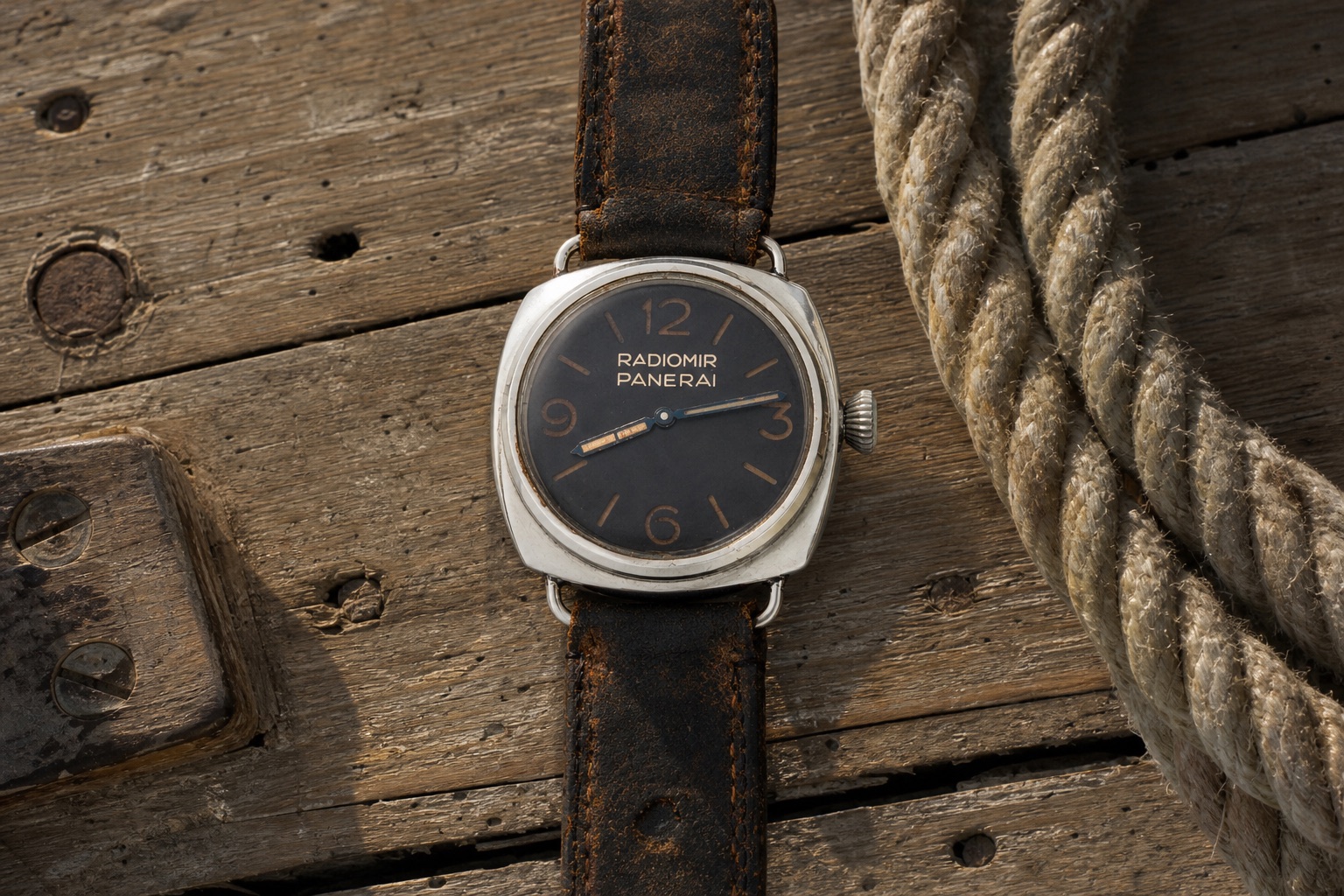
AI-generated illustration.
In the 1930s Officine Panerai was a Florentine instrument maker, the official supplier of precision instruments to the Royal Italian Navy, and the owner of a radium paste it called Radiomir (Phillips). When the navy set up "a secret program of new underwater assault vehicles and operators" in 1935, Panerai went to Geneva for the watch. Its own history says the navy's archives record Giuseppe Panerai commissioning prototypes that year, and that the best of them was the reference 2533, "made on a base supplied by Rolex-Geneva and modified by Panerai" (Panerai).
The Panerai Radiomir 3646 is what came next. Panerai calls it "the instrument that we know today as the 'Radiomir' watch", and says today's Radiomir "retains many of the features of the Ref.3646": the 47 mm steel cushion case, the wire lugs, the big luminous numerals (Panerai). Rolex built the case and supplied the movement. Panerai supplied the dial and the radium. The full story is stranger than the reissues let on. Phillips says nearly all of the 1943–44 production was requisitioned by the German navy, Rolex took its name off the last batch, and the scheme collectors use to sort the survivors was worked out by two authors, Ralf Ehlers and Volker Wiegmann, from their own database of case numbers.
Where it came from
Panerai had a luminous material long before it had a watch. Giovanni Panerai opened in Florence in 1860, and his grandson Guido Panerai (1873–1934) took the business into precision instruments and made it the official supplier to the Regia Marina (Phillips). Panerai says the radium-based powder was developed with Lieutenant Commander Carlo Ronconi to brighten the dials of instruments and sights, and that the name "Radiomir" was documented in the addendum of a patent filed in France on 23 March 1916 (Panerai). Phillips gives the same date (Phillips), while Sotheby's puts the patent in 1915 (Sotheby's). For twenty years Radiomir was a paste. It became the name of a watch in hindsight, which is why Phillips writes of the first prototype as "now known as 'Radiomir'" (Phillips).
The watch came out of the navy's frogman programme. Panerai says it tested several high-strength diving watches to meet the navy's requirements before settling on the Rolex-based 2533 (Panerai). Phillips dates the 2533 to 1936, made "in extremely small numbers", and says watches were supplied to the Italian naval forces as of 1938 (Phillips). The researcher Jose Pereztroika, who runs the site Perezcope, knows of two surviving 2533s, both with Oyster case numbers (Perezcope).
Sotheby's tells the Rolex part plainly. Panerai "placed an order for a large Rolex Oyster case model", and "that initial 47mm watch was essentially a Rolex pocket watch with wire lugs" (Sotheby's). Sotheby's credits Guido Panerai with the order, but Phillips has Guido dying in 1934, and Panerai's own account names Giuseppe. Phillips says Rolex made the 3646 "following strict technical requirements, notably a 47 mm wide (for underwater legibility) cushion-shaped case" (Phillips). No source I read names a designer. The credit is shared out by part: Rolex for the case and movement, Giuseppe Panerai for the dial.
When the 3646 itself started depends on which catalogue you open. Phillips had it "in production from 1938 until the 1950's" in May 2016 (Phillips), "having begun production in April 1940" that November (Phillips), and managed both in a single 2017 essay, "having begun production in 1940" and "produced from 1938 to the early 1950s" (Phillips). Sotheby's uses 1938 (Sotheby's). I've gone with 1940. Pereztroika quotes Panerai's own book, Panerai – Una storia Italiana, saying the 3646 "was the first exclusively for Panerai produced watch in April 1940", and adds that "the only thing that changed from Ref. 2533 to Ref. 3646 was the reference number and obviously also the case numbers" (Perezcope). Panerai's history page files the 3646 under the 1940s. My read is that 1938 marks the first deliveries to the navy, which is how Phillips' November 2016 essay uses it.
The dial was Panerai's contribution, and it took more than one try. Panerai says Giuseppe Panerai rebuilt it from "overlapping discs, known as sandwich dials", with an upper disc of anodised aluminium and perforated numerals "in order to make the radium paste more legible and luminescent", and cut the layout to "just 4 large Arabic numerals in the cardinal points and 8 indexes" (Panerai). The auction record puts the sandwich a little later than that story implies. Sotheby's dates it to 1941–1942, when it "replaced its predecessor, the fragile rivet dial" (Sotheby's). The earliest known Type B, from about 1941, has one of those earlier dials: layers of plastic "held together by two pins or rivets near the center post", which Sotheby's says "tended to warp with time" (Sotheby's).
If the 1940 start is right, the 3646 existed by the night of 18 December 1941, when the submarine Scirè released three manned torpedoes near Alexandria and Luigi Durand de la Penne placed a charge under HMS Valiant (Perezcope). I found nothing that puts a numbered 3646 on one of those men, and Panerai's own history page doesn't mention the raid.
The watch
| Spec | Value |
|---|---|
| Case | Stainless steel cushion case, soldered curved wire lugs, 12-sided screw-down caseback |
| Diameter | 47 mm (Panerai and most catalogues); 46.5 mm on some Type C and D lots; no source says whether the crown is included |
| Length and thickness | 54 mm and 16 mm (one Sotheby's lot, case 260'429) |
| Crown | Screw-down "onion" crown |
| Crystal | Perspex |
| Dial | Black, radium "Radiomir" lume; rivet, sandwich, painted brass or Rolex Error-Proof depending on the batch |
| Movement | Calibre 618: Cortébert-made, Rolex-finished, 16 lignes, 17 jewels, manual wind |
| Water resistance | No rating in any source I found |
| Strap | Long tanned leather strap, to be worn over protective clothing |
It's a pocket-watch movement in an oversized case, and the size was the point. Phillips says the 47 mm width was "for underwater legibility" (Phillips), and Panerai says the calibre 618 was "derived from a pocket watch" (Panerai). Pereztroika found that the early 3646s carry case numbers from Rolex's pocket-watch series, while the two 2533s carry Oyster numbers (Perezcope). The movement is Cortébert's, finished by Rolex. Phillips calls it "the Rolex-finished Cortébert caliber 618" (Phillips), and on a Type C Sotheby's describes a bridge engraved "ROLEX 17 RUBIS" with seven Côtes de Genève stripes (Sotheby's).
The measurements are looser than the round 47 mm suggests. Phillips catalogued a Type C at 46.5 mm (Phillips), and Sotheby's gives 46.5 mm for a Type D (Sotheby's). The only full set of dimensions I found is a single Sotheby's lot, case 260'429, at "47 x 54 mm thickness 16 mm" (Sotheby's).
Some of the gaps are surprising for a diver's watch. I found no depth rating, and no lug width, beat rate or power reserve from a source I'd trust. The strap is better documented than the water resistance: Panerai describes tanned, water-resistant leather "long enough to be worn over protective clothing" (Panerai).
How it changed
The Type A to G scheme in the auction catalogues belongs to Ehlers and Wiegmann. Their book, The References, covers "seven different number groups, which we have sorted since 2009 into 3646 / Type A to 3646 / Type G" (vintagepanerai.com), and Phillips borrows it wholesale: "produced in various versions classified Type A to Type G" (Phillips). The authors call the caseback markings "just one of the most important indicators", and their first three groups are told apart by the stamp inside it (vintagepanerai.com). The table uses what they and the auction houses have published. For two of the seven groups, A and F, I found no published case-number range.
| Type | Case numbers | Inside caseback | Dial | Movement | Dated |
|---|---|---|---|---|---|
| A | Not published online | "Oyster Watch Co" (large) | 618 Type 1 | ||
| B | Earliest known 1'009'911 | "Oyster Watch Co" (small) | Pin dial or sandwich, signed Radiomir Panerai | 618 Type 1 | c. 1941 |
| C | 1'010'xxx | "Brevetee Rolex S.A." | Sandwich, signed or anonymous | 618 Type 1 | 1942–43 |
| D | 260'408 to 260'873 | "Brevetée Rolex S.A." | Anonymous sandwich or painted brass | 618 Type 1b | 1943–44 |
| E | From 260'850 | Rolex hallmark and reference removed | Rolex Error-Proof or painted brass | Anonymous 618 Type 1 mod. | 1944 |
| F | Not published online | Anonymous 618 Type 1 mod. | |||
| G | 317'488 to 317'53x | No Rolex hallmark or reference | Error-Proof or painted brass | Anonymous 618 Type 1 mod. |
The case-number and caseback columns come from vintagepanerai.com, Sotheby's and Phillips; the movement column is Pereztroika's (Perezcope); the dates are the auction houses'. Treat every range as the authors' records to date, since new watches keep widening them.
Two things change in the middle of the table. The case numbers jump from seven digits in the 1,009,000s and 1,010,000s to six-digit 260,000s, and the volume goes up. Phillips describes "an order of 720 reference 3646 pieces made in mid 1943 but delivered in three lots": 260400 to 260695 in 1943, 260696 to 260849 in early 1944, and 260850 to 261120 in the second quarter of 1944 (Phillips). A 1984 Rolex service letter that Perezcope reproduces gives the same number, "720 examples of these extraordinary diver watches were produced in 1943" (Perezcope). The batches weren't identical. The first had a 6.3 mm case and a tall bezel to clear thick sandwich dials (Perezcope), and the last has, in Phillips' words, "a slimmer middle case (5.4 mm vs. 6.3 mm), a low bezel" and Rolex's thin Error-Proof dial (Phillips).
Then Rolex's name disappears. Phillips says the last batch "was anonymized by Rolex by removing the Rolex stamps from the casebacks and using unbranded movements", to "conceal the manufacturer of the watches" (Phillips). The authors list a Type E inner caseback as "missing the Rolex hallmark and reference number" (vintagepanerai.com), and Pereztroika's late movements carry only "17 Rubis, Fab. Suisse" on the train bridge (Perezcope).
How many survive is a moving number. "According to scholarship, 211 examples are known of the reference 3646," Phillips wrote in 2016 (Phillips), and it repeated the figure in 2017 (Phillips). The authors' database kept growing. They featured 143 watches in their 2009 first edition and had "more than two hundred" registered by January 2021, when they counted 103 Type D against 79 five years earlier (vintagepanerai.com). Type E went from 26 in May 2016 (Phillips) to 31 by September 2021 (vintagepanerai.com). Sotheby's says that by its own research "only 52 were made" of Type C (Sotheby's). Hold 103 and 31 against the 720 of 1943, and most of that order is still unaccounted for.
The end of the run is the vaguest part. The catalogues say the 3646 was made "until the 1950s" (Phillips), but they don't say which watches those were. Panerai's history moves straight to the 6152 and 6154 being tested in 1954, with a case "made from a single block" and a tubular crown "replacing the conical cylindrical of the historic Radiomir" (Panerai).
The variations that matter
Case
The case barely changes in outline, so the details that date it are small. Phillips says the model "always had" the 47 mm cushion case, soldered wire lugs and screw-down onion crown (Phillips). It singles out Type C for "comparatively longer fixed lugs" (Phillips), though the authors' test is the caseback. The bezel height is easier to see: tall on the 1943 watches with their thick sandwich dials, low on the slim 1944 cases. Inside, the stamp moves from "Oyster Watch Co" to "Brevetée Rolex S.A." and, on the last cases, to nothing at all.
Dials
The dials changed most, and they're what a buyer is paying for. The order runs from the plastic rivet or pin dial of the early Type B, to the anodised aluminium sandwich signed "RADIOMIR PANERAI" from 1941–42 (Sotheby's), to the same sandwich with no name on it, to painted brass and Rolex's Error-Proof dial on the last cases. The authors record painted brass dials on Type D as well: ten of the seventeen Type D watches they added between 2016 and 2019 had one (vintagepanerai.com). The original lume is radium-based. Sotheby's catalogued one Type D dial with "a strong Geiger counter reading" in 2025 (Sotheby's).
Movement
Pereztroika sorts the 618s by their engravings. Types A to C have Rolex engravings that "follow the upper curve" of the train bridge, Type D has straight ones, and Types E to G have no Rolex marking at all (Perezcope). That makes the movement a check on the case: a 618 from the wrong group means a swapped movement.
Co-branded, commissioned and error dials
No retailer-signed or co-branded 3646 dial turned up anywhere in the research. The commissions were military, and the two dials collectors have named both come out of the last two years of the war.
The Kampfschwimmer dial
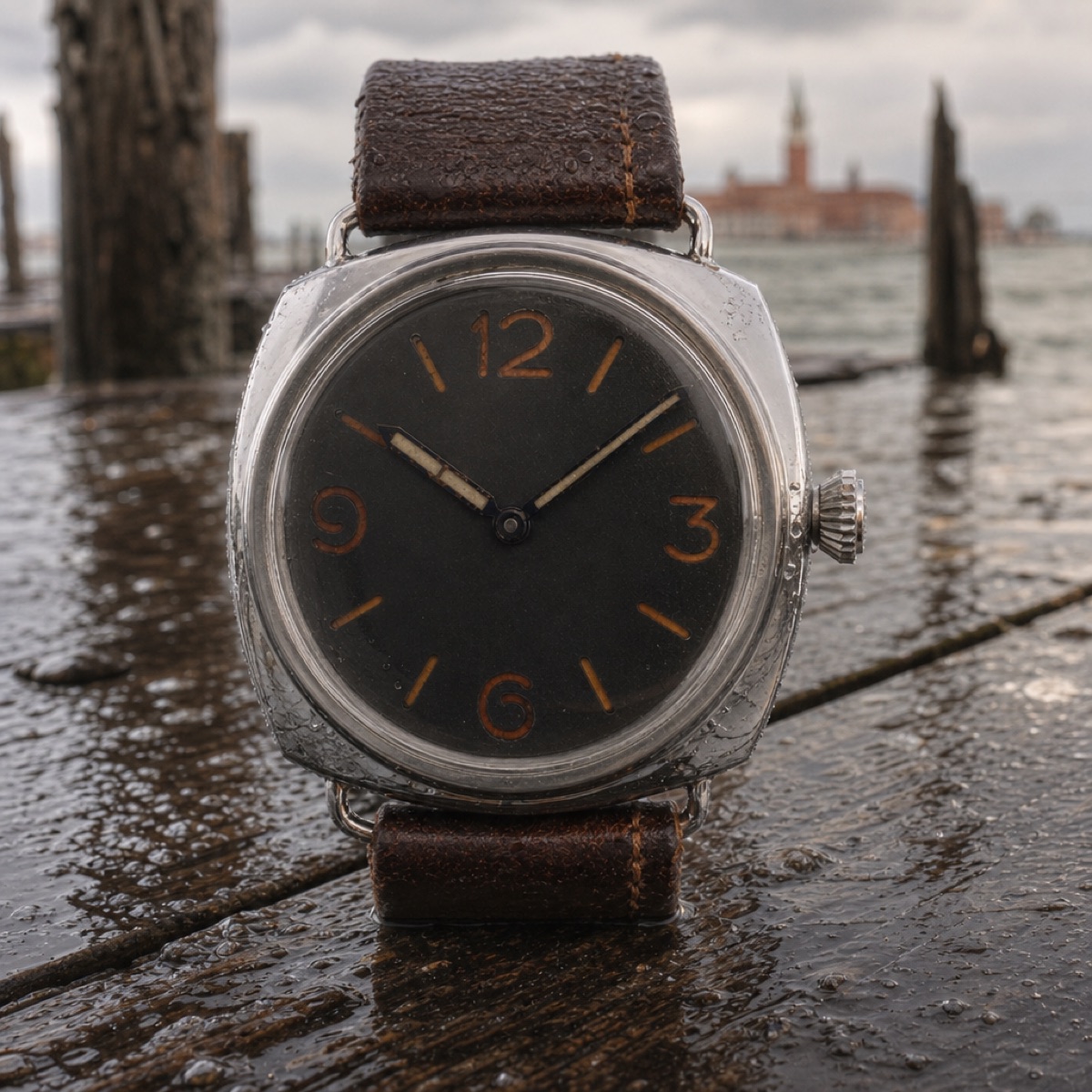
The anonymous sandwich dial is named after the men who wore it. Sotheby's says the Type D dials "are further known as 'Kampfschwimmer' dials, and primarily date to the mid 1940s", with no branding on the dial (Sotheby's). The Kampfschwimmer were the German navy's combat swimmers. It's the same black sandwich construction as the signed dial, with the words "Radiomir Panerai" left off, and it turns up on Type C as well.
How the Germans got the watches is told three ways. Pereztroika writes that after Italy's surrender in September 1943, a batch meant for the new Decima Flottiglia MAS "was collected in Florence by Lieutenant Commander Heinz Schomburg and later distributed solely among German Kampfschwimmer recruits. The Italians did not receive a single watch, even though they paid for them" (Perezcope). The recruits trained with the Italian Gruppo Gamma at Valdagno. Phillips is broader: of the 720 ordered in 1943, "With few exceptions, all of these watches were requisited by the German Navy" (Phillips). Rolex's own 1984 letter says the opposite, that "the whole series was sold to Italy and delivered to the Italian army as equipment for their frogmen" (Perezcope). Both can be true if Italy paid and Germany took delivery, which is Pereztroika's version.
The best-documented one I found is a Type C that Phillips sold in November 2017, case 1'010'351, with an anonymous sandwich dial and the soldier's book of its owner, Helmut Rösel, a combat swimmer in the German navy's special marine unit. Rösel wrote that every combat swimmer received a diver's watch after training. It made CHF 75,000 (Phillips).
Why the dials went blank has three explanations and no document. Phillips says it's "highly possible that Panerai created these dials during the war years to avoid recognition, lest the watch was found by an enemy" (Phillips). A 2026 Sotheby's essay says "Guido Panerai stopped stamping his name on dials after the German occupation of Italy" (Sotheby's), which can't be right as written if Guido died in 1934. And Phillips puts the stripping of the last cases on Rolex. I'd treat the motive as unknown.
AI-generated illustration.
The California, or Error-Proof, dial
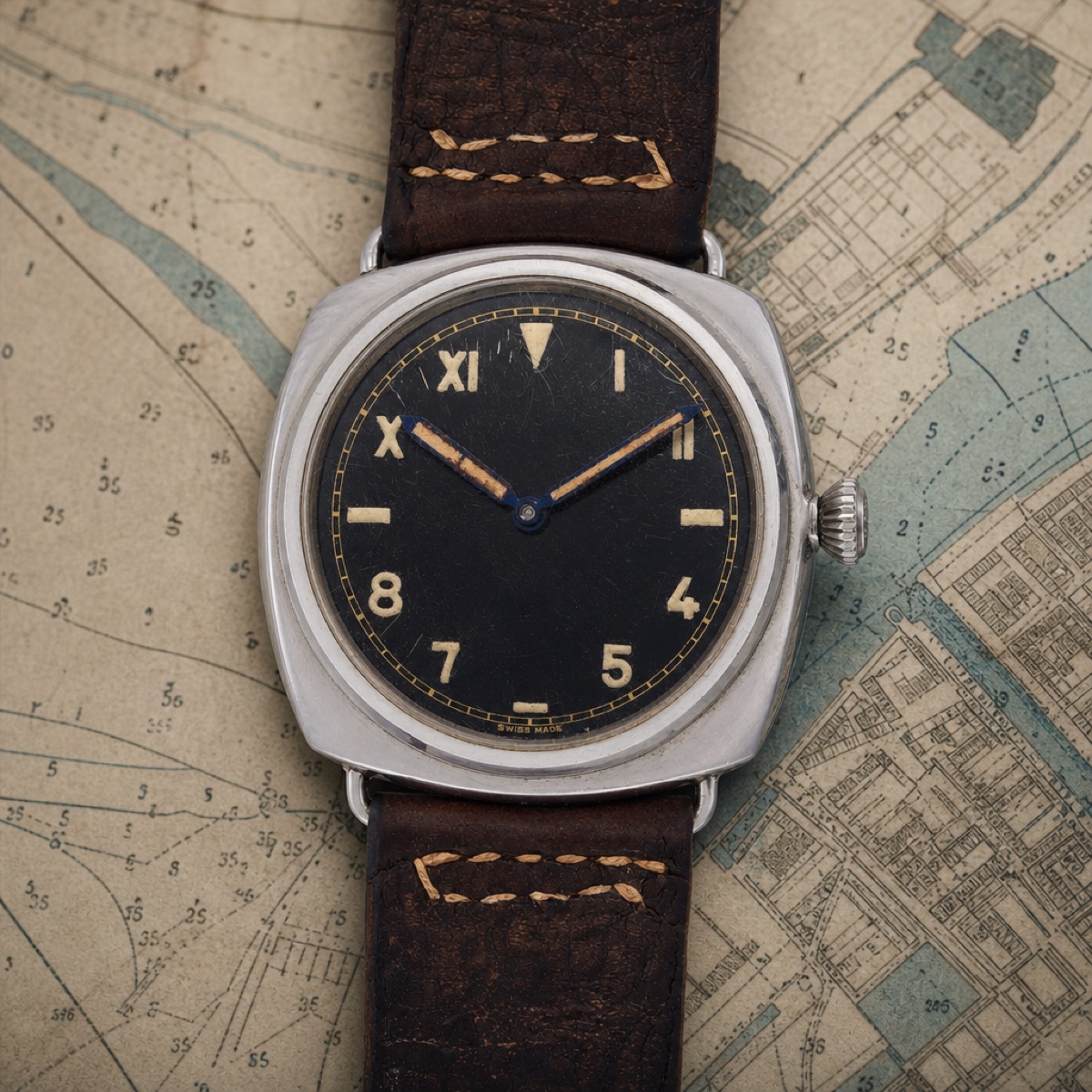
The other named dial is Rolex's, and it arrived last. Rolex filed Swiss patent CH221643, for a watch dial, on 30 May 1941, and it was published on 15 June 1942 (Google Patents). The claim is a dial with some hour signs in Roman numerals and others in Arabic, and the patent never mentions Panerai. (Phillips' "patented by Rolex on May 30, 1941" is the filing date.) On the 3646 the dial appears in 1944 on the last lot: black lacquer, half Arabic and half Roman luminous numerals, "only marked 'SWISS MADE' below 6 o'clock" (Phillips). Ehlers and Wiegmann call it Rolex's "Error-Proof Radium Dial" and note the railroad-track minute markers and the lume "applied from above" (vintagepanerai.com). It's thin, and Pereztroika points out that the low-bezel 1944 cases "do not have enough clearance to take thick Panerai sandwich dials" (Perezcope).
"California" is a collector's nickname, and an unflattering one at first. Phillips traces it to "a dial refinisher from California who in the late 1980s specialized in restoring Rolex Bubbleback dials" (Phillips). The collector Jeff Hess put it more bluntly to Fratello: "To most 'California Dial' means 'fake dial'", and "the proper term is simply half-Arabic, half-Roman" (Fratello).
Phillips counted 26 Type E watches in May 2016, 17 of them with this dial, and sold the earliest known one, case 260'850, for CHF 106,250 (Phillips). By 2022 it wrote that "only 22 pieces of this type have surfaced" (Phillips). The same essay tells the hoard story. Before Florence was liberated in August 1944, it says, the German army confiscated what was left in the Panerai workshop and shipped it to the Arturo Junghans factory on La Giudecca in Venice, where workers clearing the buildings in the early 1990s found loose dials and "around 30 NOS (New Old Stock) Ref. 3646 featuring Error-Proof dials, still in their original cardboxes." It's a good story with no named witness, and Phillips files the related tale of Error-Proof dials made for senior navy officers under "folklore".
AI-generated illustration.
Why it matters
The 3646 is the template, and the modern company treats it that way. Panerai only began selling its own watches to civilians in September 1993 (Phillips), and "The Richemont Group (then the Vendôme Group)" bought it in 1997 (Panerai). When it put a California dial on the PAM01349 in 2023, it called the watch "Inspired by Ref 3646 from the archives of the Maison" and noted that the dial was "historically always produced in 47mm" (Watches and Wonders).
The obvious objection is that the founding Panerai is a Rolex. Pereztroika's line is that the cushion Panerais before the GPF 2/56 "were in reality Rolex Oyster watches outfitted with Panerai-made dials" (Perezcope), and Phillips, writing with Panerai, mentions an exclusivity agreement that forbade Panerai "to supply watches with Rolex parts to foreign countries" (Phillips). I think that undersells the dial, which is the part of the 3646 Panerai still sells. The heritage page is selective, though. It tells the 1935 programme and the Rolex-Geneva base, and it says nothing about the German navy, which by Phillips' account ended up with most of the 1943–44 watches.
Every auction result I could confirm for a wartime 3646 is under CHF 110,000. They run from CHF 33,750 for a rivet-dial watch at Antiquorum in November 2024 (Antiquorum) to CHF 106,250 for that earliest Type E in May 2016, with a Type D at CHF 65,000 in May 2018 (Phillips) and an Error-Proof Type E at CHF 94,500 in May 2022 (Phillips). The telling result came in the same May 2016 sale as that Type E. A "Transitional 3646" made in 1961, with an Angelus 8-day movement and catalogued as a Luminor, made CHF 197,000 (Phillips). No source I read claims a record for a wartime 3646.
What I'd check before buying one
- The case number against its group, and the caseback stamp that group should carry (see the table). The authors' database is the reference here.
- The movement against the case. Pereztroika writes that "Many 3646 Type C for instance have later Rolex 618 Type 1b units", and he reads that as an exchanged movement (Perezcope).
- The dial. "California dial" once meant a refinished one, and even Panerai has replaced them: Sotheby's sold an unsigned late 3646 restored at Officine Panerai with "a re-manufactured dial with Superluminova" (Sotheby's).
- The lume. Sotheby's catalogued that 2025 Type D with "the lume on the dial having possibly been refilled" (Sotheby's).
- The name. A "Transitional 3646" is a 1961 Panerai build with an Angelus movement, not a wartime watch.
Sources
- Antiquorum, Geneva, November 2024, lot 239
- Fratello, A Californian controversy: the origins of the California dial
- Google Patents, CH221643A, Timepiece dial
- Panerai, history (archived copy)
- Perezcope, Battle-tested Rolex-Panerai 3646 Kampfschwimmer
- Perezcope, Case numbers of early Ref. 3646
- Perezcope, Differences within Rolex 618 Type 1
- Perezcope, Rolex-Panerai 3646 Error Proof from a Bosnian bazaar
- Perezcope, Vintage Panerai heavy metal at Phillips Hong Kong
- Perezcope, Vintage Panerai on the wrist of Decima MAS members
- Phillips, Geneva Watch Auction THREE, lot 122 (Type E, May 2016)
- Phillips, Geneva Watch Auction THREE, lot 123 (Transitional 3646, May 2016)
- Phillips, Geneva Watch Auction FOUR, lot 152 (Type D, November 2016)
- Phillips, Geneva Watch Auction SIX, lot 210 (Type C, Helmut Rösel, November 2017)
- Phillips, Geneva Watch Auction SEVEN, lot 213 (Type D, May 2018)
- Phillips, Geneva Watch Auction XV, lot 159 (Error-Proof dial, May 2022)
- Phillips, Winning Icons, lot 16 (Type E, October 2017)
- Phillips, Panerai Radiomir PAM01346 charity auction
- Sotheby's, Important Watches, Geneva 2013, lot 293
- Sotheby's, Important Watches, lot 166 (restored late 3646)
- Sotheby's, Important Watches, December 2023, lot 34 (Type B, Hammer Collection)
- Sotheby's, Important Watches Part I, 2024, lot 69 (Type C)
- Sotheby's, Important Watches, 2025, lot 81 (Type D)
- Sotheby's, Important Watches, 2026 (Kampfschwimmer Type D)
- vintagepanerai.com (Ehlers and Wiegmann), Type A
- vintagepanerai.com (Ehlers and Wiegmann), Type D
- vintagepanerai.com (Ehlers and Wiegmann), Type E
- vintagepanerai.com (Ehlers and Wiegmann), Type G
- Watches and Wonders 2023, Panerai Radiomir California PAM01349