Rolex Explorer 1016
- Make
- Rolex
- Reference
- 1016
- Model
- Explorer
- Production
- 1959–1989
- Case diameter
- 36 mm
- Calibre
- 1570
- Case material
- Stainless steel
- Water resistance
- 100 m (328 ft)
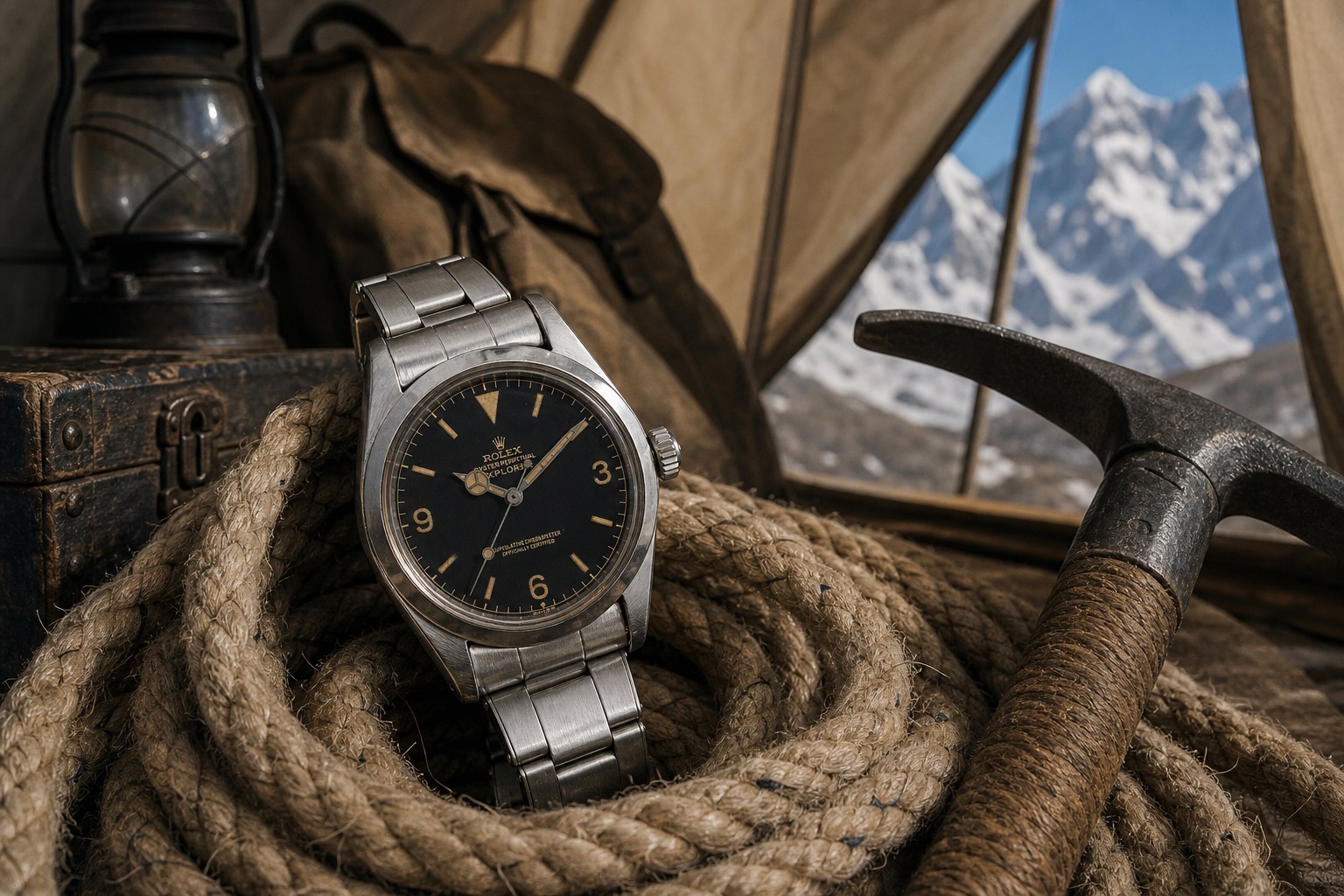
AI-generated illustration.
Rolex registered the name Explorer in January 1953, a few months before Edmund Hillary and Tenzing Norgay reached the top of Everest. The first watch to carry the name on every dial, the 6350, came that same year, and the 6610 followed in 1955. Then came the Rolex Explorer 1016, and Rolex left the reference number alone for three decades. The first cases were made around 1960 and the last watches left the factory in 1989, which makes the 1016, in Phillips' words, "the longest-running Explorer model".
The 1016 is where the Explorer settled into the watch it still is. It kept the 6610's 36 mm case and black 3-6-9 dial, took the new calibre 1560, and with it the words "Superlative Chronometer Officially Certified", which Hodinkee says the Explorer line first wore on the 1016. Rolex also doubled the water resistance from 50 to 100 metres. Over the next 30 years the dial went from gilt to matte, the movement learned to hack and the bracelet went from riveted links to solid ones, yet a 1987 example looks almost exactly like a 1962 one from across a room. Phillips calls it "the vintage model most closely associated with the Explorer name": say "vintage Explorer" to a collector and this is the watch they picture.
I don't own one and have never handled one. What follows leans on the auction record, on Hodinkee's Reference Points guide to the Explorer, and on Andrew Hantel's explorer1016.com, a site devoted to this single reference that most collectors now use for its dial taxonomy.
Where it came from
The Explorer story starts on Everest, and the facts there are messier than the advertising. Revolution reports that Rolex supplied twenty reference 6098 watches to the British expedition in two batches: seven in 1952 for the advance research team, and thirteen for the climbers who joined later. Smiths sponsored the climb too, and Hillary and Tenzing carried a watch from each. Which one reached the summit is still argued. Hodinkee points to an Outdoor Journal article that, citing period evidence, concluded it was the Smiths. The expedition Rolex now sits in Zurich's Beyer Museum.
Whichever watch reached the top, there's no doubt about who made more of it. Rolex had registered the Explorer name in January 1953, on the 26th according to explorer1016.com, so the name existed before the climb. My read is that the name was waiting for a story, and Everest supplied it. A Rolex advert from the coronation year, which Hodinkee reproduces, promised that the Explorer "will function perfectly under water to depths of at least 300 ft. and, in the air, to the fantastic height of 12 miles."
The references either side of the climb tightened the idea. The 6150 of 1952 and 1953 had the 3-6-9 dial, but most say "Precision" instead of "Explorer" and it wasn't a chronometer. The 6350, made from 1953 to 1955, is the one everyone agrees is an Explorer: it carries the name on every dial and "Officially Certified Chronometer" above the 6. The 6610 ran from 1955 to 1959 with the calibre 1030, which Phillips says allowed a flatter caseback, and some early 6610s print a red "50m = 165ft" depth rating on the dial.
The 1016 changed the inside more than the outside. The calibre 1560, adjusted with Microstella screws, replaced the 1030 and earned the new chronometer wording on the dial. Water resistance went to 100 metres. The case stayed at 36 mm, though the dial changed enough that Hantel notes the 6610's and 1016's dials can't be swapped: the feet and diameter differ. No source I read names a designer, and I found no launch price.
When it started depends on whom you ask, and Phillips has given both ends of the range. Its catalogue for an albino 1016 in 2023 says "Introduced in 1959 and produced until 1990", while at least four other Phillips lots say 1963. Sotheby's says 1959, Hodinkee says 1960, and a Christie's catalogue says the 1016 "appeared in Rolex catalogues as of 1962". Dated watches rule out the latest of these. Hodinkee reports that Ian Fleming's 1016 has a 1960 case production date stamped inside its caseback, and Hantel's earliest dials sit in cases numbered from 516xxx, a range his case notes place in 1959 and 1960. Hodinkee adds a caveat worth keeping: the caseback date tells you when the case was made, and watches were often assembled a year later and sold later still. So the first cases date from 1959 or 1960, and the watch was in Rolex's catalogue by 1962.
The end is clearer. The last 1016s carry L-prefix serials, and Phillips sold a Tiffany-signed example as "one of the rare last pieces to leave the Rolex factory with an L serial number before discontinuation in 1989". Its successor, the 14270, brought applied numerals, a gloss dial and the calibre 3000 at 28,800 vph, in the same 36 mm.
The watch
| Spec | Value |
|---|---|
| Case | Stainless steel Oyster, screw-down caseback, no crown guards |
| Diameter | 36 mm, without the crown |
| Lug width | 20 mm |
| Lug to lug | 43 mm |
| Crown | 6 mm Twinlock, screw-down |
| Crystal | Domed acrylic, Tropic 22 |
| Movement | Calibre 1560 at launch, calibre 1570 from the mid-1960s; automatic, 26 jewels |
| Frequency | 18,000 vph (1560), 19,800 vph (1570) |
| Hacking | Added to the 1570 in the early 1970s |
| Water resistance | 100 m |
| Dial text | Rolex, Oyster Perpetual, Explorer; Superlative Chronometer Officially Certified |
These figures come from Hantel's case and movement pages and from auction catalogues, since Rolex's site doesn't carry discontinued references. The catalogues agree on 36 mm. A few early dials, which Hantel calls Type 0, still read "Officially Certified Chronometer", the 6610's wording.
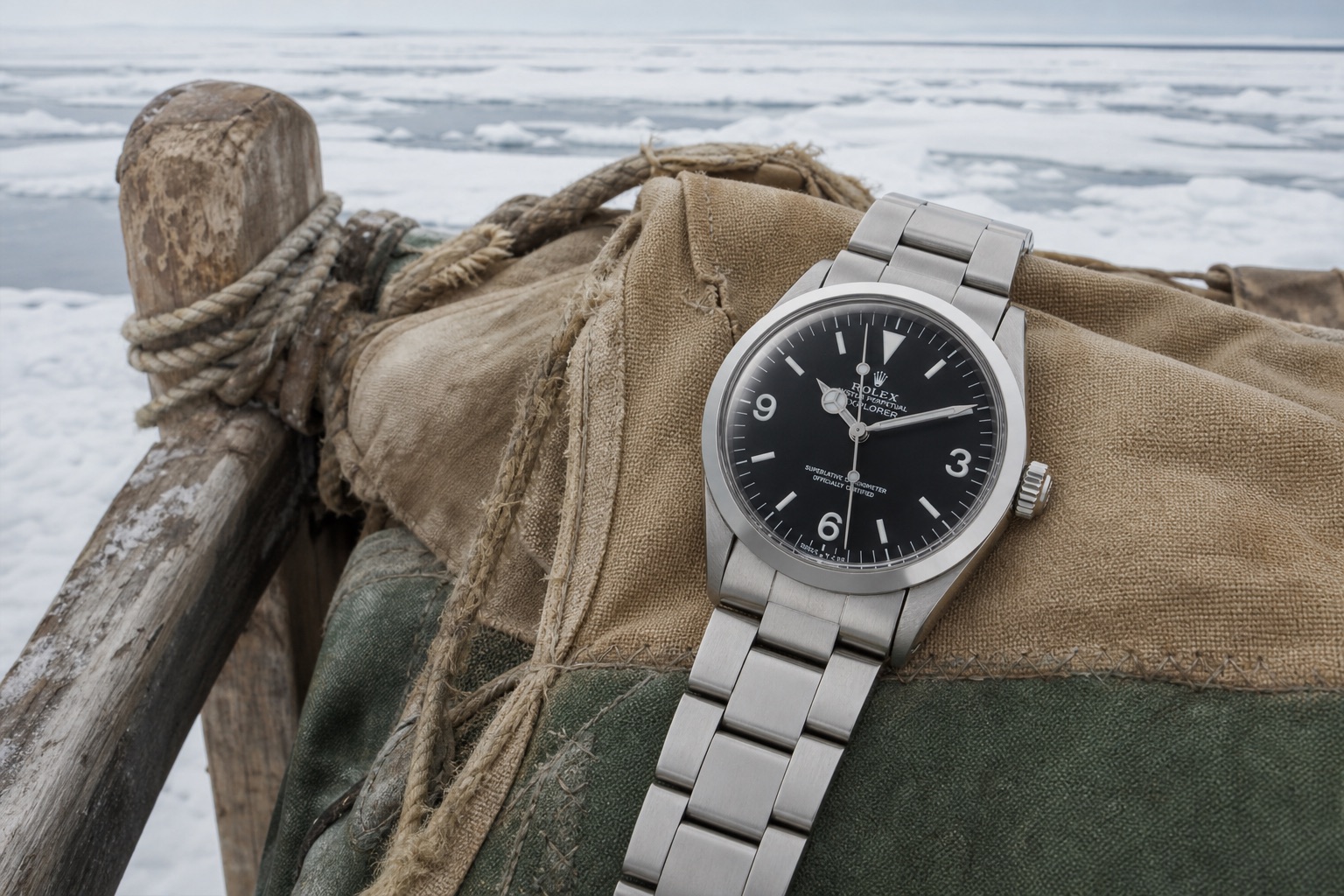
The dial is the 6610's layout, cleaned up. Christie's describes it as a black dial "with the luminous triangle at 12, luminous Arabic numerals for the other three quarters and luminous baton numerals for the remaining hours". A Mercedes hour hand and a seconds hand with a luminous dot finish it off. Hodinkee describes the Explorer as a watch made for maximum legibility in low light, and this dial is that idea with almost nothing added.
The movement story has one awkward wrinkle. Hodinkee and Hantel agree on the sequence: the 1560 at 18,000 vph first, the 1570 at 19,800 vph from the mid-1960s ("as early as 1965", says Hantel), and hacking added in the early 1970s, which Hantel puts "sometime in 1971". The dated watches back them up. Phillips catalogued a 1560 in a case stamped II.64 and a 1570 in one stamped II.66. The wrinkle is that the second of those Phillips lots also says Rolex introduced the 1016 in 1963 "with an upgraded movement, the caliber 1570, incorporating a hacking feature", which Phillips' own 1963 and 1964 lots, both with the 1560, contradict. Movements get swapped at service, so a 1016's calibre should fit its serial, and a hacking movement in a 1960s case is worth a question.
The case is plain and that's its appeal. The crown is 6 mm with an underlined coronet, which marks the Twinlock system and its two gaskets. There are no crown guards. The original crystal is a domed acrylic Tropic 22, and Hantel's tip for spotting a replacement is the edge: service crystals have a tall vertical side and a flatter top.
How it changed
| Years, approx. | Serial range, approx. | Dial | Movement |
|---|---|---|---|
| 1960–62 | 516xxx–596xxx | Gilt with chapter ring, Type 0 (OCC) then Type 1; "Swiss" | 1560 |
| 1962–63 | 516xxx–105xxxx | Gilt with chapter ring, Types 2 and 3; exclamation point, underline or both | 1560 |
| 1963–64 | 90xxxx–105xxxx | Gilt Type 4, the first without a chapter ring | 1560 |
| 1964–67 | 10xxxxx–174xxxx | Gilt Types 5 and 6; "Swiss T<25" | 1560, then 1570 |
| 1967–74 | 15xxxxx–35xxxxx | Matte Mark 1, the "frog foot"; Mark 2 in 1969 | 1570, hacking from the early 1970s |
| 1974–76 | 36xxxxx–41xxxxx | Matte Mark 3 | 1570 |
| 1975–81 | 40xxxxx–66xxxxx | Matte Mark 4, tall coronet | 1570 |
| 1981–87 | 66xxxxx–9xxxxxx | Matte Mark 5 | 1570 |
| 1984–89 | 80xxxxx to the L series | Matte Mark 3 again; Mark 4 in the final L series | 1570 |
The years are Hodinkee's, the serial ranges Hantel's, and the ranges overlap because the dials did. Hantel is candid that his ranges are "my educated estimations and not written in stone", and Hodinkee notes the "somewhat haphazard way the 1016 had different dial variations appear and then reappear later". Rolex also stopped stamping case production dates inside casebacks in the mid-1970s, so later watches are dated by serial alone.
The story the table compresses has three acts. The first is gilt: until 1963 every dial has a printed chapter ring around the minute track and the radium-era "Swiss" at 6, and Rolex experiments with small marks below the text. In 1963 the chapter ring goes, and within a year "Swiss T<25" replaces "Swiss" at 6, marking tritium lume. The second act is the change to matte, which Sotheby's dates to "late 1966 to early 1967" and calls "one of the most significant changes in the 30 years production run". The calibre 1570 arrives in the same years. The third act is two decades of matte dials that differ in small ways, mostly in the coronet and the lettering.
Note what doesn't change in 30 years: the case, the 36 mm, the acrylic crystal, the 3-6-9 layout and the 100 metres. When Rolex finally replaced it, the 14270 kept the size and changed the dial and the movement.
The variations that matter
Dials
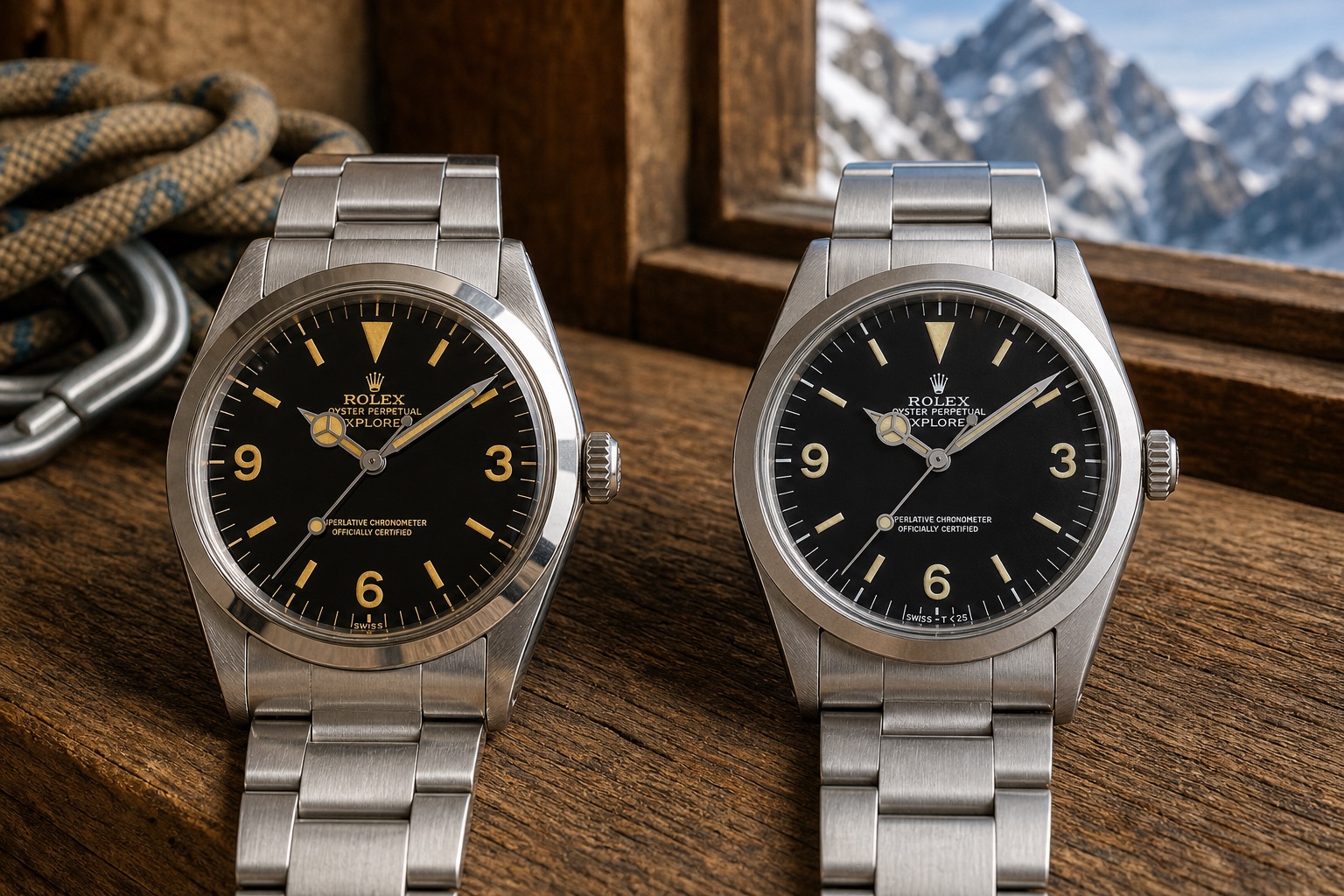
The gilt dials were made by a galvanic process. Hodinkee explains that the text and markers were masked out, the black applied around them and the whole dial lacquered, which leaves bright gold printing under a gloss that can crack or turn brown with age. Three marks help date them. The "exclamation point" is a small lume dot just below the 6, which Hodinkee says was "supposedly to indicate that the lume is not as radioactive", and it appears on Submariners and GMT-Masters of the same years. The underline is a short line below the chronometer text, which Hodinkee says indicated tritium. A few 1016 dials have both, a combination Hodinkee says you won't see on the Submariner or GMT-Master. Then there's the chapter ring, a thin printed circle enclosing the minute track, which disappears from 1963.
Brown "tropical" gilt dials are their own market. Sotheby's has catalogued one with "Hands are original with same lume discolouration as dial", which is exactly the match a buyer wants to see. In Phillips' TOKI sale, a 1964 "tropical-underline" dial made HK$381,000, well above the other gilt 1016s in this article.
AI-generated illustration.
The matte dials trade the gilt for white printing on a textured black surface, made by a simpler and probably cheaper process. Collectors split them into five Marks, almost entirely by small details:
- Mark 1 is the "frog foot", named for a coronet with widely splayed points that, in Hodinkee's phrase, "resembles the animal's webbed digits". The earliest have fat, puffy lume on the 3, 6 and 9.
- Mark 2 is a 1969 dial in a tight serial range, with outward-sloping serifs on the E of Rolex and the "T<25" above the minute track.
- Mark 3 is defined by what it lacks. Hantel's rule is that if a matte dial shows none of the other Marks' tells, it's a Mark 3.
- Mark 4 has a tall, thin coronet that Hantel nicknames the "Gumby".
- Mark 5 has E's in "Explorer" whose middle bars sit high.
If I were buying, I'd want a Mark 1. It's the first matte dial, and the frog foot is the one tell you can see without a loupe. The objection worth naming is that this whole system is a collector's construction. The Type and Mark names come from Hantel's site, and no auction catalogue I read uses them; the houses say "gilt", "exclamation", "tropical" and "matte". The Marks record what collectors have seen in the wild, and Rolex never published them, which should temper how much anyone pays for one Mark over another.
Hands
Hantel splits the handsets in two. Gilt dials and Mark 1 matte dials up to about serial 1.7 to 1.8 million have flat hour and minute hands; after that both hands are slightly convex. A curved handset on an early gilt watch is a sign of a later replacement, and Hantel shows the shorter service hands for comparison.
Bracelets
| Bracelet | End links | On the 1016 |
|---|---|---|
| 7206 riveted Oyster | 58 | 1960–72 |
| 6636 riveted Oyster, spring links | 58 | 1960–72 |
| C&I riveted Oyster (made in the USA) | Unmarked | 1960–77 |
| 7836 folded Oyster | 280 | From 1967 |
| 78360 solid-link Oyster | 580 | From 1975–76 |
| 6251 Jubilee | 50 | To the mid-1970s |
| 62510H Jubilee | 550 | From 1976 |
The table is Hantel's, and the auction record mostly agrees. Phillips has sold 1016s on 7206 rivet bracelets with 58, 80 and 82 end links, and on 78360s with 580s. Hantel notes that parts catalogues give the 58 end link for Explorers and the 80 for Submariners, but 80s turn up on Explorers that were probably sold that way. He treats a two-to-three-year gap between a bracelet's date stamp and the watch's as normal. The folded 7836 takes a 280 end link in Hantel's table, and Phillips has catalogued two with 258s. Some bracelet charts pair it with a 580, but on the 1016 that end link goes with the solid 78360.
Co-branded, commissioned and error dials
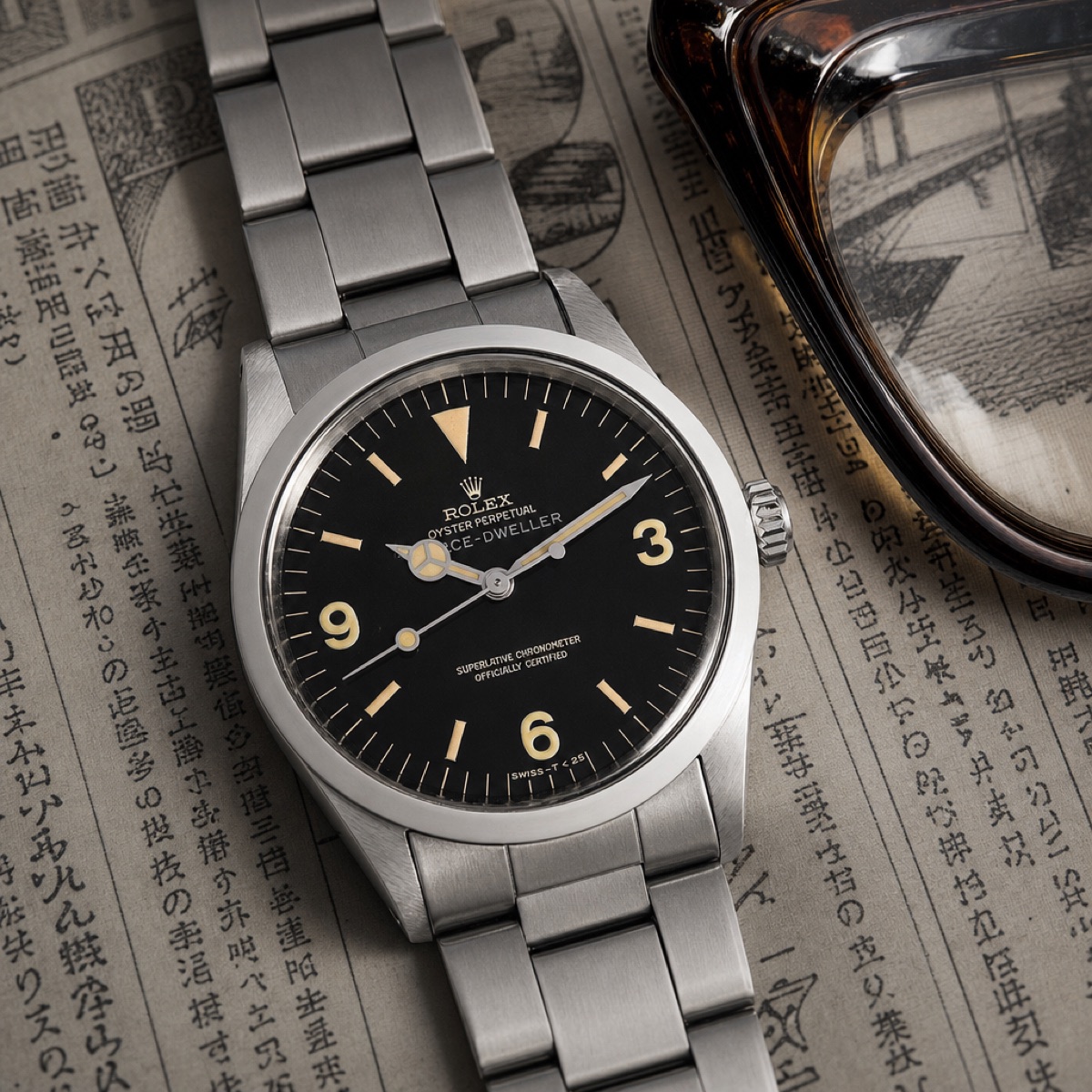
Space-Dweller
The Space-Dweller is a 1016 with one word changed: "Space-Dweller" printed where the dial normally says "Explorer". Phillips tells the story as "horological lore": after the Mercury flights, the astronauts made a goodwill tour of Japan in 1963, and Rolex released the Space-Dweller there in limited numbers. It "did not gain traction", Phillips says, and "Rolex abandoned 'Space-Dweller' as a model name".
The trademark record tells a different story. Hodinkee and Wind Vintage say Rolex applied for the name in Switzerland in 1966 and filed it in 1968, which points to first use around 1967, years after the astronauts' tour. Hodinkee adds that the Space-Dweller case numbers known to the dealer Watchistry date from 1963 and 1968, and questions any Space-Dweller dial in a 1963 case.
The sharpest critique comes from Perezcope. On a normal dial "Explorer" is part of the galvanic printing and sits slightly recessed. On a Space-Dweller the name is printed in silver on top of the finished dial and stands raised. Sotheby's Geneva sold four loose Space-Dweller dials in 2008, two in May and two in November, and Perezcope traces them to liquidation stock the Swiss authorities seized from the dealer Eric Tortella. He counts about 13 Space-Dwellers known and argues that several are dials married to cases later.
AI-generated illustration.
The best-documented example is the one Phillips sold in New York in December 2023: case 1'734'971, circa 1967, calibre 1570, with two Rolex Japan service receipts that Phillips said added "a much desired level of credibility". Perezcope reports it made USD 190,500 including premium; Phillips' lot page doesn't show the result. My read is that the Space-Dweller is real as a dial and doubtful as a factory watch, and buyers are paying model-level money for a single line of print.
The albino
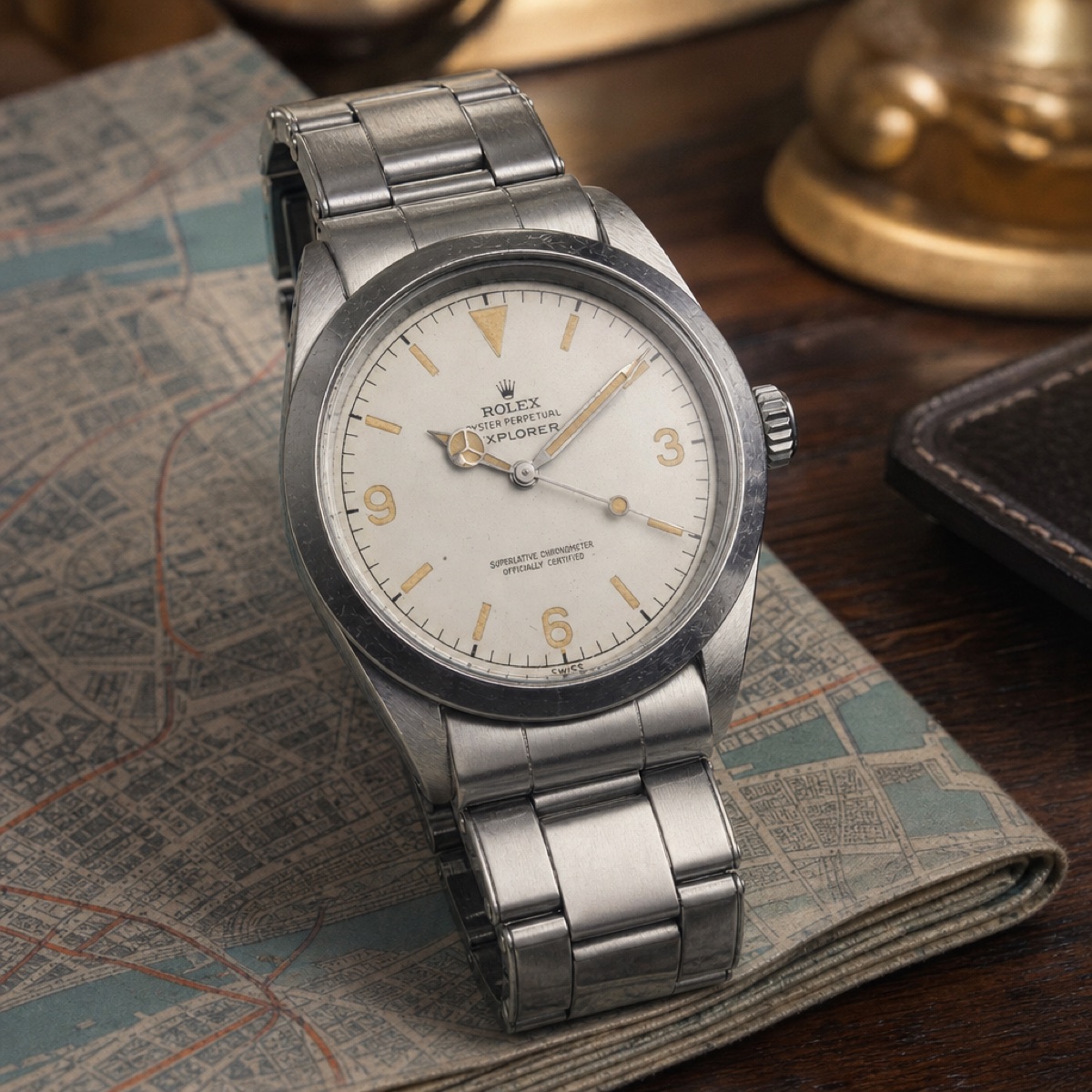
Rolex made a small number of white "albino" dials for its early sports watches, and a few 1016s have one. Hodinkee counted 20 to 25 albino dials at most across the early Submariner, GMT-Master and Explorer, and most of the albino Explorers are 6610s. Christie's sold an albino 1016 in 2007 for CHF 45,600. In May 2023 Phillips sold another, circa 1962, with an exclamation-point white dial, describing it as "so far unique". It made CHF 101,600 against an estimate of CHF 40,000 to 80,000.
The two claims sit awkwardly together. Phillips' "unique" may refer to the exclamation-point version, since the Christie's watch had already sold. Hodinkee's own caution is the one to keep: it's essentially impossible to prove a dial was born in the case it's in. No celebrity is attached to an albino 1016; the albino Rolex that Eric Clapton once owned is a Daytona.
AI-generated illustration.
Tiffany & Co. and Astrua
Retailer signatures exist but are scarce. Christie's has catalogued a 1016 from about 1979 signed for Tiffany & Co., and Phillips Hong Kong sold an L-serial Tiffany dial from about 1989, with its Tiffany-stamped guarantee, for HK$533,400. In Geneva, Phillips sold a 1969 watch signed for Astrua of Turin, one of the few retailers it says Rolex let put a name on its dials, with a guarantee showing it was sold in August 1972.
The best Tiffany story belongs to Bunny Mellon. Hodinkee reports that she bought eight Tiffany-signed 1016s as gifts for a dinner party, had six engraved with her initials, and, the story goes, put them in a drawer when the party was cancelled. They surfaced at Sotheby's in November 2014, and all but one sold for under $20,000. One detail doesn't line up: Hodinkee describes the Tiffany stamp as on the dial, while Sotheby's description of lot 146 mentions it only on the caseback.
I found no documented Middle East, military or company-logo 1016 dial. If one is offered, it needs its own provenance.
Why it matters
The 1016 did the job it was named for. In Geneva, Phillips sold a circa 1966 example engraved "Allan Gill North Pole 6th April 1969". Gill was the navigator on Wally Herbert's British Trans-Arctic Expedition. The team medic, Colonel Kenneth Hedges, confirmed that all four members were issued a Rolex, and that he gave Gill this one, his own, after Gill "had lost his own in the snow". It sold for CHF 32,500.
AI-generated illustration.
Other stories are less formal. Hodinkee has handled the Mark 1 that the cowboy Gary Leffew won for the bull riding at the 1969 Calgary Stampede, which Rolex used in a print advert and which later survived being stepped on by a bull. Hodinkee also reports, citing research by Dell Deaton, that Ian Fleming wore an early gilt 1016 with a 1960 case, and that it appears to be the watch he had in mind for Bond. That second claim rests on one researcher, so I'd call it likely but unproven.
The market has been kind to the 1016 without getting carried away. Hodinkee's line is that good Explorers "bring in respectable sums, but nothing like the Submariners or the Daytonas". The auction record bears that out:
| Sale | Watch | Result |
|---|---|---|
| Phillips Geneva Watch Auction: FIVE | 1987, matte, with Bucherer guarantee | CHF 18,125 |
| Phillips Geneva Watch Auction: XI | Circa 1983, matte, on a 78360 | CHF 18,750 |
| Phillips Game Changers, New York | 1963, exclamation-point gilt dial | $27,500 |
| Phillips Geneva Watch Auction: SIX | Circa 1966, the Allan Gill watch | CHF 32,500 |
| Phillips Hong Kong Watch Auction: XIV | Circa 1963, exclamation-point gilt dial with chapter ring | HK$138,600 |
| Phillips Geneva Watch Auction: XVII, May 2023 | Circa 1962, albino | CHF 101,600 |
| Phillips New York Watch Auction: NINE, December 2023 | Circa 1967, Space-Dweller | $190,500, per Perezcope |
| Phillips Hong Kong Watch Auction: XIX | Circa 1989, Tiffany & Co., L serial | HK$533,400 |
The ordinary watches in that table sold for CHF 18,000 to 33,000. The money goes to dials with a story, and some of those stories, as the Space-Dweller shows, are better than the evidence.
What I'd check before buying one
- Dial against serial: match the dial type to Hantel's serial ranges. Mark 3, 4 and 5 dials were also supplied as service dials, as was a service-only design, and some service dials carry Luminova. An early case with a late matte dial is a service dial until proven otherwise.
- Type 0 dials: Hantel has seen aftermarket "OCC" dials, mostly made for the 6610, so their feet don't fit a 1016.
- Hands and lume: the hands should be flat or curved to suit the serial, and their lume should have aged like the dial's.
- Case: look for brushing on the lug tops and crisp edges, which polishing removes. Hantel notes that serials around 4.4 million are Rolex replacement service cases.
- Crystal and movement: a domed Tropic 22 is original; a flat-topped one is service. The calibre should suit the serial: 1560 early, 1570 from the mid-1960s, hacking from the early 1970s.
- Bracelet: the reference and end links should suit the era, with the clasp's date stamp within two or three years of the watch.
- A 34 mm "Explorer": Hodinkee warns that Rolex's 34 mm 5500 Explorer is "an often-faked Explorer-like variation", because a fake dial in a common Air-King 5500 case does the job. Eric Wind told Hodinkee that most of the ones he's asked about turn out to be fakes.
Sources
- Phillips, lot catalogues for reference 1016: Geneva XVII lot 19 (albino), Geneva SIX lot 245 (Allan Gill), New York NINE lot 23 (Space-Dweller), Hong Kong XIX lot 847 (Tiffany), Geneva FOUR lot 163 (Astrua), Hong Kong XIV lot 1088, TOKI lot 26, Game Changers lot 10, New York lot 46, New York SEVEN lot 26, Geneva FIVE lot 125, Geneva XI lot 28; and for the 6610, Geneva lot 154.
- Sotheby's: Explorer 1016, circa 1967 (2023), Explorer 1016, circa 1973 (2022), Explorer 1016, circa 1964 (2019), Mellon Jewelry lot 146 (2014).
- Christie's: Live Auction 1404, lot 216, Tiffany & Co. 1016.
- Jon Bues, "A Comprehensive Collector's Guide To The Rolex Explorer I", Hodinkee Reference Points, 4 February 2022.
- Anthony Traina, "What's the deal with albino Rolex dials", Hodinkee (Japanese edition), May 2023.
- Andrew Hantel, explorer1016.com: history, case, movement, bracelet, Type 0 dial, service dials.
- "A Brief History of the Rolex Explorer", Revolution.
- "Space Junk: the reality of the infamous Rolex Space-Dweller", Perezcope, December 2023.
- "Rolex Space-Dweller reference 1016", Wind Vintage.