Rolex GMT-Master 6542
- Make
- Rolex
- Reference
- 6542
- Model
- GMT-Master
- Production
- 1954–1959
- Case diameter
- 38 mm
- Case material
- Steel
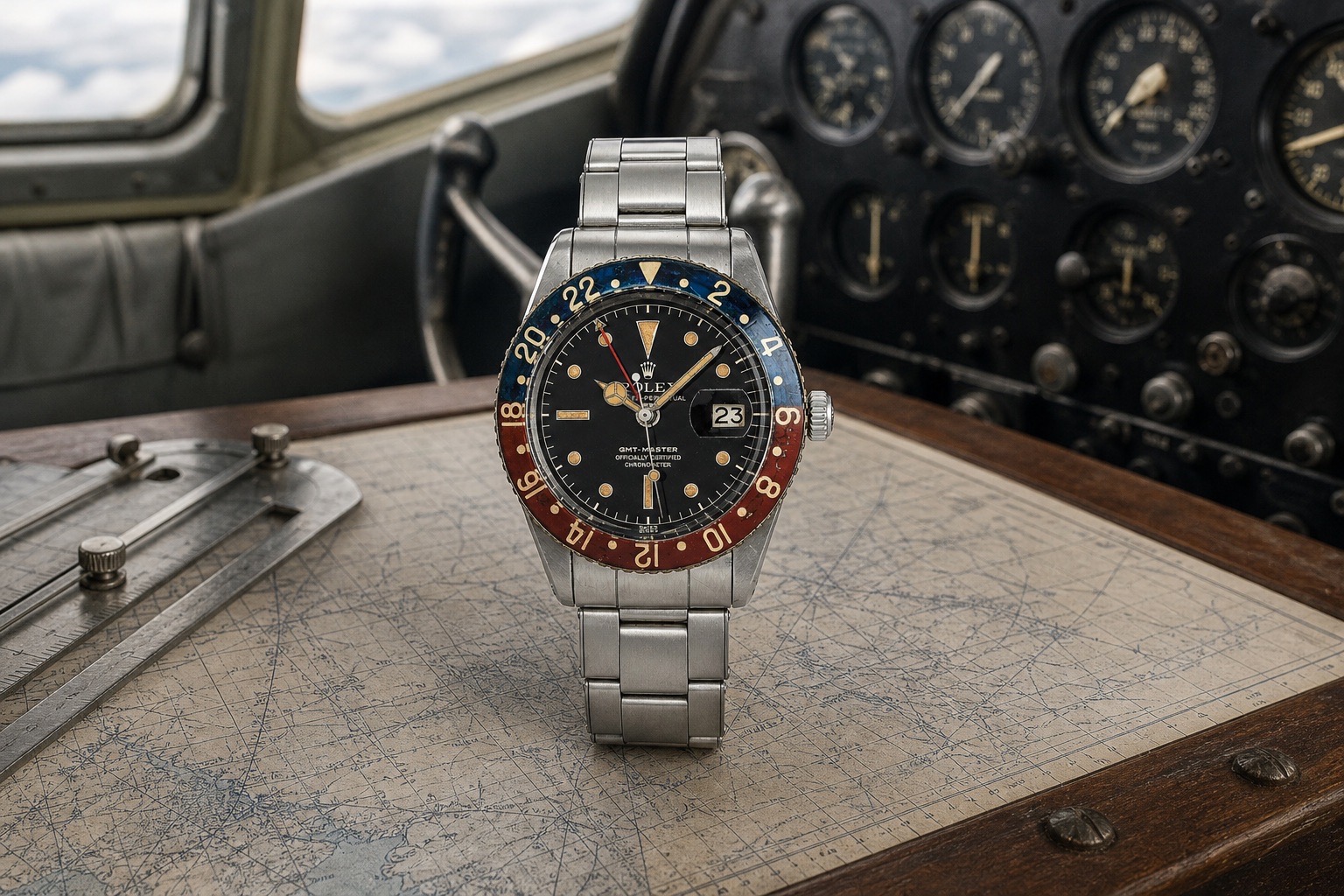
AI-generated illustration.
Rolex had a turning bezel before it had a GMT-Master. The Turn-O-Graph 6202 of 1953 put a graduated rotating bezel on an Oyster, and Phillips says the GMT-Master "was born a year later", built on that design (Phillips). The new watch added a fourth hand that went round the dial once in 24 hours, and gave the bezel 24 hours to match. Set the bezel to the offset and a pilot could read home time and local time at a glance. That watch was the Rolex GMT-Master 6542, and Christie's calls it "the first GMT reference" (Christie's). It's also where the red and blue bezel starts: Sotheby's says the 6542 "also introduced Rolex's famous Pepsi bezel" (Sotheby's).
It's the first GMT-Master and the odd one out. The bezel insert was Bakelite, a brittle early plastic, with radium numerals painted on its underside, and it cracked. By 1959 the 6542 had given way to the 1675, which had a metal insert and crown guards. That leaves the 6542 as the GMT-Master with the Bakelite bezel and the bare crown, made for five or six years depending on whose start date you take, in steel and in a very few gold examples. Most of the arguments about it are about that bezel: whether it's original, whether it was swapped at service, and whether Rolex really recalled them.
Where it came from
Every auction house tells the same origin story. Phillips says "Rolex initially created the model for Pan Am airlines to track dual time zones" (Phillips), and Christie's says it was "Created in 1954 at Pan Am's request" (Christie's). Sotheby's adds a date and a second airline: "In 1953, Rolex was asked by Pan American Airlines and a European airline (there is some speculation as to which one)", to make a watch "that could display two time zones simultaneously" (Sotheby's). Antiquorum goes further and names people. It credits Pan Am's Captain Frederick Libby, a navigator, and Rolex's René-Paul Jeanneret, who "conceived of a watch with an additional hour hand that revolved once every 24 hours" (Antiquorum).
The agreement is wider than the evidence. I found Libby and Jeanneret in that one essay and nowhere else, and nobody shows a letter, a contract or a Pan Am memo. Sotheby's says the watch "immediately became" Pan Am's official watch, but it doesn't show how. Antiquorum itself is more careful in a later catalogue, where Pan Am "might have been one of Rolex's first major clients" (Antiquorum). The nearest thing to a document is an advert. Sotheby's sold a 1958 6542 that belonged to the Pan Am captain Clarence "Jooj" Warren Jr., and says it can be seen on his wrist in the 1959 "Pan Am flies on Rolex time" advert (Sotheby's). I haven't seen the advert. So a Pan Am captain wore one in a 1959 advert built on the airline's name. Who asked whom, and when, rests on the auction houses' word.
Sources split on the launch year. Phillips, Christie's, Bonhams, Antiquorum and Revolution all give 1954 (Bonhams, Revolution), and so does Sotheby's Captain Warren essay. A 2022 Sotheby's catalogue says "In 1955, Rolex launched reference 6542" (Sotheby's), and a Phillips Hong Kong essay says Rolex "answered in 1955 by launching the world's first ever chronometer certified dual-time wristwatch" (Phillips). So Phillips and Sotheby's each give both years. I've gone with 1954 because most of the catalogues say it, but neither side shows a Rolex document. No source names a designer, beyond Antiquorum's credit to Jeanneret for the idea, and I found no launch price.
The end is clearer. Phillips writes that "Fitted with an extremely fragile Bakelite bezel, reference 6542 was replaced in 1959 by reference 1675" (Phillips). Bonhams says it "remained in production for only six years", and Antiquorum says "only 6 years of production", which from 1954 lands in 1959 or 1960. The latest lots I found are catalogued circa 1959.
The watch
| Spec | Value |
|---|---|
| Case | Stainless steel Oyster case, no crown guards; a small number in 18k yellow gold |
| Diameter | 38 mm in most catalogues, none of which says whether the crown is included |
| Lug to lug | 48 mm (Wind Vintage, one watch) |
| Crown | 6 mm screw-down crown |
| Bezel | Bidirectional rotating 24-hour bezel with a Bakelite insert, numerals painted on the underside |
| Dial | Glossy black gilt dial with date window; brown, honey or bronze on gold watches |
| Movement | Automatic, 25 jewels, chronometer; catalogued as calibre 1030, 1036, 1065 or 1066 |
| Water resistance | 50 m (Bob's Watches) |
| Bracelet | Riveted Oyster; end links stamped 65 on watches from 1958 to 1960, 58 on a 1955 watch with a 1960 clasp |
The case is the 38 mm Oyster that Revolution describes as having "a 6mm screw-down winding crown" (Revolution), and Phillips, Sotheby's, Bonhams and Monaco Legend all catalogue it at 38 mm. Wind Vintage measured one at 48 mm lug to lug. What's missing is as telling as what's there. With no crown guards, the crown stands proud of the case side, and BeckerTime calls the 6542 "unique in the GMT series for its lack of crown guards" (BeckerTime). When the 1675 arrived, Sotheby's notes, it came "adding crown guards to the case (along with a smaller crown)" (Sotheby's).
The bezel is the reason the watch is collected. Sotheby's describes the Pepsi bezel as "rendered in translucent Bakelite plastic", and Phillips says the "twenty-four hour numerals" were "painted on the underside" (Phillips), so you read them through the plastic. Bonhams says the early inserts had "radium-coated numerals" (Bonhams). The result glowed, and it didn't last. "These Bakelite bezels have a propensity for cracks and are radioactive," says Wind Vintage.
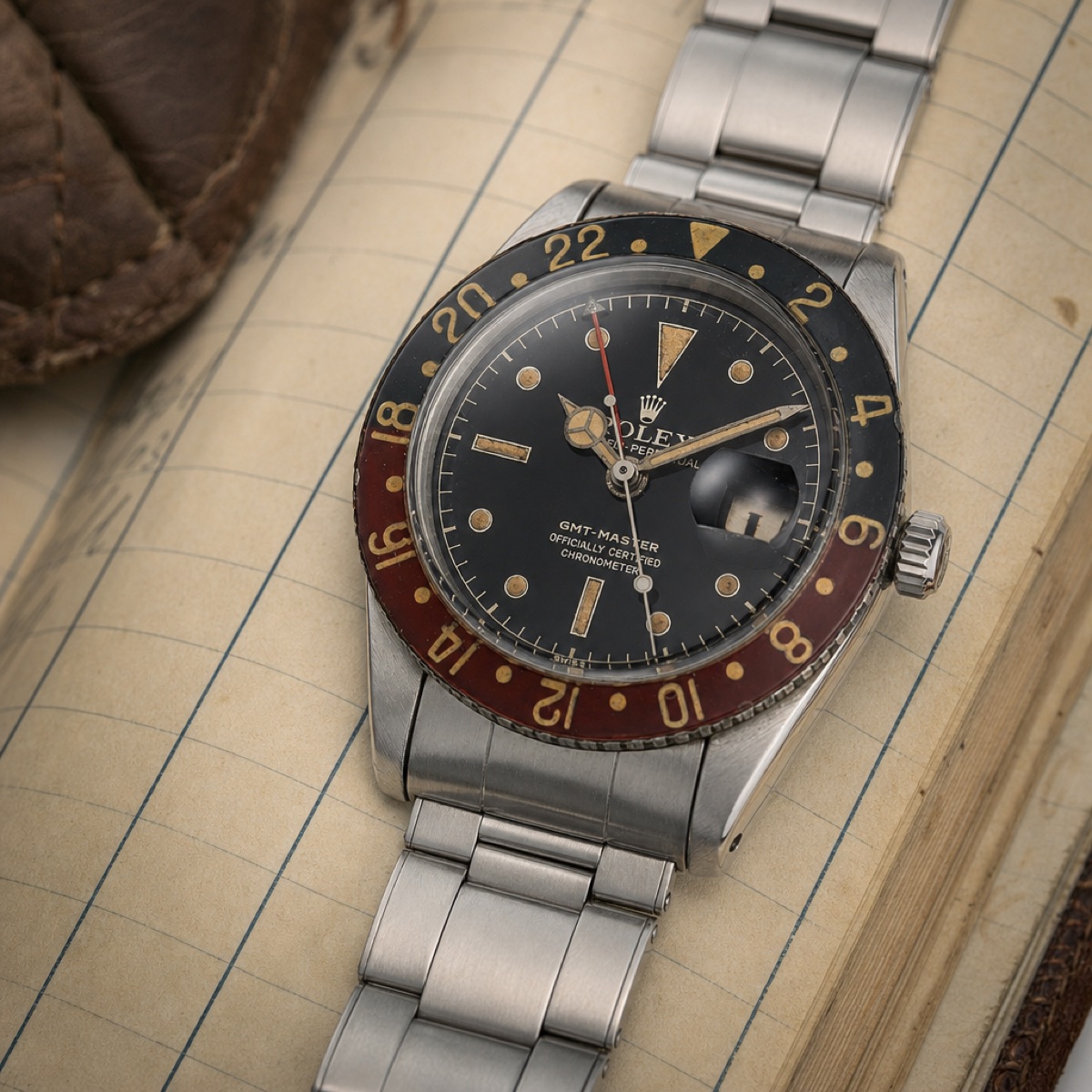
AI-generated illustration.
The movement is where the catalogues fall apart. Revolution says the watches used "a base Calibre 1030 which was modified to include the 24-hour hand" (Revolution), and Monaco Legend's essays say the 6542 was "Initially powered by the caliber 1036, and later the 1065 and 1066" (Monaco Legend). The lots themselves print all four numbers. Sotheby's catalogued Captain Warren's 1958 watch as a calibre 1030, Monaco Legend a 1955 watch as a 1036, Phillips its 1958 gold watch as a 1065, and Phillips both a 1955 and a 1959 steel watch as 1066s (Phillips, Phillips). That 1955 watch alone breaks the "1036, later 1065 and 1066" order. My read is that the 1030 is the base family and the other three are the GMT versions of it, but no source I read ties a calibre to a serial range. I wouldn't reject a 6542 on its movement number alone.
How it changed
The 6542 was made for about five years, so it changed far less than the 1675 did. The table is built from dated auction lots: case numbers as printed, years as each house catalogued them. Treat the ranges as approximate, because a few lots don't fit their neighbours.
| Catalogued | Case numbers | Dial | Bezel | Calibre on the lot | Bracelet |
|---|---|---|---|---|---|
| 1955 | ~112,000–113,000 | Glossy gilt; the earliest with GMT-MASTER printed in red | Blue and red Bakelite | 1036, 1066 | End links 58, on a clasp dated 1960 |
| c. 1956–57 | ~186,000–322,000 | Glossy gilt; a gold watch catalogued c. 1956 | Bakelite; dark red-brown on gold | 1030 | |
| 1958 | ~367,000–398,000 | Gilt; gold watches with honey or bronze dials | Bakelite; cognac brown on gold | 1030, 1065 | Big Logo clasp, end links 65 |
| c. 1959 | ~461,000–486,000 | Gilt | Bakelite | 1030, 1065, 1066 | End links 65 |
Sources for the rows: Monaco Legend and Phillips for 1955; Sotheby's, Antiquorum and Monaco Legend for 1956 and 1957; Phillips, Sotheby's and Wind Vintage for 1958; Sotheby's, Phillips and Phillips for 1959.
The case numbers are the clearest guide. They climbed from about 112,000 in 1955 to about 486,000 by 1959, and Rolex stamped a quarter and year inside the caseback, so the two can be read against each other: Phillips' 482'084 is stamped "III.59". The gold watch joined the steel one along the way, mostly dated to 1958 and 1959, with one Antiquorum example catalogued circa 1956. The bracelets are harder to read. Watches from 1958 on carry end links stamped 65, while Phillips' 1955 watch has 58s on a clasp dated 1960, so that bracelet may be younger than its case. The bezel material held steady. Every insert these lots describe as original, from 1955 to 1959, is Bakelite.
The variations that matter
Case
The steel case is the standard. The gold one is a different-looking watch, and Phillips says Rolex made "very few examples of the first generation ref. 6542 models produced in gold" (Phillips). It came with a brown Bakelite insert in place of the Pepsi colours. Revolution says the gold version "also had a Bakelite bezel but instead of the Pepsi colour scheme it was all brown" (Revolution), Phillips calls one "cognac brown-colored", and Antiquorum calls another "dark red/brown-colored" (Antiquorum). Sotheby's adds "Alpha hands (instead of the more common Mercedes-style hands)". It also contradicts itself on the year, giving 1958 in one sentence and 1959 in another (Sotheby's). The lots support 1958 at the latest: the gold watch Phillips called "the best-preserved and most complete 18-karat gold known in the collecting community", case 367'383, is catalogued 1958, and Antiquorum's case 186415 is catalogued circa 1956.
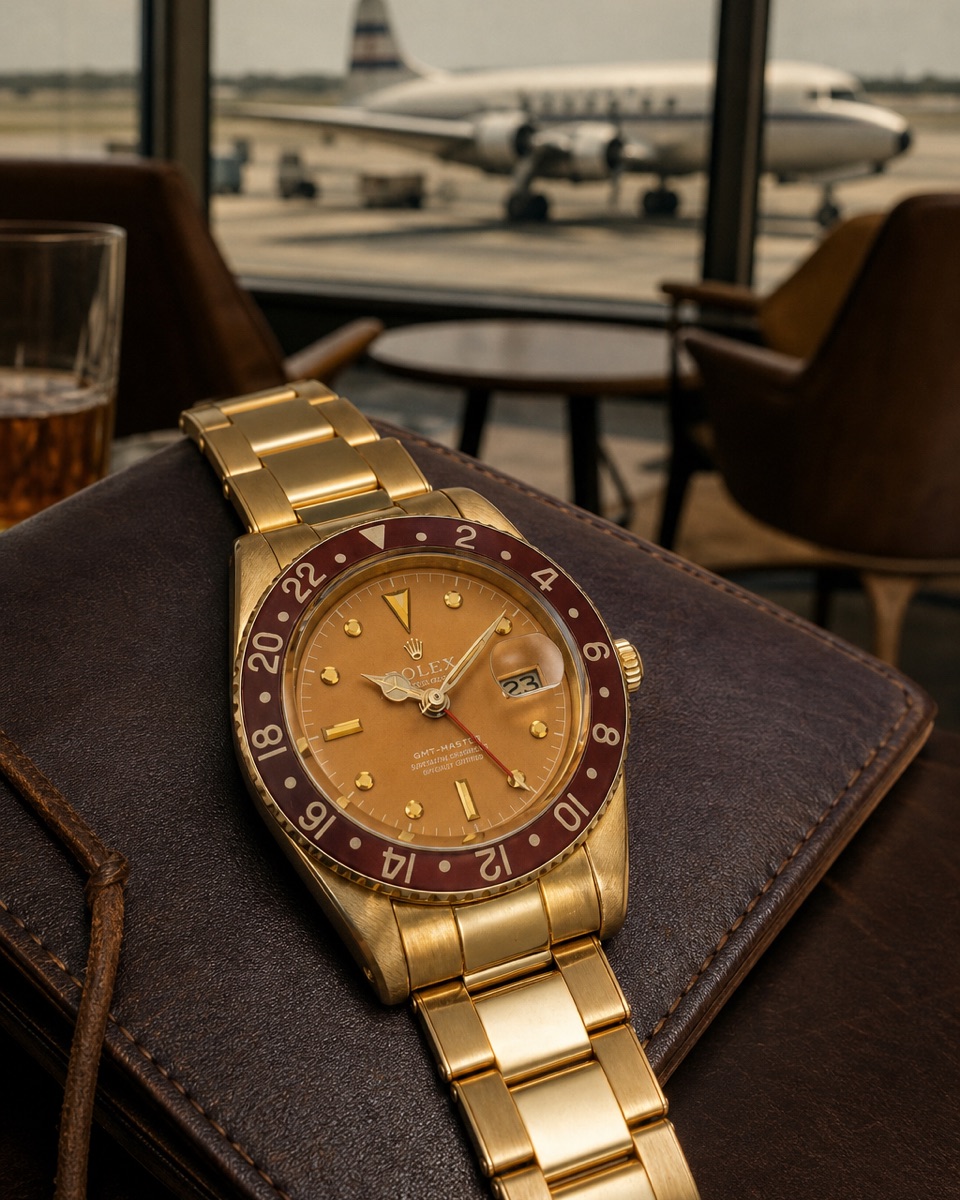
AI-generated illustration.
Dials
The dials are gilt, and Revolution explains the term: "The dials were manufactured using a galvanic process where the text is relief print" (Revolution). The lot photographs show the wording. Phillips' 1955 and 1959 steel watches read "Officially Certified Chronometer" under GMT-MASTER (Phillips, Phillips), and Monaco Legend's 1958 gold watch reads "Superlative Chronometer Officially Certified" (Monaco Legend). That's three dials, which is too few to call either one a rule.
The earliest dials print the model name in red. Monaco Legend sold a 1955 watch, case 113'013, with "the "GMT-MASTER" designation printed entirely in red", and says these are early variants "of which fewer than a handful are known" (Monaco Legend). Black gilt dials age unevenly. Sotheby's catalogued a 1956 watch, case 212425, with a "black 'tropical' dial" that has turned brown (Sotheby's), and Wind Vintage says the dials are "often known for cracking and crazing".
Many dials didn't survive at all. Analog:Shift sold a 6542 on which "the original Radium dial was switched out in favor of a tritium version" (Analog:Shift), and a Christie's condition report says of another, "The dial appears to be relumed" (Christie's).
Hands
The 24-hour hand is red, thin, and tipped with a small arrow. "The red 24-hour hands on these early watches featured small arrows at the tip," says Revolution, and Phillips calls it "The "small arrow" ("freccino", in Italian) 24-hour hand" (Phillips). Steel watches have Mercedes hour hands, and gold ones the Alpha hands Sotheby's describes. Hands were replaced at service like everything else. The same Christie's report says "The GMT hand is a later replacement."
Bezels
Most 6542s no longer wear the insert they left the factory with. Revolution says "It was commonplace to replace these delicate bezels" with aluminium inserts at service (Revolution). Phillips goes further, saying "many, if not most, of the watches born with bakelite bezels were upgraded during service to a metal bezel" (Phillips). Sotheby's calls an aluminium insert on a 6542 "not uncommon". Antiquorum and Bonhams date a change to metal to about 1956, but every lot I read that calls its insert original is Bakelite. So I'd treat an aluminium insert on a 6542 as a service part, and price it as one, unless the seller can prove otherwise.
Then there's the recall, which is the most repeated story about this watch. Sotheby's says "these watches were subject to a recall in the US" and that "The Atomic Energy Commission stated that the levels of radiation from this watch were too high" (Sotheby's). Its Captain Warren essay places it "in the late 1950's due to the radium used in the bezel". Bonhams says "Rolex recalled the watches and eventually replaced the bezel inserts with aluminum after two years from the initial releases" (Bonhams). Phillips describes the insert on its 1959 lot as "a tritium bezel - so a 1960s service, most likely replaced during the famous 6542 recall campaign" (Phillips). The count comes from Sotheby's, which writes "Of the 605 pieces imported to the US, few exist in noteworthy condition" (Sotheby's), and BeckerTime turns that into "a recall of every one of the 605 original GMTs that had been imported into North America" (BeckerTime).
I believe something like this happened, because four auction houses describe it. The details don't hold together, though. The dates run from 1956 (Bonhams' "two years", and Antiquorum's insert that "was the first item to be changed in 1956") to the late 1950s (Sotheby's) to the early 1960s (Phillips). Christie's says radium concerns meant "Rolex stopped production of bakelite bezels very quickly" (Christie's), but Monaco Legend's 1958 gold watch still has "its original bakelite bezel", and the gold lots from 1959 have Bakelite too. Nobody shows the Atomic Energy Commission document, a Rolex service bulletin, or where 605 comes from. My read is that Rolex did replace radium Bakelite inserts, in the US at least, and that the specifics are auction-catalogue lore until someone publishes the paper.
For a collector, that leaves three kinds of bezel on a 6542: an original radium Bakelite insert, a later Rolex insert (aluminium, or by Phillips' account a tritium Bakelite), and a reproduction. Christie's put a Geiger counter on one, and found the bezel "appears to be correct, but was stripped of its radium at one point and does not register on the Geiger". Collectors also claim that original inserts still glow and reproductions mostly don't. I found that only in a forum post, so I'd treat it as a lead and not a test.
Bracelets
The bracelets on the lots I read are riveted Oysters, and the end links date them. Phillips' 1955 watch, case 112'196, has "end links stamped 58" and a clasp stamped "1.60" (Phillips), so its clasp is about five years younger than its case. Phillips' 1959 watch has a "riveted "Big Logo" bracelet stamped "65" to the endlinks", and Phillips says Big Logo bracelets "were made for only 3 years from 1958 to 1960" (Phillips). Phillips' gold lots carry 65s too. You'll find tables online that fit the 6542 with specific rivet bracelet references and other end-link numbers. None of the lots I read prints a bracelet reference, and the tables cite nothing, so I'd use the end links and the clasp date and leave the reference number alone.
Co-branded, commissioned and error dials
Serpico y Laino
The best-documented signed dials on the 6542 come from Serpico y Laino, the Caracas retailer, which put its name in gilt above GMT-MASTER. Phillips calls a steel one it sold "one of a handful of correct examples with the signature of the storied retailer on the dial", and notes that "the caseback retains the S&L engraving", a mark that polishing usually removes (Phillips). Antiquorum sold another in Monaco on 24 January 2021 for EUR 143,000, with a caseback "engraved "S&L Acero"" and stamped "III.1958" (Antiquorum). Sotheby's sold one in October 2008 for USD 107,500 (Sotheby's).
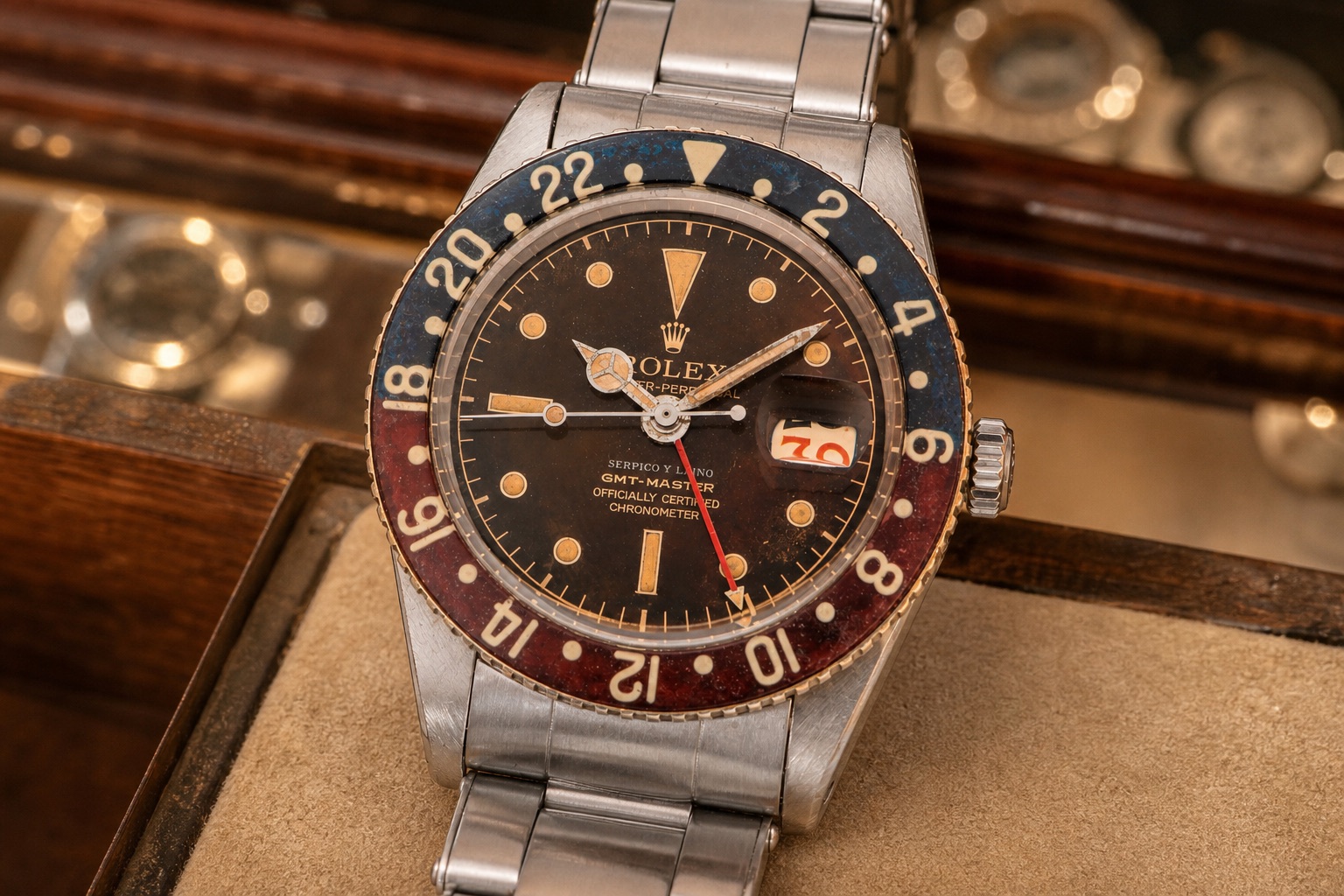
AI-generated illustration.
There's one in gold. Phillips offered a 1958 yellow gold 6542 with a honey-coloured dial signed Serpico y Laino in its Double Signed sale in November 2019, calling it "the only known and correct reference 6542 cased in yellow gold and retailed by Serpico y Laino" (Phillips). SJX says it had sold at Christie's in 2012 for CHF 207,000 (SJX). I couldn't find the 2019 result.
Tiffany & Co.
Monaco Legend sold a Tiffany-signed 6542 in Lugano on 4 June 2026 for CHF 662,500 (Monaco Legend). It's case 322'253, a 1030-calibre watch, and its dial is stranger than a co-signature. Monaco Legend describes it as reading "Chronometer" and "Automatic" with the Tiffany & Co. name, where you'd expect GMT-MASTER. Monaco Legend calls the layout "an exceptional and possibly unique configuration" and points to "the hand-engraved retailer inventory or commission number "3801"" behind a lug. That's the seller's case for the watch, and I found no second example to compare it with.
The "Albino"
The white-dial 6542 is the most contested of these. Monaco Legend sold one on 26 April 2025 for €187,500 (Monaco Legend), "Originally acquired by a Chilean Marine Infantry soldier", who the house says owned it for life. It wears a steel bezel, and the house says it has "reason to believe" that bezel "is the original one mounted by Rolex", on the strength of the provenance. Nobody I read gives a count, and Italian Watch Spotter says collectors still argue about whether a white-dial 6542 exists. I'd want a second example, or a Rolex extract, before I treated it as a factory variant.
I looked for Pan Am logo dials, other retailer signatures and named misprints on the 6542 and found none documented. As far as I can tell, the Pan Am connection lives in the adverts and the provenance.
Why it matters
The nickname comes from the cinema. Sotheby's says the 6542 "is commonly referred to as Pussy Galore after being worn by Honor Blackman's character in James Bond Goldfinger in 1964" (Sotheby's), and Phillips repeats it (Phillips). Neither shows a film still that identifies the reference, so I'd call the nickname well established and the on-screen identification unproven.
The prices show what collectors think of it. Phillips sold 6542s for CHF 138,600 in May 2022 (Phillips) and HK$945,000 in June 2021 (Phillips), and Sotheby's sold the Warren watch itself for CHF 177,800 in May 2023 (Sotheby's). The gold watches go higher. In May 2016 Phillips sold a 1958 gold 6542 for CHF 341,000, which Watch Collecting Lifestyle reported as a new world record "for any Rolex GMT Master ever sold at auction" (Phillips, Watch Collecting Lifestyle). In June 2026 Monaco Legend sold another 1958 gold watch, with its Bakelite "intact and free of the fractures so commonly encountered", for CHF 343,750, up from CHF 289,000 at Christie's in 2008 (Monaco Legend). Phillips also sold what it called a "possibly unique and previously unknown" left-handed steel 6542 for HK$2,125,000 in May 2018 (Phillips).
The money follows the bezel. The two gold watches are the highest results I found for a standard dial, and both houses sold them on their inserts: Phillips described an "unrestored, fully intact cognac brown-colored Bakelite bezel", and Monaco Legend its intact Bakelite. That makes sense to me, because the Bakelite is the part that makes a 6542 different from a 1675. It's also the part most likely to have been changed.
What I'd check before buying one
I'd like a 6542, and this is the list I'd work through.
- The bezel. An aluminium insert is a service part, so price it that way. A Bakelite insert needs checking for cracks, for the numerals painted on the underside, and, if the seller will allow it, for radium with a Geiger counter, as Christie's did. Reproductions exist.
- The dial. Radium dials were often swapped for tritium service dials or relumed. Look for gilt printing that matches the lot photographs of known examples, and lume on the dial that matches the hands.
- The 24-hour hand. It should be red with a small arrow, and it's often a replacement.
- The case number against the inside caseback stamp. They should agree, and the dial, bezel and bracelet should fit the same period.
- The case. Look for one that still has its shape. The Warren essay notes service centres "polishing many cases further and further away from their factory proportions".
- The bracelet. End links stamped 65 fit from about 1958, and a Big Logo clasp belongs to about 1958 to 1960. A clasp years younger than the case is common and should cost less.
- Signed or white dials. A Serpico y Laino dial is more convincing with the S&L caseback engraving behind it. A Tiffany or Albino dial needs provenance you can check.
- The radium. Sotheby's calls the red Bakelite "dangerously radioactive" and Wind Vintage agrees it's radioactive. Know what you're buying and wearing.
Sources
- Analog:Shift, Rolex GMT-Master 6542
- Antiquorum, Geneva, 14 Nov 2009, lot 260
- Antiquorum, Monaco, 24 Jan 2021, lot 300 (Serpico y Laino)
- Antiquorum, Forte dei Marmi, 24 Jun 2022, lot 165 (gold)
- Antiquorum, lot 102 (gold and steel 6542)
- BeckerTime, the GMT-Master 6542
- Bob's Watches, Rolex GMT-Master 6542
- Bonhams, Watches Online, 26 May 2024, lot 75
- Christie's Online, Rolex GMT-Master Bakelite bezel 6542
- Christie's Online Dubai, lot 73
- Italian Watch Spotter, vintage Rolex GMT-Master guide
- Monaco Legend, Exclusive Timepieces 36, lot 22 (Albino)
- Monaco Legend, Exclusive Timepieces 38, lot 226
- Monaco Legend, Exclusive Timepieces 41, lot 37 (gold)
- Monaco Legend, Exclusive Timepieces 41, lot 86 (Tiffany & Co.)
- Phillips, Geneva THREE, lot 190 (gold)
- Phillips, Geneva FIVE, lot 13 (gold)
- Phillips, Geneva XI, lot 67
- Phillips, Geneva XI, lot 179
- Phillips, Geneva XV, lot 118
- Phillips, Hong Kong SIX, lot 952 (left-handed)
- Phillips, Hong Kong XII, lot 966
- Phillips, Double Signed, lot 14 (gold, Serpico y Laino)
- Phillips, Watches: Decade One, Serpico y Laino
- Phillips, 6542 essay on the Turn-O-Graph
- Revolution, A brief history of the Rolex GMT-Master
- Revolution, Master Stroke: GMT-Master part 1
- SJX, Phillips Double Signed
- Sotheby's, Fine Watches 2022, "Pussy Galore" 6542
- Sotheby's, Important Watches 2023, Captain Warren 6542
- Sotheby's, Watches 2014, lot 83
- Sotheby's, The Rolex GMT-Master: the complete collector's guide
- Sotheby's, The Rolex Pepsi: rare examples from the archive
- Sotheby's, The six most expensive GMT-Master watches
- Watch Collecting Lifestyle, gold 6542 at Phillips THREE
- Wind Vintage, Rolex GMT-Master 6542