Rolex Oysterquartz Day-Date 19018
- Make
- Rolex
- Reference
- 19018
- Model
- Oysterquartz Day-Date
- Variants
- 19019, 19028, 19038, 19048, 19049, 19058, 19068, 19148, 19158, 19168
- Production
- 1977–2001
- Case diameter
- 36 mm
- Calibre
- 5055
- Case material
- 18k yellow gold
AI-generated illustration.
Rolex sold its first quartz watch in 1970, and the movement inside it wasn't Rolex's. The ref. 5100 "Quartz Date" ran on the Beta 21, a module from a Swiss consortium whose movement went into the watches of sixteen other companies as well. Rolex made 1,000 of them in solid gold, left the consortium in 1972, and spent the next five years building a quartz movement of its own. What came out in 1977 was a pair of calibres, the 5035 for the Datejust and the 5055 for the Day-Date, which many people consider, in Christie's words, "among the most exquisitely finished quartz calibres ever made".
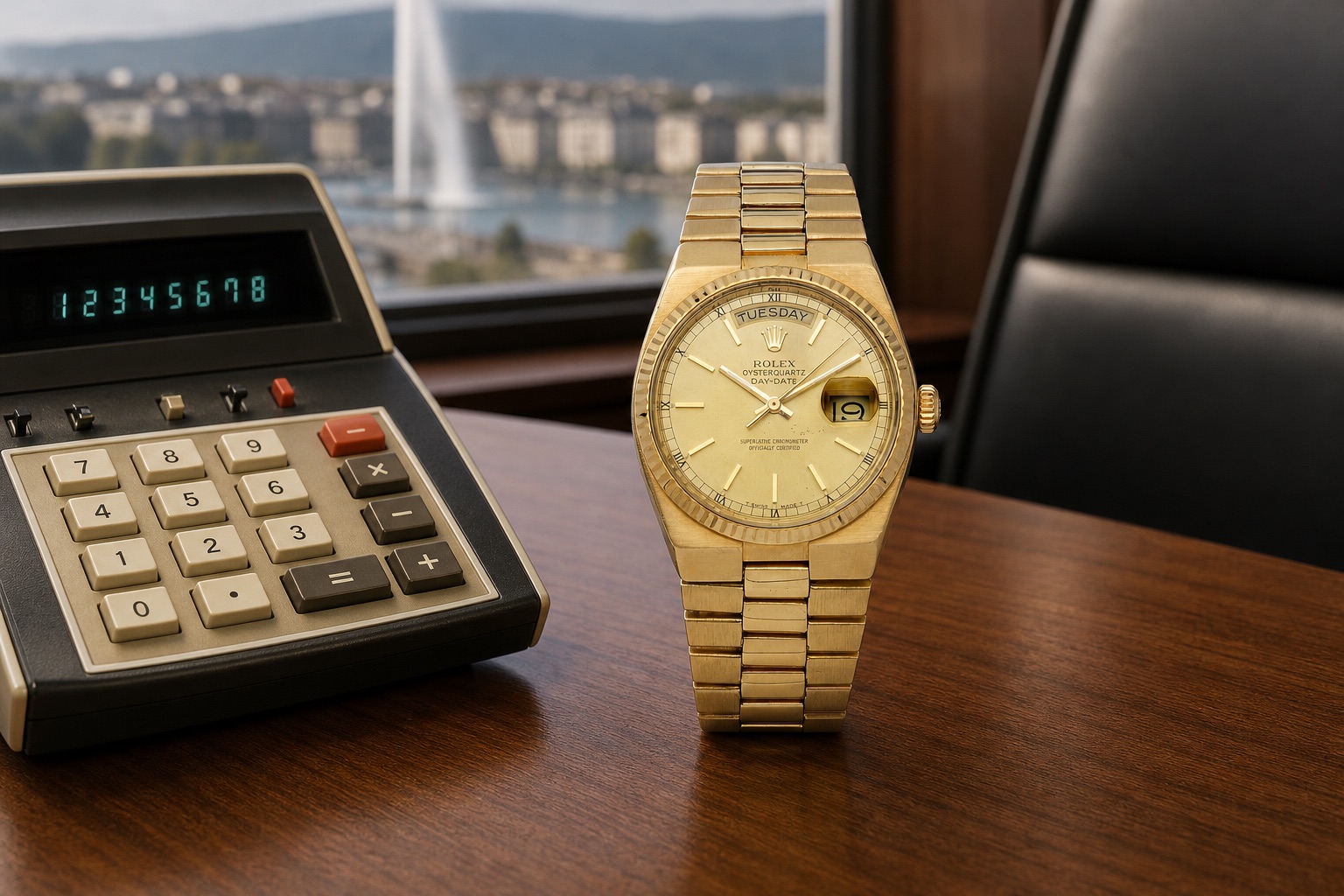
The Rolex Oysterquartz Day-Date 19018 is the plain yellow gold version of the 5055 watch: 36 mm, fluted bezel, flat sapphire crystal, a hard-edged case that runs straight into its bracelet, and a seconds hand that ticks. Rolex made it until 2001, sold the last ones in 2003, and hasn't made an Oysterquartz since.
For a company whose reputation rests on the mechanical watch, the Oysterquartz was a long and expensive detour, and Christie's reads its finish as proof of "Rolex's commitment to conventional watchmaking standards even in an electronic movement". I think it's one of the most interesting things Rolex has made, and it's on my list of watches I want to own.
Where it came from
Rolex got to quartz earlier than its reputation suggests. It began researching quartz timekeeping in the early 1950s and was granted its first patent in the field in 1952. In the late 1960s it joined a group of leading Swiss makers to create the Beta 21, a shared quartz movement that Patek Philippe, Audemars Piguet, Omega and IWC also put into their own cases.
Rolex's Beta 21 watch was the 5100. oysterquartz.net, the most thorough collector's site on these watches, dates its debut to 5 June 1970 and says all 1,000 serially numbered examples sold between 1970 and 1972. It had an integrated 18k gold case and bracelet and a synthetic sapphire crystal, a first for Rolex, and collectors call it the Texan for its heavy 40 mm gold case. Rolex sold it as a club. Its promotional material, as reproduced on oysterquartz.net, describes "a Golden Register, a Who's Who of our clients who proudly count a Rolex Quartz among their most precious possessions", which members were invited to sign on a visit to Geneva.
Rolex didn't stay. In 1972 it withdrew from the consortium and began work on a movement of its own. I haven't found Rolex's own reason. oysterquartz.net offers one, and is careful to call it a surmise: Rolex had to design the 5100 around a module it didn't control, so it couldn't use an Oyster case, the watch was listed as "water resistant" instead of "waterproof", and the movement inside was, for all intents and purposes, the one sixteen other companies were selling. For Rolex in 1972 that sounds like reason enough.
The new movement took five years. Christie's has it embodied in 1977 "after five years of research and design", and Sotheby's gives the same figure. The watches reached Rolex retailers in the fall of 1977.
The case came before the movement. Rolex finished the case and bracelet first, so in 1975 it put them on two automatic watches, the Oyster Perpetual Date 1530 and the Datejust 1630, as what Fratello calls a "trial run". Teddy Baldassarre's history puts that run at 1975 to 1977 and about 1,500 watches.
Nobody has documented who designed the case. Gérald Genta's name gets attached to it because it looks as if it belongs next to a Royal Oak, but Fratello's history found no evidence at all for the claim and quotes Genta himself in 2009: "Personally, I have only designed one Rolex, which still exists today and forms part of the Cellini collection." The story dealers tell instead is that Rolex's CEO, André Heiniger, was determined that the Oysterquartz not be mistaken for a mechanical watch, so it got its own hard-edged look. I can't trace that one to a Rolex source either, but it fits the watch better than the Genta story does.
Sources split on the launch year by one. Christie's, Sotheby's, Smith & Singer and oysterquartz.net say 1977. A Phillips Hong Kong essay says the Oysterquartz was "first released in 1976", and Antiquorum once catalogued a 19018 as "Made in 1976". I've gone with 1977, which is the majority view, and oysterquartz.net's autumn retail date is the most specific claim anyone makes. No source I read gives a launch venue or a launch price.
The watch
| Spec | Value |
|---|---|
| Reference | 19018 (inside caseback stamped 19000) |
| Case | 18k yellow gold, integrated with the bracelet, 36 mm diameter |
| Height | 13.5 mm (Antiquorum) |
| Bezel | Fluted, 18k yellow gold |
| Crystal | Flat sapphire, Cyclops lens over the date |
| Crown | Screw-down |
| Movement | Rolex cal. 5055, quartz, 11 jewels, adjusted to temperature |
| Oscillator | 32,768 Hz, thermocompensated |
| Functions | Hours, minutes, ticking centre seconds, day, date; quickset day and date; hacking seconds |
| Certification | COSC chronometer; dial reads "Superlative Chronometer Officially Certified" |
| Battery | UCAR 357 silver-oxide, 1.55 V |
| Water resistance | 50 m on early watches, 100 m later, per Fratello; no Rolex figure found |
| Bracelet | Integral 18k yellow gold President bracelet with hidden clasp |
| Made | 1977 to 2001 |
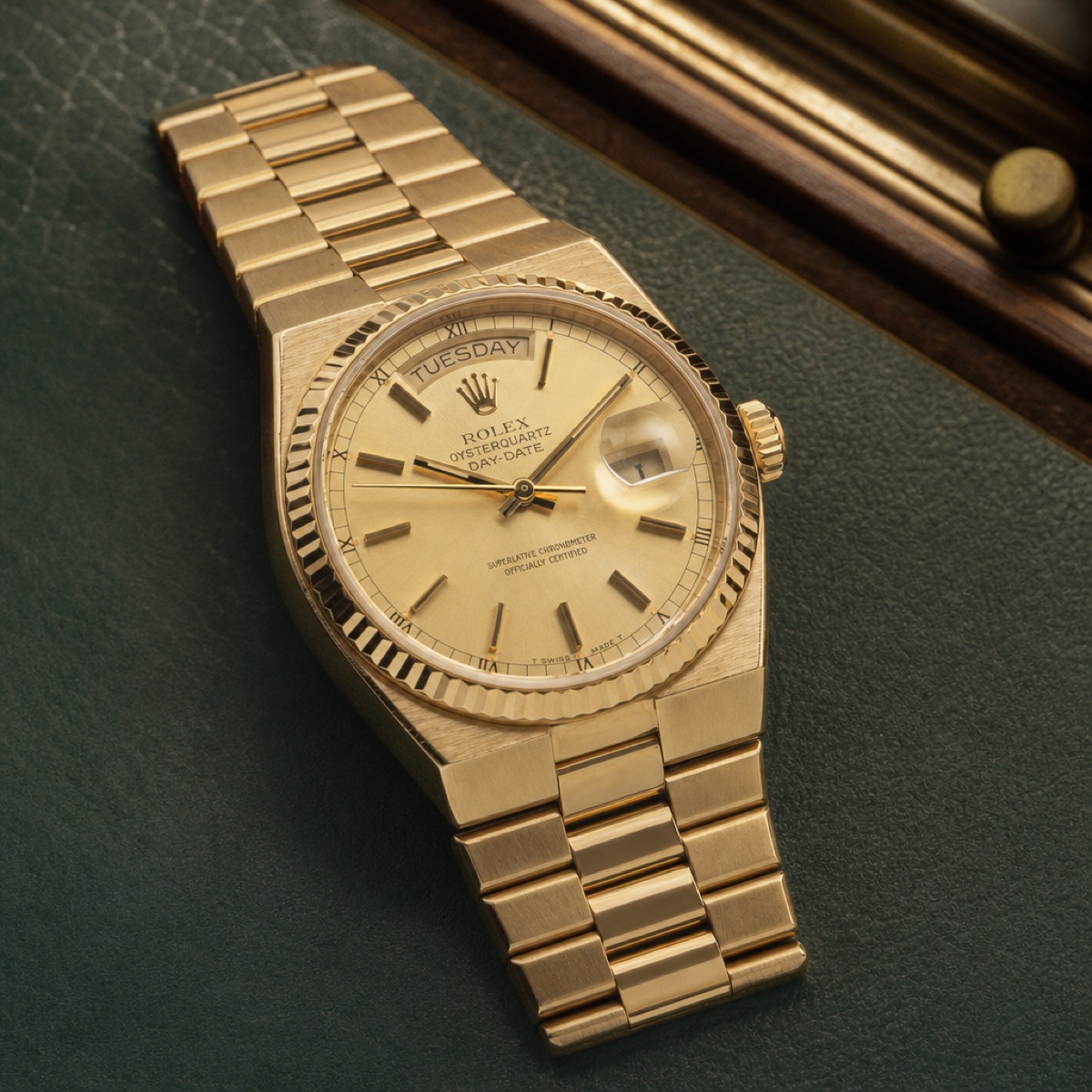
The case is the thing you notice. Phillips describes it in four items: "an angular case, an integrated bracelet, a flat sapphire crystal and most importantly, ticking seconds". The bracelet's outer rows are brushed and its centre row polished, with two rows of brushed links on the sides and one row of polished links in the middle, and the clasp hides under the links. Because the bracelet is fixed to the case, the reference number moved: Christie's notes that it's engraved on the case "under one of the lugs". Inside the caseback there's a different number, 19000, which turns up on 19019, 19028 and 19058 cases as well as the 19018. Bonhams catalogued Michael Caine's watch as Ref. 19018/19000. No source I read explains the stamp. My read is that it marks the case family shared by every gold Oysterquartz Day-Date.
AI-generated illustration.
The movement is where the five years went. oysterquartz.net, which reproduces the specification for both calibres, gives the 5055 a 32,768 Hz quartz module, four times the frequency of the Beta 21's oscillator, with a thermistor that reads the ambient temperature so the electronics can correct the rate. It has 11 jewels, hacking seconds and a quickset day and date. On finish (anglage, perlage and Geneva stripes) the site says the 5035/5055 "still reigns supreme" among quartz movements. That's a collector's judgement, but Christie's essay about the "exquisitely finished" calibres says much the same.
Every 5055 went to the chronometer testing office. oysterquartz.net says all Mark I and II 5055 Day-Date movements were certified chronometers, and Antiquorum's lot titles carry the dial wording, "Superlative Chronometer Officially Certified". I found no accuracy figure from Rolex. oysterquartz.net puts a typical Oysterquartz at plus or minus 2 to 5 seconds a month, which is a collector's figure, not a specification.
How it changed
Outwardly, hardly at all. I found no documented change to the case, bezel or bracelet across the run, and the crystal is sapphire throughout. The one documented change is inside. About 18 months into production Rolex changed the quartz crystal to a tuning-fork shape, and oysterquartz.net says movements from before and after the change were known inside Rolex as Mark I and Mark II. On the Datejust the change sent the movement to the chronometer testing office for the first time and added the chronometer line to the dial, which Revolution dates to late 1978. The Day-Date was certified from the start, so its dial wording doesn't date it.
Case numbers do date it, roughly. These are the dated Day-Date cases I found in auction catalogues, with each house's own circa date. Read the years as approximate.
| Circa | Case number | Reference | Catalogue |
|---|---|---|---|
| 1977 | none found | Launch; cal. 5055 introduced | |
| 1979 | 6'158'815 | 19018, wood dial | Christie's |
| 1982 | 7'420'476 | 19158, gem-set | Christie's |
| 1983 | 8'036'297 | 19058, white gold | Christie's |
| 1984 | 8'480'105 | 19168 "Meccano" | Christie's |
| 1985 | 9'174'361 | 19028 | Christie's |
| 1986 | 9119700 | 19018 | Smith & Singer |
| 1986 | 9171'425 | 19028 | Christie's |
| 1987 | 9'440'962 | 19148 | Christie's |
| 1988 to 2001 | none found |
That last row is a gap in what I could find, not a gap in production. The catalogue dates I found stop in 1987, so the later years are undated, and I'd want a late guarantee before I trusted any 1990s date. The end, though, is well documented. In 2001 Rolex received 573 chronometer certificates for Oysterquartz movements, the last it received for any quartz movement. Hairspring sets that against the 762,174 movements Rolex made that year. Christie's says production continued until 2001, "with the final examples sold in 2003", and Phillips says the 5055 ended "around 2001". One Christie's essay says "discontinued in 2000", and it's the only one that does.
The variations that matter
The references
The 19018 has a family. oysterquartz.net reproduces Rolex's 2001 US price list, citing The Rolex Report, and it lists eight Day-Date references still in the catalogue that year:
| Reference | Case | Bezel | Bracelet | 2001 list price |
|---|---|---|---|---|
| 19018 | 18k yellow gold | Fluted | President | $16,500 |
| 19019 | 18k white gold | Fluted | President | $18,200 |
| 19028 | 18k yellow gold | Pyramid | Pyramid | $18,500 |
| 19038 | 18k yellow gold | Pyramid, 12 brilliants | Pyramid | $21,250 |
| 19048 | 18k yellow gold | 44 brilliants | President | $25,550 |
| 19049 | 18k white gold | 44 brilliants | President | $27,250 |
| 19068 | 18k yellow gold | 44 brilliants | Pyramid | $27,500 |
| 19148 | 18k yellow gold, 8 brilliants | 44 brilliants | Karat, 308 brilliants | $60,000 |
In both yellow and white pairs on the list, the last digit is 8 for yellow gold and 9 for white. The 19019 is the scarce one of the two plain references. John Goldberger, writing in a Phillips catalogue, calls white gold "much rarer than yellow gold" on an Oysterquartz, and that example, unpolished and with a white lacquer "Stella" dial, made HK$168,750.
The Pyramid pattern goes by several names. Phillips writes "Pyramide", Christie's calls the same 19028 bracelet both "Clous de Paris" and the Pyramid bracelet, and another Christie's essay calls the pattern "hobnail". They all mean the small faceted studs that run across the bezel and the centre links.
Other gem-set references don't appear on that list. Christie's has sold a white gold 19058 with a diamond-set dial (circa 1983, CHF 15,000), which breaks the 8-for-yellow pattern, though a dealer list has the 19058 in yellow gold. In the same sale Christie's sold a multi-coloured gem-set 19158 from about 1982 that made CHF 81,250. Then there's the 19168, which Christie's titles "Meccano". It has baguette-cut sapphires on the bezel and the bracelet's centre links, round diamonds on the end links and diamonds for hour markers. Nobody I read explains the nickname. Dealer lists add the 19078 and 19188, which I couldn't find at auction, so I've left them out of the table.
Dials
The standard 19018 dial is champagne. Caine's watch has the version most people picture: a sunburst champagne dial with applied gilt baton markers, a black outer minute track with Roman numerals at the five-minute marks, the day at 12 and the date under a lens at 3. Antiquorum has sold a champagne dial with applied Roman numerals. Christie's has sold a 19028 with a black dial and another with a silver dial and an Italian day wheel.
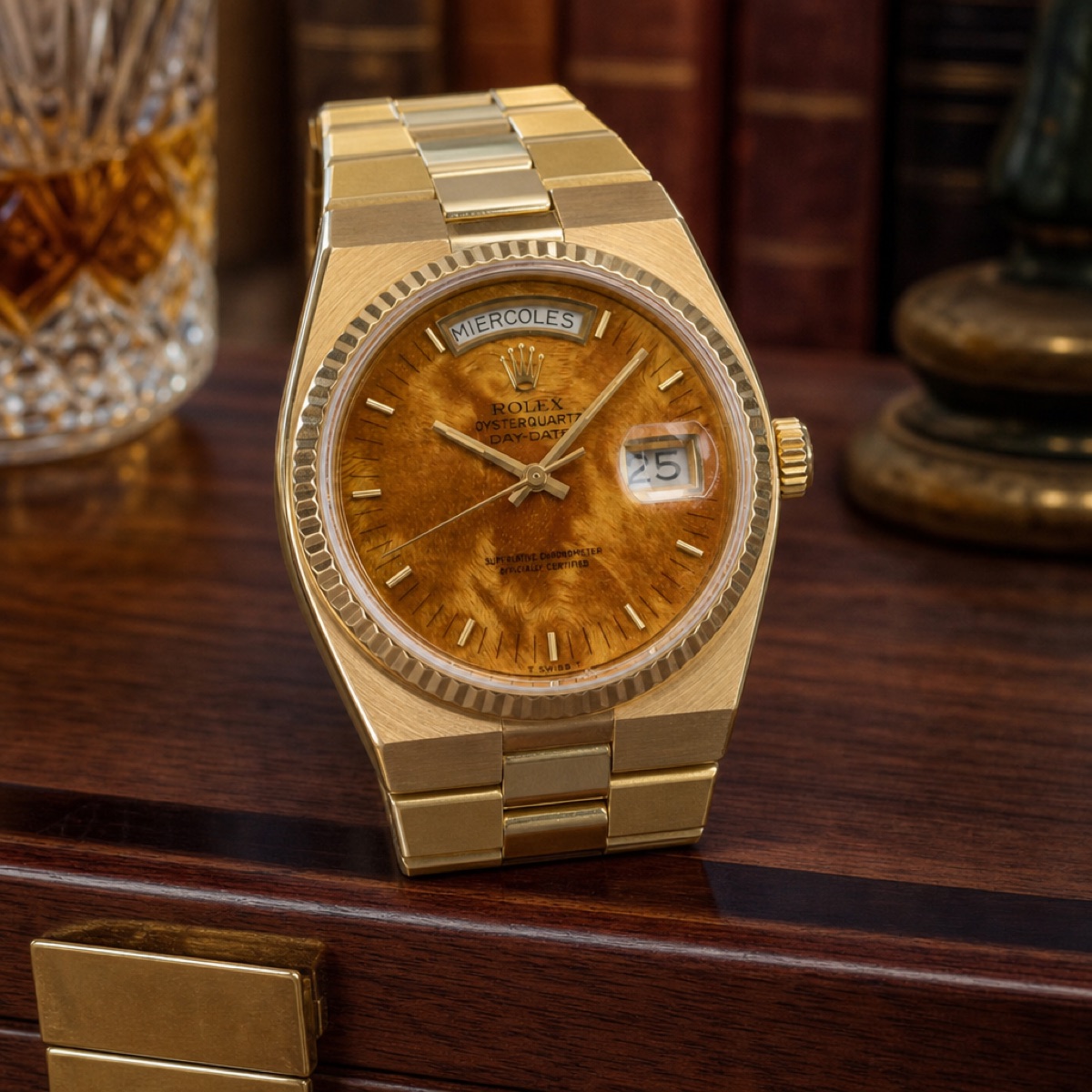
The stone and wood dials are the ones collectors chase. Sotheby's sold a 19018 with a tiger's eye dial in 2007 (it catalogued the model as "Oyster Quartz Day-Date", a reminder that even the auction houses don't agree on the spelling). Wood dials go back to the start of the run. Christie's has a 19018 from about 1979 whose dial is "crafted from birchwood", and Phillips sold one from about 1981 with a "Golden Walnut" dial set with 84 round diamonds for HK$254,000. Whether the wood is birch or walnut depends on which cataloguer you read. Neither says how they know.
AI-generated illustration.
Co-branded, commissioned and error dials
The Khanjar for Oman
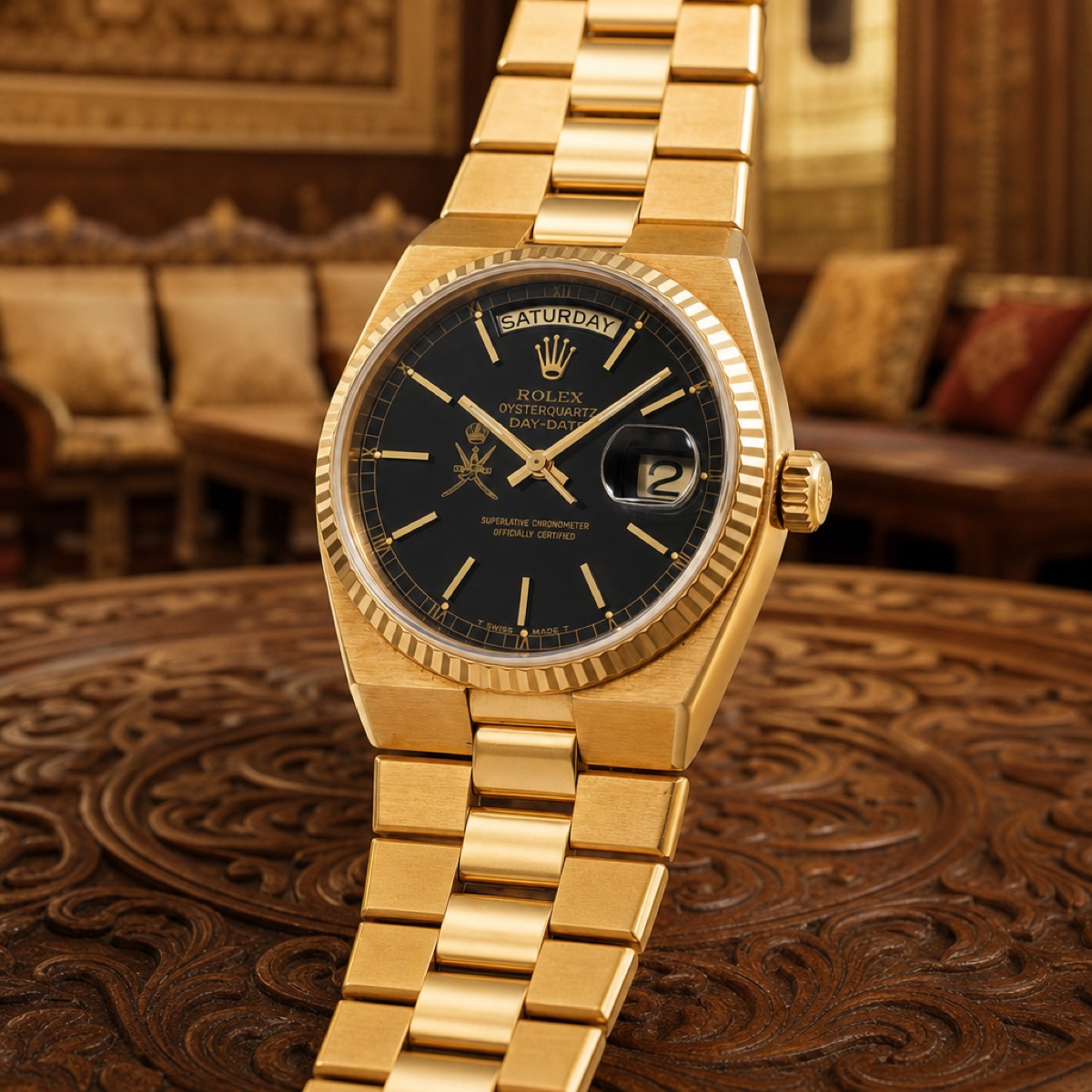
The best-documented special dial on a 19018 was made for Oman. Phillips sold one from about 1980 at The Geneva Watch Auction: XX, "made for the Sultanate of Oman", with a black dial carrying the Khanjar, Oman's dagger emblem, under a crown, and the same Khanjar engraved on the caseback in crimson. Phillips explains the crown: "It was only after 1976, following the end of the Dhofar rebellion, that the Sultan's watches displayed the crown emblem." The red caseback is what convinced Phillips the dial was born in that case. The watch sold for CHF 22,860.
Hairspring, a dealer that has offered one for sale, separates the two versions: the plain Khanjar was for the state of Oman, and the crowned one for the royal family. It adds that these dials spent a decade in the 1990s worth less than standard dials, and that many were destroyed and swapped for normal dials at retailers. That's one dealer's account, but it would explain why so few survive. Nobody gives a number.
AI-generated illustration.
Retailers and errors
I found less here than I expected. One auction listing describes a wood-dial 19018 retailed by Tiffany & Co., but I couldn't open the lot page to confirm the dial signature, so I'm calling it unconfirmed. I found no Cartier, Asprey or other retailer-signed Day-Date Oysterquartz, no factory misprints that collectors have named, and no documented service dial.
Why it matters
The watch's best story belongs to Michael Caine. He had owned his 19018 since 1979, according to Bonhams, and wore it in numerous roles, most famously as Lawrence Jamieson in Dirty Rotten Scoundrels in 1988. When he sold it at Bonhams in London on 2 March 2022 against an estimate of £8,000 to £12,000, it made £125,250 including premium, a hammer price of £100,000. Bonhams called it a new auction world record for the model. The dial is the plain sunburst champagne one, which shows how much of that price was Caine's.
The ordinary watches tell you more about the market. Each result here includes the buyer's premium.
| Sale | Lot | Watch | Result |
|---|---|---|---|
| Bonhams, London, 2 Mar 2022 | 111 | 19018, circa 1979, Michael Caine's | £125,250 |
| Phillips, Glamorous Day-Date, Geneva, 9 May 2015 | 14 | 19168 "Meccano", circa 1984 | CHF 93,750 |
| Christie's, Geneva, 20 Jul 2020 | 46 | 19158, gem-set, circa 1982 | CHF 81,250 |
| Christie's, Rare Watches, Geneva, 11 May 2026 | 28 | 19148, circa 1987 | CHF 30,480 |
| Phillips, The Geneva Watch Auction: XX | 148 | 19018 Khanjar, circa 1980 | CHF 22,860 |
| Christie's, Geneva, 10 Nov 2014 | 485 | 19028, circa 1985 | CHF 20,000 |
| Christie's, Geneva, 20 Jul 2020 | 44 | 19058, circa 1983 | CHF 15,000 |
| Phillips, The Geneva Watch Auction: XVIII | 127 | 19018, circa 1980, with guarantee | CHF 13,970 |
| Phillips, The Hong Kong Watch Auction: XVI | 1039 | 19018, Golden Walnut dial, circa 1981 | HK$254,000 |
| Smith & Singer, Sydney, 16 Sep 2020 | 139 | 19018, circa 1986 | AUD 12,500 |
Against Rolex's own prices, a plain 19018 has held its money and not much more. The 2001 list price was $16,500, and a 2002 Rolex catalogue that Fratello's Robert-Jan Broer has in front of him lists it at €14,630. In January 2022 he put a yellow gold Oysterquartz Day-Date's market value at €13,000 to €20,000, which is less than a mechanical Day-Date of the same years.
That gap is the case against the watch, and it's a fair one. It's a solid gold Day-Date with a battery, and a ticking seconds hand gives that away from across the room. It also depends on a movement Rolex stopped making a quarter of a century ago. Nobody outside Rolex knows how many were made. Phillips and Antiquorum both repeat an estimate of about 25,000, and oysterquartz.net says fewer than 25,000 Oysterquartz watches of all kinds, so it isn't even clear whether the figure covers the Day-Date or the whole line. My view is that the rest of the story outweighs those objections: the in-house movement, the five years it took and a case designed so the watch couldn't be mistaken for anything else. Rolex answered quartz once, in its own way, and the 19018 is the plainest version of that answer.
What I'd check before buying one
- The edges: Phillips warns that this model "responds particularly badly to overpolishing". The case is all flat planes and sharp bevels, so a polished one looks soft and can't be put back.
- The numbers: The reference should be under a lug and 19000 inside the caseback. A Datejust Oysterquartz case is stamped 2000 inside, so a 2000 stamp in a supposed Day-Date is a warning sign.
- The dial: Wood, stone and Khanjar dials command premiums, and Hairspring's account of Khanjar dials swapped out at retailers shows that dials do move between cases. Ask for papers, or for a caseback that agrees with the dial, as the red Khanjar does.
- The bracelet: It's integral to the watch, so a 19018 on a different style of bracelet has lost its original.
- The battery and the service: The 5055 has no end-of-life warning. Per oysterquartz.net, erratic timekeeping is the usual sign, and a battery lasts two to three years on average. Fratello wrote in 2022 that watchmakers still accept these watches for service, and also that it worries about the day a Rolex service centre says it can't. I found no statement from Rolex about parts.
- The ladies' model: There isn't one. oysterquartz.net is blunt about it: "Rolex never made a lady's model of the Oysterquartz."
Sources
- Christie's, Geneva, 11 May 2026, lot 28, Oysterquartz Day-Date ref. 19148
- Christie's, Geneva, 10 Nov 2014, lot 485, Oysterquartz Day-Date ref. 19028
- Christie's, Geneva, 12 Nov 2018, lot 96, Oysterquartz Datejust ref. 17000
- Christie's, Geneva, 20 Jul 2020, lot 44, Day-Date ref. 19058
- Christie's, Watches Online: The Dubai Edit, Rolex "Meccano" ref. 19168
- Christie's, Watches Online: The Dubai Edit, Oysterquartz Day-Date "Pyramid" ref. 19028
- Christie's, Watches Online: The Dubai Edit, Oysterquartz Day-Date ref. 19018 with wood dial
- Bonhams, Sir Michael Caine: The Personal Collection, lot 111, and press release
- National Jeweler, Michael Caine's Rolex sells for $133K at auction
- Phillips, The Geneva Watch Auction: XX, lot 148, 19018 "Khanjar"
- Phillips, The Geneva Watch Auction: XVIII, lot 127, 19018
- Phillips, The Hong Kong Watch Auction: XVI, lot 1039, 19018 "Golden Walnut"
- Phillips, Rolex Milestones, lot 819, 19019
- Sotheby's, London, 2007, lot 144, 19018 with tiger's eye dial
- Sotheby's, Important Watches: Part I, lot 53, 19028
- Antiquorum, Hong Kong, 10 Jul 2005, lot 304; Geneva, 14 Nov 2004, lot 139; lot 284; Forte dei Marmi, lot 88
- Smith & Singer, Sydney, 16 Sep 2020, lot 139, 19018
- oysterquartz.net: The Quartz Date 5100, the 5035/5055 movement, FAQ, 2001 prices
- Fratello, Rolex Oysterquartz: the Crown's Nautilina (December 2021)
- Fratello, Rolex Oysterquartz Day-Date (January 2022)
- Hairspring, 19019 Rolex Oysterquartz Day-Date and Oman Khanjar dial 19018
- Revolution, Everything you need to know about the Rolex Oysterquartz
- Teddy Baldassarre, Rolex Oysterquartz