Seiko Solar Chronograph Diver's SSC015
- Make
- Seiko
- Reference
- SSC015
- Model
- Solar Chronograph Diver's
- Variants
- SSC017, SSC019, SSC021, SSC031
- Calibre
- V175
- Case material
- Stainless steel
- Water resistance
- 200 m (656 ft)
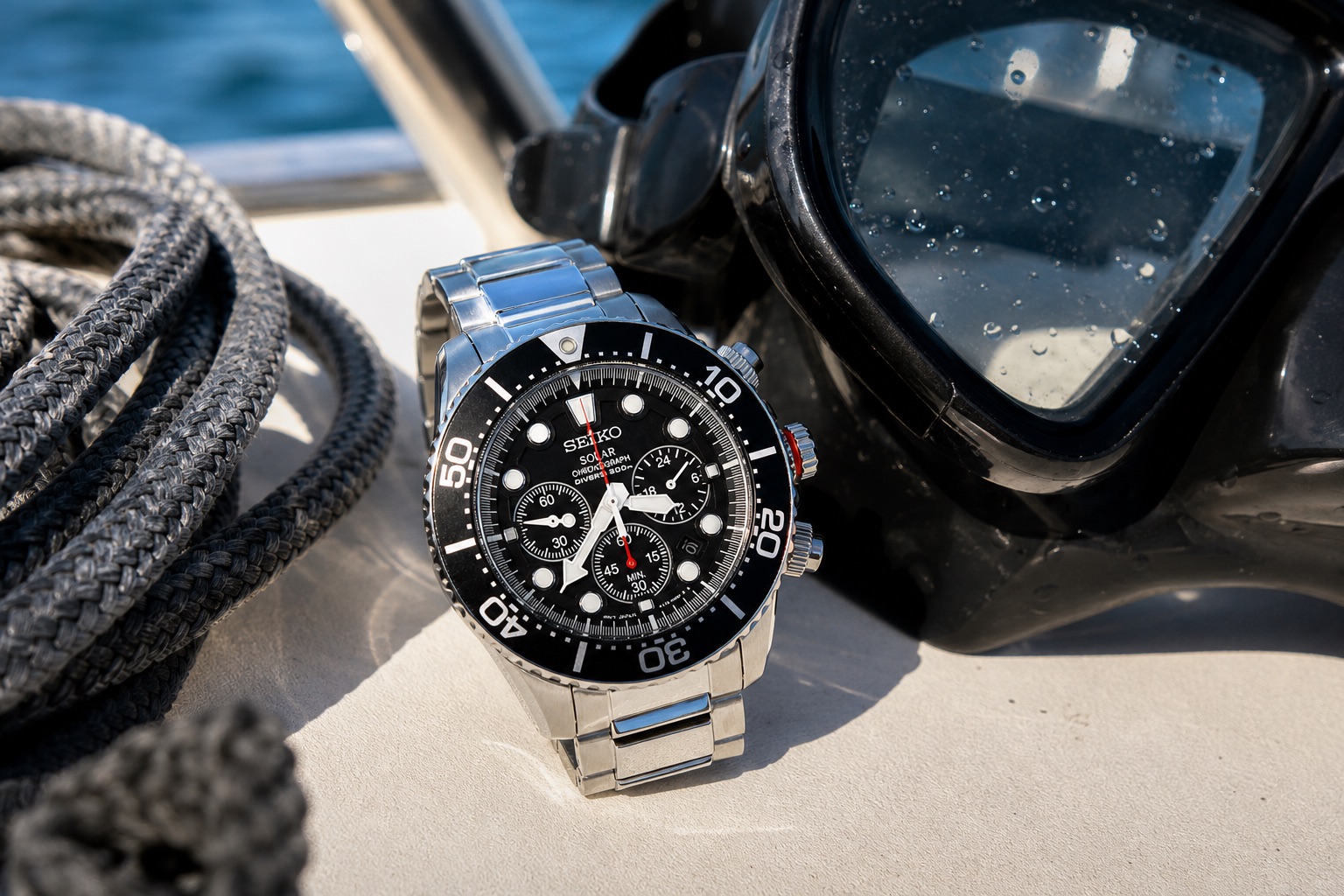
AI-generated illustration.
Seiko has a habit of building its history out of firsts and then putting them, years later, into watches that cost a few hundred dollars. Its own heritage page lists the pieces this one is made from. In 1965 came "Japan's first-ever diver's watch," rated to 150 metres and later worn on Japanese Antarctic expeditions (Seiko). In 1977, "Seiko introduced the solar powered watch." In 1983 it made what it calls "the world's first analog quartz watch with a chronograph," designed by Giorgetto Giugiaro. Seiko doesn't claim the solar watch as a world first, and it's right not to: Citizen's Crystron Solar Cell came out in September 1976 (Plus9Time).
The Seiko Solar Chronograph Diver's SSC015 puts all three in one steel case. It's a 200-metre diver with a solar-charged quartz chronograph, the calibre V175, and it reached shops in late 2011 or early 2012 alongside a handful of near-identical siblings. None of them was ever a headline watch. Seiko's own product pages for the SSC015, SSC017 and SSC019 are gone, and the most useful launch-era review is a collector's blog post from Singapore. But the case, the calibre and the dial kept going under new reference numbers for another decade, and that is the story here.
I don't own one. I want one, and the one on my list is a later relative, the SSC785 PADI, which I'll come back to. So this is written from Seiko's manual, Seiko's notices and the dealers and collectors who documented the family, and I'll say where they disagree.
Where it came from
Seiko's heritage page explains the solar part in one line: "From the moment that the quartz watch was born, Seiko strove to create technologies that did not require a battery change" (Seiko). After the 1977 solar watch, the same page lists a 1986 quartz watch powered by winding the crown, and Kinetic in 1988, which turned the wearer's movement into electricity. The chronograph line is just as long. In 1975 the digital calibre 0634 timed to a tenth of a second, and in 1983 the analog quartz chronograph timed to 5/100ths, with split times and a tachymeter.
Against that, the SSC015 looks like a step back, and on paper it is: its V175 times in fifths of a second. What it does that the 1983 watch didn't is run for months on light alone, on a 200-metre diver's case, at an entry price. That trade is the whole design.
The family's launch is less documented than you'd expect for a watch sold in this many countries. A European Seiko dealer whose data reads like a distributor feed files the SSC015P1 under "Year 2011 Fall / Winter," and gives the same season for the SSC017, SSC019, SSC021 and SSC031 (Masters in Time). The earliest dated review I found is Yeoman's hands-on with an SSC017P, posted on 15 January 2012, which gives the Singapore list price: "The list price is SGD585.30 inclusive of GST" (Yeoman's Seiko). A Japanese grey-market dealer calls it a 2012 new model and an overseas model, sold without a Japanese warranty card (Jackroad). I'd put the launch at autumn 2011, on sale by January 2012, and treat anything more precise as unconfirmed until a Seiko catalogue turns up.
The name is the next problem. Seiko's V175 instruction manual welcomes "the proud owner of a SEIKO Solar Diver's Watch Cal. V175" (Seiko manual). A 2013 notice from Seiko Japan calls the SSC015 and SSC017 the Seiko 200m Diver's Watch (セイコー 200mダイバーズウオッチ) (Seiko Japan). The first dials read SOLAR / CHRONOGRAPH / DIVER'S 200m under the Seiko logo, and trade copy at the time used "Solar Chronograph Diver's," which is the name I've used in the title. Dealer databases now file the family under Prospex Sea, and later dials carry the Prospex X. Whether Seiko sold it as a Prospex in 2011, I couldn't confirm.
No source I read names a designer, so I'm treating it as undocumented. Yeoman's review describes what the design borrowed. It has the 3-6-9 subdial layout, with the 24-hour hand at 3, chronograph minutes at 6 and running seconds at 9. The hour and minute hands are "used in the classic SKX007/009/011 models," Seiko's SKX divers, and the case has a tsunami logo on the back and a wetsuit extension in the clasp. Read plainly, it's an SKX-style diver with a solar chronograph inside.
Was the SSC015 the first watch on the V175? A reader on Yeoman's post thought so in 2013 ("if I'm not mistaken the SSC017P and its siblings were the first models to receive the new Seiko V175 movement"), but the commenter hedged it and nobody confirmed it. The dealer data does show the 2011 SSC numbers running in sequence across unrelated lines: SSC009 to SSC013 are V172 Prospex Sky models and SSC023 to SSC029 are V174 "Spirit Smart" models, with the V175 divers in between (Masters in Time). So the number is a catalogue slot. It doesn't tell you which line a watch belongs to.
The watch
| Spec | Value |
|---|---|
| Official name | "Solar Diver's Watch Cal. V175" (manual); "Seiko 200m Diver's Watch" (Seiko Japan, 2013) |
| Case | Stainless steel, screw-down case back; case code V175-0AD0 |
| Diameter | 43 mm at the bezel, 48 mm across the crown guard (measured on an SSC017); dealer data gives 43.5 mm |
| Thickness | 14 mm (Yeoman) or 14.5 mm (Masters in Time) |
| Lug width | 20 mm |
| Crystal | Hardlex (Seiko's hardened mineral glass) |
| Bezel | Unidirectional, 120 clicks of half a minute each |
| Crown and pushers | Screw-down crown; screw-lock pushers |
| Movement | Calibre V175, solar quartz chronograph, 32,768 Hz |
| Accuracy | ±15 seconds a month at 5 °C to 35 °C |
| Functions | Hours, minutes, small seconds, 24-hour hand, date; 60-minute chronograph in 1/5-second steps with split time |
| Power | Manganese titanium-lithium rechargeable cell; about 6 months from a full charge |
| Water resistance | 200 m diver's |
| Lume | LumiBrite |
| Bracelet | Seiko M0ES327J0, steel, push-button clasp with diver's extension |
Sources for the table: the movement, bezel, crown and power rows are from Seiko's V175 manual; the measured case dimensions are Yeoman's; the case code, 43.5 mm, 14.5 mm and bracelet number are from Masters in Time.
The V175 is why anyone looks twice at this watch. It runs three step motors off a rechargeable lithium cell that the dial charges, and Seiko's manual is specific about how much light it needs. A full charge takes about 110 hours under 3,000 lux, 30 hours on a cloudy day at 10,000 lux, or 5 hours in direct sun. A single day of running takes 150 minutes under office light, or two minutes in sun. Once full, it runs about six months in the dark, as long as you use the stopwatch for less than an hour a day. When the charge runs low, the small seconds hand starts jumping in two-second steps and the stopwatch refuses to start. That's the warning to put it in a window.
The chronograph is a proper one for a quartz watch. It times 60 minutes in fifths of a second, takes split times and stops itself at the hour. The case is less special. Hardlex at this price is normal; as one comment on Yeoman's review put it, "Seiko likes to use hardlex crystal for their entry level divers." The manual's bezel instructions have a nice detail. The bezel turns only counter-clockwise, half a minute per click, "so that the time measured is never shorter than the actual" dive time, and the manual warns that it may get slightly stiffer underwater, which it says is not a malfunction.
Sizes are the usual dealer mess. Yeoman put calipers on his SSC017 and got 43 mm across the bezel, 48 mm with the crown guard and 14 mm thick. Masters in Time lists 43.5 by 14.5 mm, and other dealers say 44 mm. Seiko only publishes figures for the later SSC779, which are 43.5 by 13.8 mm. That's a different case code, so I wouldn't paste it onto the SSC015.
How it changed
The SSC015 went through three looks without the movement changing. The first two kept the reference number; the third gave it a new one.
| Generation | When (approximate) | Reference | Case code | Dial text under SEIKO | 6 o'clock subdial |
|---|---|---|---|---|---|
| 1 | From autumn 2011 | SSC015 | V175-0AD0 | SOLAR / CHRONOGRAPH / DIVER'S 200m | MIN. |
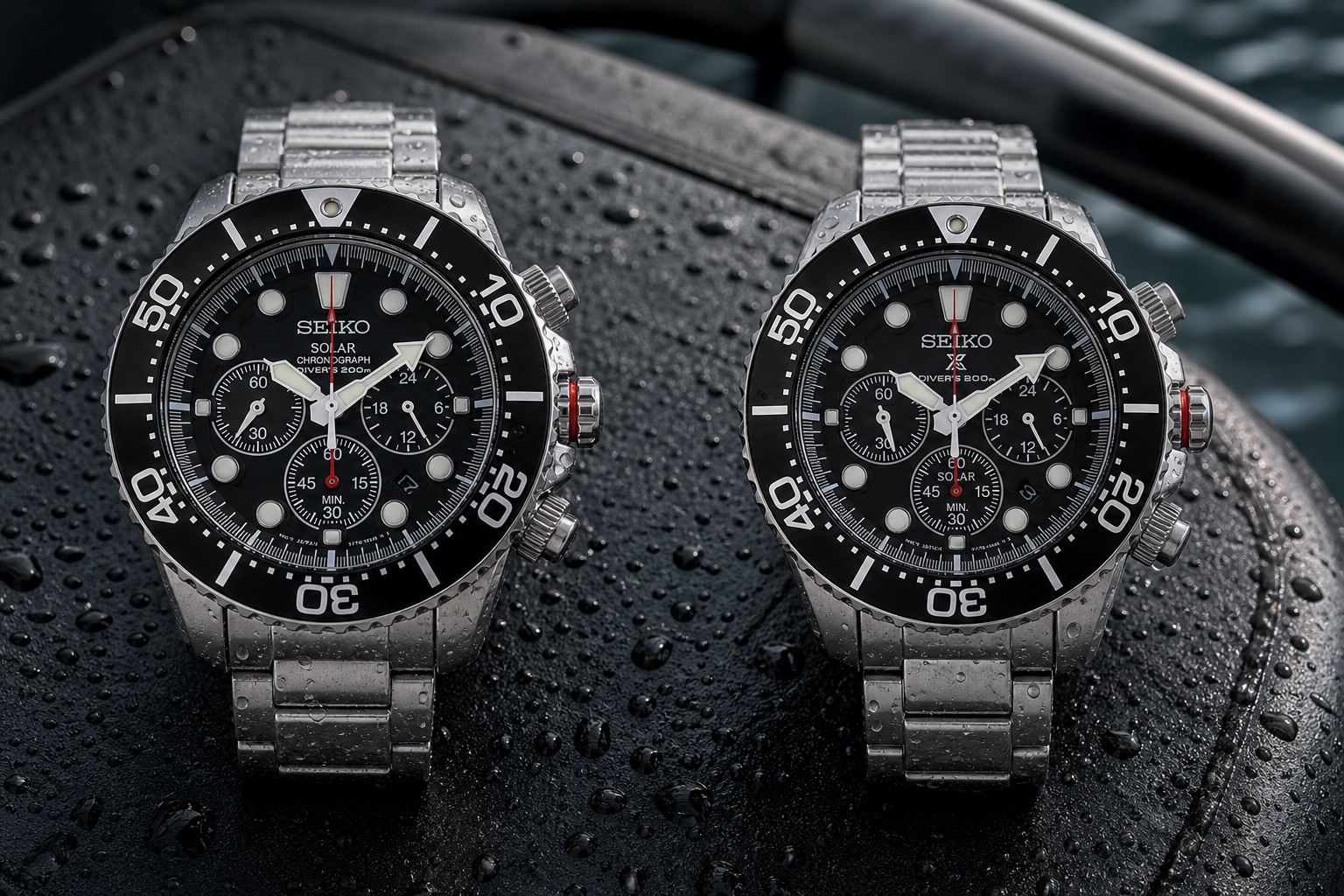
| 2 | Before mid-2018 | SSC015 | V175-0AD0 | Prospex X / DIVER'S 200m | SOLAR |
| 3 | Listed by December 2020 | SSC779 | V175-0EY0 | Prospex X / DIVER'S 200m | SOLAR |
The dates are loose. The first-generation dial is the one on Yeoman's 2012 review watch and on European resale posts from May and June 2012 (Relojes Especiales). The Prospex-logo dial shows up on the same reference numbers in dealer photos. A Singapore dealer sells it as a "New batch with PROSPEX logo on dial" (Skywatches). By July 2018 a reader on Watch Review Blog noticed that the review's own photos mixed the two (Watch Review Blog). Nobody I found dates the change itself.
The third step is the interesting one. Seiko's current catalogue has an SSC779, SSC781 and SSC783 with the same three colourways as the SSC015, SSC017 and SSC019. They have the same Prospex dial, the V175, 200 metres and 20 mm lugs, and they sit in Prospex Sea (Seiko SSC779, SSC781, SSC783). The Seiko Guy, a collector's case-code database, puts those four, plus the SSC785 PADI, on a new case code, V175-0EY0 (The Seiko Guy). Dealers list the old and new numbers as one product, as in "SSC017P1 / SSC781P1" (Watchspree). Seiko never says the SSC779 replaced the SSC015, and I haven't found what physically changed between the two case codes. My read is that the SSC779 is the SSC015 under a new number, and that you can't tell them apart from the dial.
AI-generated illustration.
The case itself had a wider second life. The Seiko Guy lists 19 references on the original V175-0AD0 case. They include the 2017 Prospex SSC613, SSC615, SSC617 and SSC618, the SSC663 PADI, the SSC673 and SSC675, the SSC701, and the Japanese-market SBDL047 to SBDL057 (The Seiko Guy). I'd call those the SSC015's case-mates. Seiko gave them their own dials and colourways.
One more change came from Seiko. In September 2013, Seiko Japan posted a notice to buyers of the SSC015PC and SSC017PC, the cases engraved V175-0AD0 or V175-0CF0. It said the part joining the band to the case was faulty. In normal use there was no problem, Seiko wrote, but under excessive force the part could deform. Owners were asked to contact Seiko's customer service or the shop that sold the watch (Seiko Japan). The notice gives no count and no production window. I can't tell from it whether watches sold outside Japan were covered, or what the second case code, 0CF0, refers to.
The variations that matter
Dials and colourways
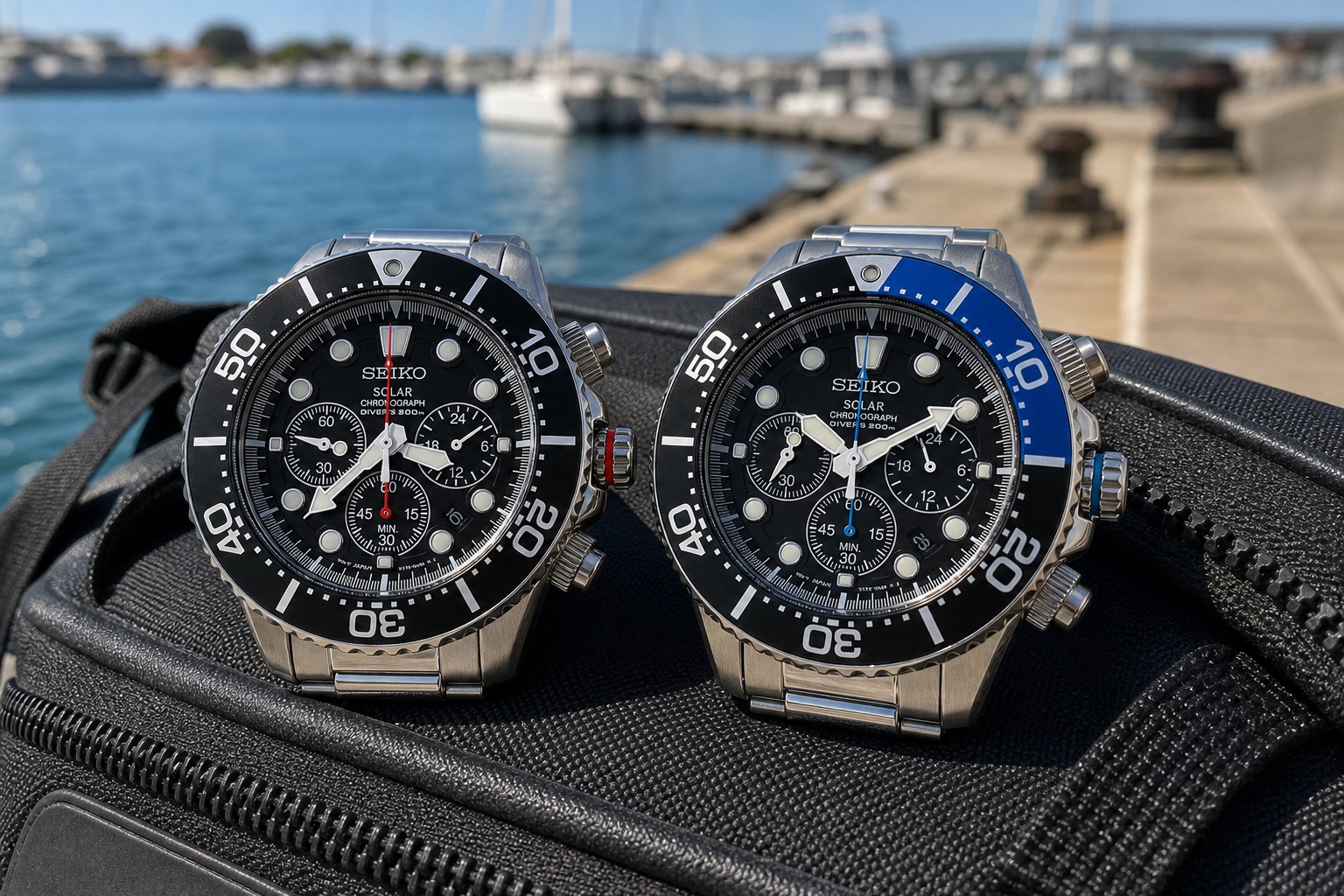
The family is one watch in a handful of colours, and each reference has a different accent colour. That colour is on the chronograph seconds hand, the ring on the crown and the bezel's first quarter. Learn the accents and you can name the reference from across a room.
| Reference | Dial | Bezel | Accent | Band |
|---|---|---|---|---|
| SSC015 | Black | All black | Red | Steel bracelet (P1); a strap version (P2) also exists |
| SSC017 | Black | Black, blue first quarter | Blue | Steel bracelet |
| SSC019 | Blue | Blue and red | Red | Steel bracelet |
| SSC021 | Black | All black | Yellow | Black rubber strap |
| SSC031 | Blue | Blue and red | Red | Black silicone strap |
The SSC015, SSC017, SSC019, SSC021 and SSC031 descriptions are Long Island Watch's, a specialist Seiko dealer (SSC015, SSC017, SSC019, SSC021, SSC031). Masters in Time confirms the five launched together in 2011 and gives the SSC015, SSC017 and SSC021 hand colours as red, blue and yellow. The P2 strap version of the SSC015 shows up in a 2012 Spanish resale post (Relojes Especiales). Retailers also list an SSC237 and SSC239 with green accents on the same case, but I only found them in shop listings, so I've left them out of the table.
The SSC015 is the plain one. Its black bezel has no colour in it, and the red is limited to a sliver on the crown, a tip on the chronograph hand and the 12 o'clock marker. I think that makes it the most wearable of the five, and the SSC017 the most distinctive. Owners call the SSC019's blue and red bezel the "Pepsi" (Yeoman's Seiko), borrowing the name from Rolex.
AI-generated illustration.
Bracelets
The original bracelet is Seiko M0ES327J0 (Masters in Time). Yeoman describes solid links with a polished centre and brushed outer links, folded end links and a push-button clasp with a wetsuit extension. Yeoman himself was less kind about it: what he found wanting was "the cheap feeling of the factory stainless steel bracelet." The folded end links are the weak point at this price, and the aftermarket filled the gap. Strapcode sells solid-link 20 mm bracelets made to fit the SSC015 and its case-mates (Strapcode).
Co-branded, commissioned and error dials
The SSC015 and SSC017 have none that I could find. Every listing, review and parts database I read treats them as regular catalogue models. There's no retailer edition, no commissioned dial and no named misprint. The two dial printings in the table above are the only dial variation on these references.
The special editions in this family are on the case-mates. Time+Tide reviewed the SSC673, a limited, blacked-out version with a fully black case (Time+Tide). It also covered the SSC675 "Save The Ocean," with a blue wave-pattern dial and part of each sale going to ocean causes (Time+Tide). Neither review gives a production number. On the new 0EY0 case, Seiko's SSC785 has a black wave dial with a PADI logo in the 6 o'clock subdial, a blue-and-red bezel and a blue silicone strap (Seiko SSC785). That's the one on my list. Seiko's page says nothing about how the PADI partnership came about, so I won't either.
What I'd check before buying one
The rechargeable cell is the part that ages. Seiko's manual says its capacity "may gradually deteriorate" with long use, and that when it does, "it will be necessary to have the watch repaired." It also says not to swap the cell yourself, and warns that fitting an ordinary silver-oxide battery "can generate heat" (Seiko manual). Owners in review comments report watches that "no longer" charge, which is what you'd expect from cells now ten years old or more (Watch Review Blog). Before buying one used, I'd ask how long it runs off the bench, and leave it in sun for an afternoon to see if the seconds hand stops stepping.
- Chronograph hands off zero: the manual blames shocks or an internal IC reset. You fix it by setting the hands with the crown at the second click, so it's a reason to check, not a reason to walk away.
- Crown and pushers: all of them screw down. Yeoman's commenters mention pusher collars that wouldn't lock and a crown that wobbles slightly when unscrewed.
- The dial text. Check it matches what the seller claims. The first-generation dial is the one I'd pay a little more for.
- The caseback reference, which tells an SSC015 from an SSC779. The dial won't.
- The bracelet and its fittings, given Seiko's 2013 notice on the band connector.
I found no fakes documented for this family. Seiko issued a general warning in 2025 about counterfeit and modified watches sold through online and auction sites, without naming models (Seiko). At the SSC015's price, a franken-watch of mixed parts is a more likely problem than a fake. The Seiko Guy's parts list for the case runs to crowns, crystals, gaskets and bracelets, so parts are clearly out there (The Seiko Guy).
I'd also be honest about what this watch is. It's a quartz diver with a mineral crystal and a folded-link bracelet, and Seiko itself no longer lists the reference. What it has that its SKX cousins don't is a chronograph and a movement that runs for months off a window. If that's what you want from a beater, it's a good one. If you want a watch with a story, the SSC015's story is thin, and most of it is about the watches that came after it.
Sources
- Seiko, Our Heritage
- Seiko, Cal. V175 instructions (PDF)
- Seiko Japan, notice to buyers of the 200m Diver's Watch SSC015PC and SSC017PC, 25 September 2013
- Seiko Singapore, SSC779, SSC781, SSC783, SSC785
- Seiko Singapore, notice on counterfeit and modified watches, 6 October 2025
- Yeoman's Seiko, "Seiko Solar Chronograph Diver – SSC017P", 15 January 2012
- Plus9Time, "World's First Analog Solar Watch – Citizen Crystron Solar Cell"
- Masters in Time, SSC015P1 and SSC017P1
- The Seiko Guy, case V175-0AD0 and case V175-0EY0
- Long Island Watch: SSC015, SSC017, SSC019, SSC021, SSC031
- Watch Review Blog, "Seiko SSC017 Prospex Solar Watch Review"
- Time+Tide, Seiko Prospex SSC673P hands-on and SSC675P "Save The Ocean" hands-on
- Jackroad, SSC015P1
- Skywatches, SSC017P1
- Watchspree, SSC017P1 / SSC781P1
- Relojes Especiales, SSC015P2 sale thread, May 2012
- Strapcode, SSC015P1 bracelet gallery