Swatch
AI-generated illustration.
On 27 March 1980, Ernst Thomke, the head of the movement maker ETA in Grenchen, called a young engineer named Elmar Mock into his office. Mock wanted an injection-moulding machine that cost half a million francs, and he and his colleague Jacques Müller had been working on something nobody had asked them to build. What they showed Thomke was a sketch of a very simple plastic watch, coloured in pink and blue. As Mock tells it, Thomke's answer was "I've been waiting for this for over a year!" (Le Temps, Europa Star). Three years later the watch went on sale in Zurich as the Swatch.
The sketch held two inventions. One was a way to build a watch: the plastic case is also the movement's base plate, the crystal is welded on, the parts count drops to 51, and machines assemble the whole thing and seal it for good. The other was a way to sell a watch, as a cheap fashion accessory with a new look every season, so that people would own several. The usual telling adds a third, that the Swatch saved the Swiss watch industry; Swiss television marked its thirtieth birthday by calling it the industry's rescuer (SRF). I think that's about half right, and the half that's wrong is the more interesting story.
It's also where watches started for me. My first watch was a Swatch, a neon blue, purple and green one. I've been looking for it on eBay for years, and I'm sure I'd know it if I saw it.
Timeline
These are the dates the sources agree on, or Swatch Group's own where it's the only source. Where sources split, the era sections say so.
| Year | Event |
|---|---|
| 1979 | Ebauches SA unveils the 1.98 mm Delirium, 12 January |
| 1980 | Mock and Müller's sketch of a plastic quartz watch, 27 March |
| 1982 | ETA registers the name "Swatch" (July); a test sale in Texas fails (November) |
| 1983 | ASUAG and SSIH merge; Swatch launches in Zurich on 1 March with 12 models |
| 1985 | Hayek's investor group buys 51% of the merged group; Swatch Ltd set up in Biel; the 10 millionth Swatch; first Art Special, by Kiki Picasso |
| 1986 | Keith Haring's Swatches |
| 1990 | Swatch Collectors Club starts in Europe and the US |
| 1991 | Swatch Automatic, the first self-winding Swatch |
| 1992 | The 100 millionth Swatch, 7 April |
| 1994 | SMH and Mercedes-Benz announce the Smart car venture, 4 March |
| 1995 | Irony, the first metal Swatches |
| 1996 | Swatch is Official Timekeeper of the Atlanta Olympics |
| 1998 | SMH becomes The Swatch Group (24 June); Swatch sells its Smart stake; Internet Time (23 October) |
| 2004 | Paparazzi, with Microsoft's MSN Direct |
| 2010 | Nicolas G. Hayek dies, 28 June |
| 2013 | Sistem51, a 51-part automatic |
| 2022 | Omega x Swatch MoonSwatch, 26 March |
| 2023 | Blancpain x Swatch Scuba Fifty Fathoms, September |
| 2026 | Audemars Piguet x Swatch Royal Pop, 16 May |
A supplier's side project, 1979–1983
The Swiss watch industry the Swatch was born into was losing badly. Swiss watch employment fell from 89,000 in 1970 to 33,000 in 1985, and over 1981–1985 Japan's watch production was worth more on average than Switzerland's watch exports, according to the business historian Pierre-Yves Donzé (Donzé). The two big Swiss groups were in the worst shape. SSIH, the owner of Omega and Tissot, went from 12.4 million watches in 1974 to 1.9 million in 1982. ASUAG, set up in 1931 to control the making of movements and parts for nearly the whole industry, owned the movement makers, ETA and its parent Ebauches SA among them. Between 1981 and 1983 the banks put more than CHF 900 million into the two groups (Donzé, HLS).
ETA had already built one radical watch. On 12 January 1979 its parent, Ebauches SA, unveiled the Delirium for Concord, Eterna, IWC and Longines: 1.98 mm thick, the thinnest watch made to that point, with the movement and case designed as one unit. Thomke had taken charge of the project and driven it into production (Grail Watch). When Europa Star first described the Swatch in detail in late 1982, it noted how much its integrated movement resembled the Delirium's (Europa Star).
Mock had trained as a watchmaker and then studied plastics technology, which is why he wanted the moulding machine (House of Switzerland). In his own account, he and Müller were working without a mandate, and neither knew that Thomke wanted a cheap watch that could conquer the world. Once the three had found each other, the project ran fast. The first prototypes appeared in mid-1981 with their hands turning backwards, the result of a design error (Le Temps). Mock and Müller are named on three Swiss patents filed in 1981 and 1982 (Watchonista). The American version of the last of them describes joining a plastic crystal to a plastic case "with the joint being sealed and permanent" (Google Patents). By Mock's account the weld cost an eighth as much as fitting the crystal another way, and it meant nobody would ever open the watch to repair it. His book puts the final production cost at 5 francs (Le Temps).
Two designers, Marlyse Schmid and Bernard Müller, drew the final 34 mm case, nearly every dial from the 1981 prototypes until 1986, and the logo (Fratello). Franz Sprecher built the marketing idea that the watch should be sold as a fashion item (Le Temps). ETA registered the name "Swatch" in July 1982 (Europa Star). What it means is disputed. Europa Star calls it a contraction of "Swiss Watch" (Europa Star), while Hodinkee cites Swatch's own ten-year history, Swatch 83-92, for the "S" standing for "second", as in second watch (Hodinkee). I couldn't find who coined it.
The first launch failed. Swatch Group's chair, Nayla Hayek, told shareholders in 2013 that the story "began in 1982. In November. In Texas.", where a few watches went out through an American distributor with an ad campaign. "The result? A flop!" (Swatch Group). Most traditional watch retailers wouldn't stock it either, so it went out through mass-market channels (Europa Star). Thomke presented the Swatch at a press conference on 1 March 1983 (Europa Star), and the first twelve models went on sale in Switzerland that day at CHF 39.90 to 49.90 (swissinfo).
That leaves the question of Nicolas G. Hayek, whom Swatch Group's own pages put at the centre. They say a "Hayek Study" of 1983 recommended launching a "second watch", the Swatch, and that his "decisive leadership was critical to the launch" (Swatch Group). The independent record is different. Donzé has the banks hiring Hayek as a consultant, his 1982 reports proposing the merger of ASUAG and SSIH, and Hayek serving as special adviser to the board until 1986 (Donzé). The sketch, the patents, the name and the Texas test all came before any 1983 study. Nayla Hayek's version has her father, then an outside consultant, arguing after Texas for a proper launch in Switzerland, Germany and England with real advertising behind it (Swatch Group). My read is that the engineers and Thomke made the watch, and Hayek may well be why it got a second chance. Hayek's own answer, when the journalist Lucien Trueb wrote about the Swatch's creation in the NZZ in 2008, was that the Swatch "had had many fathers", with a list of about fifty names (Worldtempus).
The second watch, 1983–1992
It sold from the start. Trade Bulletin counted about 400,000 in the first half-year, when it was on sale only in Switzerland, Britain and the United States (Europa Star). Later in 1983 the price was fixed at CHF 50. The ten millionth Swatch was made in autumn 1985, the 50 millionth in 1988, and the 100 millionth came off the line at Grenchen on 7 April 1992 (swissinfo, HLS). Secondary sources give first-year totals anywhere from one million to four million, and they can't all be right, so I've left them out.
The company around it changed underneath. ASUAG and SSIH merged in 1983, and in 1985 Hayek and a group of investors bought 51% of the merged group for CHF 153 million (HLS); other sources give CHF 151 million. He became chairman in 1986 (Donzé). Swatch Group dates the group's new name, SMH, to 1985, while Donzé uses it from the 1983 merger. Also in 1985, the group set up Swatch Ltd in Biel to run the brand, with ETA in Grenchen making the watches (Swatch Group).
In the United States, Swatch was sold to teenagers. Max Imgruth, a marketing consultant who became president of Swatch Watch USA, aimed it at young women and put it in department stores (Fratello). By April 1986 the Christian Science Monitor was reporting $30 Swatches with underwater and Egyptian themes, "an upscale Swatch" with four diamonds at $100, and buyers who were mostly girls aged 14 to 24, some wearing two or three at a time. The competition admitted it had been caught out. "They [Swatch] started all this nonsense; we were late to participate," said Timex's David Rahilly (Christian Science Monitor).
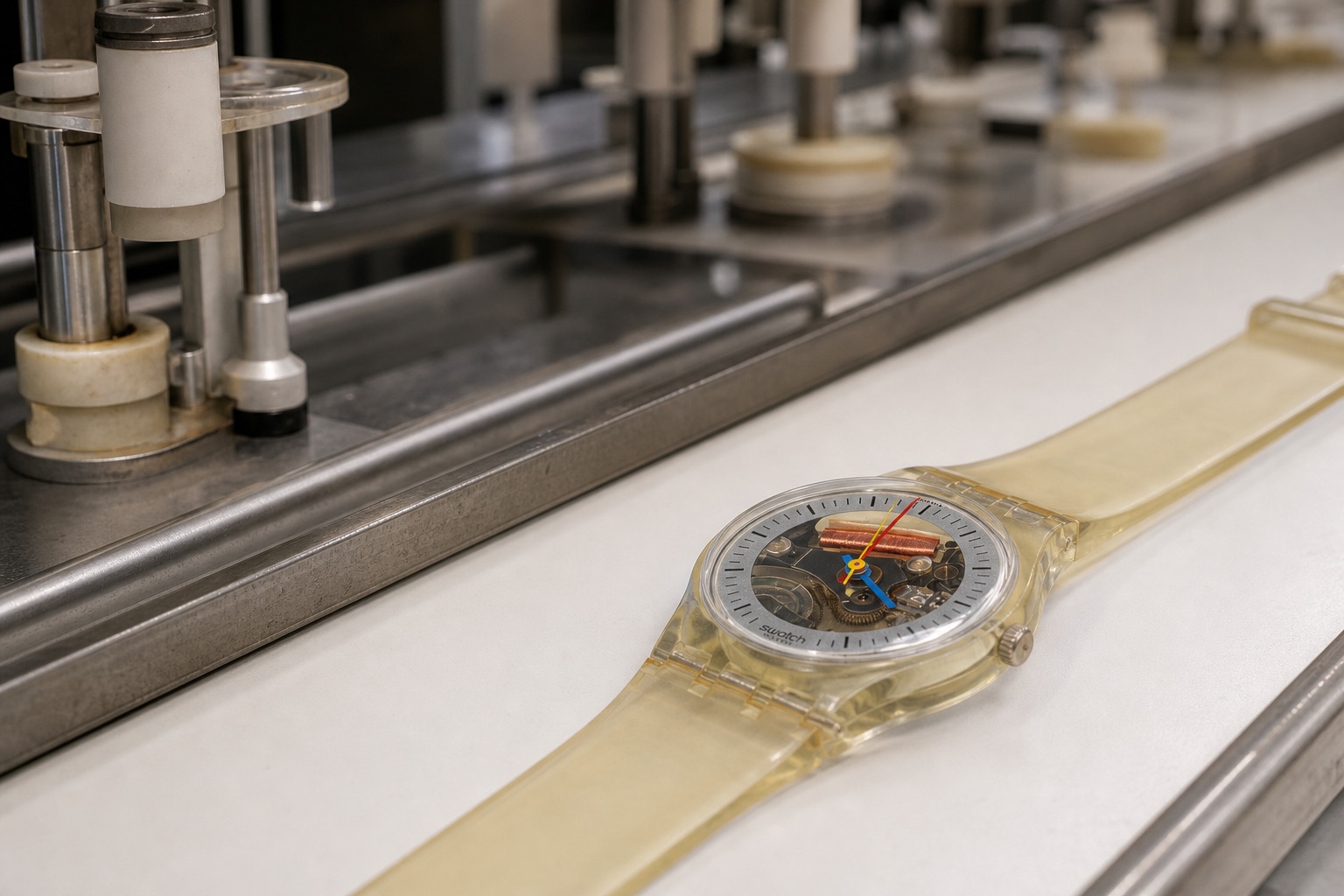
Art made it collectable. Swatch dates its first Art Special to 1985, a design by the French artist Kiki Picasso in an edition it gives as 120 (Swatch). Guinness World Records gives 140, designed in 1984, and lists one sold at Sotheby's in Milan in 1989 for $45,000 as the most paid for a Swatch at auction (Guinness World Records). Keith Haring followed in 1986 (Swatch). By Fratello's account, Imgruth had asked Andy Warhol, who was too busy and suggested Haring (Fratello). The Jelly Fish, a transparent Swatch designed by Marlyse Schmid, put the construction itself on show; Sotheby's catalogued the original as a 1983 edition of 200 (swissinfo).
The collectors got a club. The Swatch Collectors Club started in much of Europe and the US in 1990 and had 100,000 members worldwide by 1995 (Marketing Week). In 1991 came the Swatch Automatic, the first self-winding Swatch (swissinfo), which Fratello says ran until 1997 (Fratello). The next spring Swatch passed a hundred million watches, nine years after launch.
Metal, a car and Internet Time, 1993–2003
By the best measure available, the plastic Swatch peaked in 1993. Donzé uses Swiss exports of non-metal watches as a stand-in for Swatch sales, since the group doesn't report them, and that figure rose from CHF 13.4 million in 1980 to a high of CHF 798.7 million in 1993, then fell sharply until 2000 (Donzé). Swatch spent the rest of the decade stretching the brand in new directions.
The first was metal. In September 1995 Marketing Week reported the launch of "an entire new concept for Swatch: metal watches", which became the Irony line (Donzé), alongside the news that Swatch would be Official Timekeeper at the 1996 Olympics in Atlanta. By then the company was making 15 to 17 million watches a year and launching more than 150 designs annually (Marketing Week). Swatch kept the Olympic job for Sydney in 2000 and Athens in 2004, and then the group handed it to Omega (Swatch Group).
The second was a car. On 4 March 1994 SMH and Mercedes-Benz announced a joint company to build a small city car (Hagerty). The car reached European showrooms as the Smart, and in November 1998, after what it called the car's successful introduction, the group announced it had sold its remaining 19% of Micro Compact Car to Daimler-Benz, effective 31 October. Its explanation was that a hybrid drive it had wanted, the "SwatchMobil" system, ran into "almost insurmountable space problems", and that Daimler paid it compensation for dropping the project (Swatch Group). That's the seller's account, and it's the only one I could read.
The third was the internet. On 23 October 1998 Swatch launched Internet Time, which divides the day into 1,000 ".beats" of 1 minute 26.4 seconds each, measured from Biel Meantime, whose meridian was inaugurated with the MIT Media Lab's Nicholas Negroponte (Swatch).
The brand mattered more to the group than ever, all the same. In February 1998 the board made Nick Hayek, until then Swatch's vice-president of marketing, general manager of the brand. Four months later shareholders renamed SMH The Swatch Group Ltd, because "the name SMH is very complicated" and because the new name took account of "the worldwide notoriety of the brand" (Swatch Group, Swatch Group). The owner of Omega, Longines and Blancpain renamed itself after its plastic watch.
Collectors were cooling. In November 2001 Antiquorum ran an online sale of 1,489 Swatch lots, each starting at CHF 5. Every lot sold, for a total of CHF 111,021, and the top result was a 1985 Kiki Picasso at CHF 10,350, about $6,310 (Europa Star). That's around a seventh of the 1989 Milan price. In 2003 Nicolas Hayek handed operational control of the group to his son (HLS).
Sistem51 and the long middle, 2004–2021
Swatch tried the smartwatch early. In October 2004 it launched Paparazzi with Microsoft's MSN Direct service, four colourful watches that received news, sports, weather and stock quotes, and Nick Hayek modelled one in New York beside Bill Gates (Microsoft). In October 2015 it tried again with Bellamy, a pay-by-the-wrist Swatch presented in Shanghai (Swatch Group).
Nicolas G. Hayek died of heart failure in his office in Biel on 28 June 2010, aged 82 (swissinfo). His daughter Nayla became chair, and his son stayed chief executive (swissinfo).
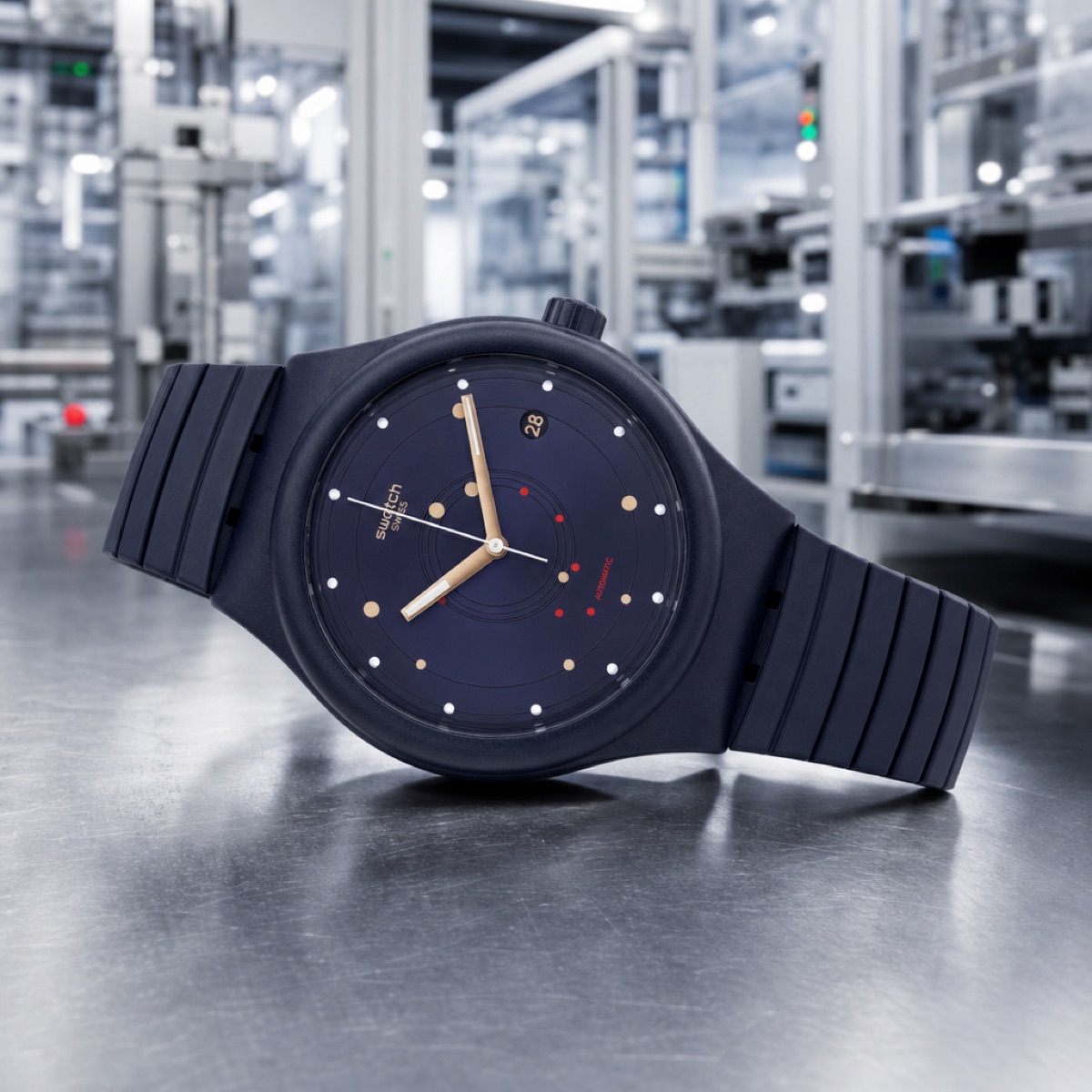
The important watch of these years is Sistem51. Nick Hayek unveiled it at Baselworld on 25 April 2013, the first time the group had shown Swatch-brand watches at the fair, at a planned CHF 100 to 200. About 100 watchmakers and engineers had spent almost two years on it, and The Local reported it was protected by 17 patents (The Local). It's a self-winding mechanical movement of 51 parts, built as five modules welded together around a single central screw, with a 90-hour power reserve and no regulator: the rate is set at the factory by laser (Swatch Group). "Not a single human hand touches this watch during manufacture," Gear Patrol wrote (Gear Patrol). Swatch calls it "the first and only mechanical movement with fully automated assembly", a claim I found no independent check of either way. It went on sale in Swiss stores that December (SJX).
AI-generated illustration.
I think Sistem51 is the most Swatch thing the company has made since 1983. It's the same trick played again: design the watch around the machine that builds it, accept that it can't be serviced, and sell the result for the price of a nice dinner. Ten years on, it's the movement inside the Blancpain collaboration.
The rest of the decade was harder. In July 2020 the group said it would cut 2,400 jobs and close 260 stores (National Jeweler). Those were group-wide figures, and the group doesn't say how many fell on Swatch.
The collaborations, 2022–2026
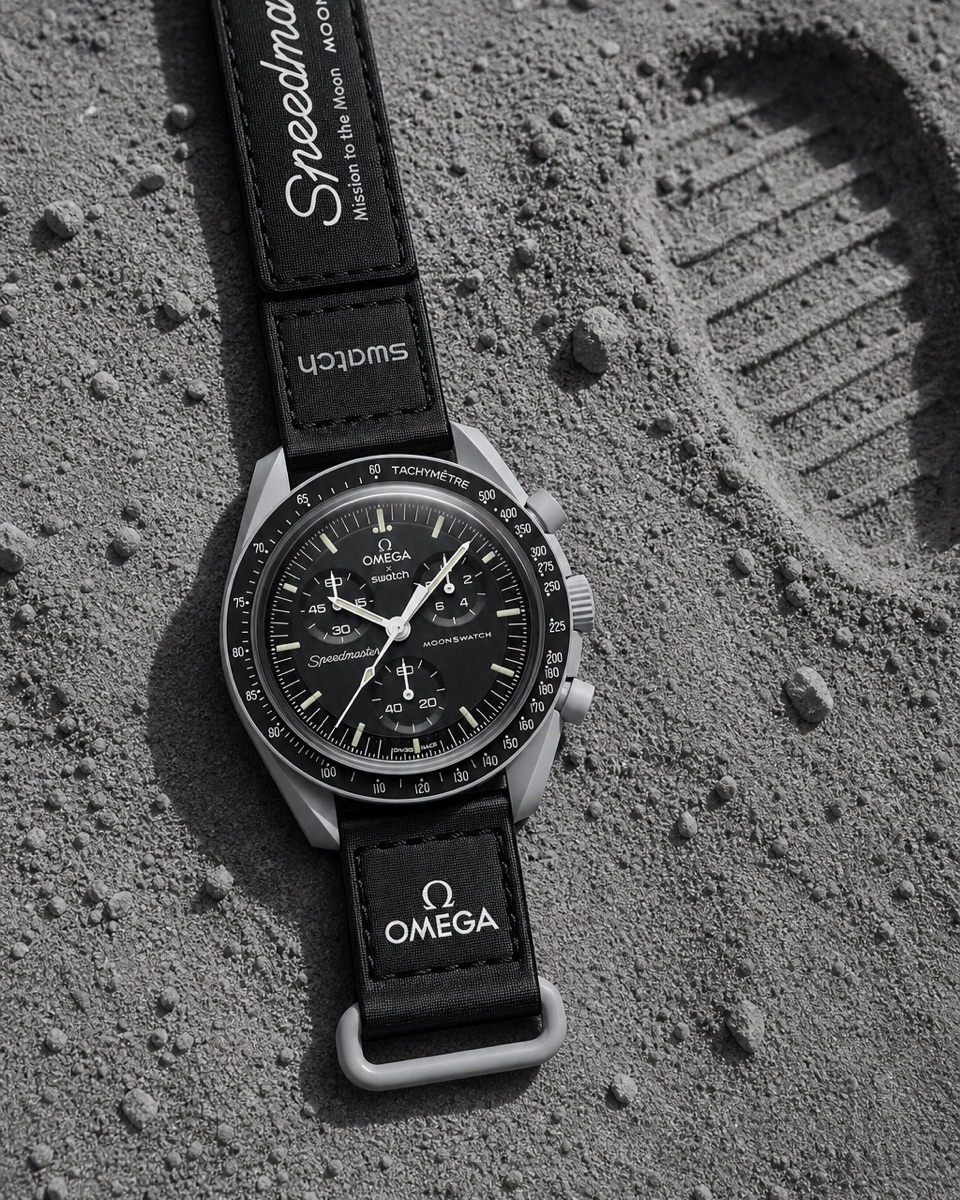
On 26 March 2022 Swatch and Omega released the Bioceramic MoonSwatch, eleven watches modelled on the Speedmaster Moonwatch, and they sold out within days (The National). Bioceramic is Swatch's material, which it describes as two-thirds zirconium oxide ceramic powder and one-third material derived from castor oil (Swatch). The cheap watch sold the expensive one, too. By July, Nick Hayek told Bloomberg that sales of all Speedmaster models had "risen by double digits" and Omega's own stores were up more than 50% since the launch (The National).
AI-generated illustration.
Swatch Group doesn't publish sales for the Swatch brand. The best estimate I found is Morgan Stanley's, as reported by Man of Many: Swatch's turnover rose 63% in 2023 to CHF 660 million, three times the CHF 214 million of 2021 (Man of Many). If that's close, the MoonSwatch roughly tripled the brand in two years.
Swatch repeated the formula with Blancpain in September 2023. The Scuba Fifty Fathoms is five divers, one for each ocean, at $400, and it uses a Sistem51 in its plastic-ceramic case, a nod to Blancpain's motto that there has never been a quartz Blancpain (SJX).
The group around it was struggling. Swatch Group's sales fell from CHF 7,888 million in 2023 to CHF 6,735 million in 2024 and CHF 6,280 million in 2025, and operating profit fell from CHF 1,191 million to CHF 304 million and then CHF 135 million (Swatch Group, Swatch Group, Swatch Group). The activist investor Steven Wood twice sought a board seat to loosen the Hayek family's grip, and lost the second vote on 12 May 2026 with 79.6% against him (swissinfo). The brand's own leadership changed too. Alain Villard, the Swatch brand's CEO, took a sabbatical year in October 2025, and Vivian Stauffer, the head of Hamilton, took over his duties (Swatch Group, bluewin).
Then came the Royal Pop. Audemars Piguet and Swatch revealed eight Bioceramic pocket watches built on Royal Oak cues, the octagonal bezel and eight screws, priced at $400 to $420 and on sale from 16 May 2026 (Revolution). The launch got out of hand. Swatch had to shut several stores around the world, police secured the queue in Geneva, and in Paris they fired tear gas outside one store (Euronews). Group sales for the first half of 2026 rose 8.5% at constant exchange rates to CHF 3,121 million, but operating profit was CHF 52 million against CHF 68 million a year earlier. Swatch Group says the Royal Pop also lifted sales of the MoonSwatch and the Scuba Fifty Fathoms (Swatch Group).
What Swatch gave watchmaking
The first thing is a way of building a watch. A normal quartz watch of the early 1980s had about 91 parts; a Swatch had 51, mounted directly in an injection-moulded case that doubled as the movement's plate (swissinfo). The welded crystal made it sealed and cheap, and the automated line made it cheap in volume. Swatch Group's own phrase for the result is "the world's first plastic watch" (Swatch Group), and I couldn't find an independent source that backs that up. The new part is narrower and better documented: a plastic case that is also the movement's base, closed for good by a welded crystal, covered by Mock and Müller's patents. Even that had a predecessor in ETA's own Delirium. Sistem51 took the same approach to a mechanical movement thirty years later.
The second is a way of selling a watch. Donzé's argument is that the Swatch Group's recovery rested on what he calls non-technological innovation: brand segmentation, distribution, retailing and communication more than new mechanisms (Donzé). Swatch is the clearest case of it. Seasonal collections, a low fixed price, artists' editions and a collectors' club are ordinary in the watch business now. Timex's complaint in 1986 shows how new they were then.
The third is the claim it saved the Swiss industry, and here the evidence is mixed. Donzé's figures show that Swiss exports of non-metal watches, mostly Swatches, averaged only 16.0% of the group's sales in 1985–1990, reached 22.8% at the 1990–1995 peak, and have been under 10% since 1999. In his words, the Swatch was "a key supply of money for restructuring", but it "did not play the overwhelming role that is usually thought"; the recovery came from rationalising production and a new marketing strategy (Donzé). I think both halves are true. The Swatch helped pay for the rescue and made Swiss watches feel modern again, while by Donzé's figures 75 to 80% of the group's sales in the 1980s and 1990s, and about 90% in the 2000s, came from everything else.
The fourth is a collecting culture with its own prices. Peter and Linda Blum's collection sold at Phillips in Hong Kong on 24 November 2011 for HK$51,707,500, about $6.6 million, then the largest single lot of Swatches ever auctioned (Europa Star). Paul Dunkel's 5,800 Swatches made HK$46.48 million at Sotheby's Hong Kong in 2015, more than four times the estimate (SJX). That November, Schmid and Müller's own archive of 1,000 watches, including 380 prototypes, stored for years in an attic in canton Neuchâtel, sold at Sotheby's in Geneva for CHF 1.3 million (swissinfo).
Significant references
Swatch gives every colourway its own code and keeps no public archive. Where Swatch or an auction house prints the code, it's in the Reference column; otherwise the column names the line as Swatch does.
| Reference | Model | Years | Why it matters |
|---|---|---|---|
| First collection | Swatch | 1983 | Twelve 51-part plastic quartz watches launched in Zurich |
| Original Jelly Fish | Jelly Fish | 1983 | First transparent Swatch; designed by Marlyse Schmid |
| Kiki Picasso | Art Special | 1985 | Swatch's first artist edition; $45,000 at Sotheby's in 1989 |
| Keith Haring | Art Special | 1986 | Haring's Swatches, recommended by Warhol |
| Swatch Automatic | Automatic | 1991–1997 | First self-winding Swatch |
| Irony | Irony | 1995 | First metal-cased Swatches |
| Sistem51 | Sistem51 | 2013 | 51-part automatic assembled entirely by machine |
| SO33M100 | MoonSwatch Mission to the Moon | 2022 | Omega x Swatch Speedmaster homage in Bioceramic; sold out in days |
| Scuba Fifty Fathoms | Blancpain x Swatch | 2023 | Sistem51 in a $400 Bioceramic diver |
| Royal Pop | Audemars Piguet x Swatch | 2026 | Eight Bioceramic pocket watches; the launch closed stores |
Swatch today
As of November 2026, Swatch is the entry-level brand of The Swatch Group, run through Swatch AG in Biel, which the group owns outright (Swatch Group). The group is listed on the SIX Swiss Exchange, and the Hayek Pool and its related parties controlled 44.5% of the votes at the end of 2025. Nick Hayek has run the group since 2003 and Nayla Hayek has chaired it since 2010. The last change at the head of the brand I could find is Stauffer's, in October 2025.
Swatch sells through its own shops and online. "Swatch only own stores," Nick Hayek said on the group's results call in July 2026 (Swatch Group). The website leads with Big Bold, Skin, Skin Irony, Sistem51 and the Originals, alongside the MoonSwatch, the Scuba Fifty Fathoms and the Royal Pop (Swatch). Forty-three years on, the brand is drawing queues again, while the group that took its name is still waiting for the profit to follow. In July 2026 the group said its spring sales would "lead to a significant improvement in profitability in the second half of the year" (Swatch Group).
Sources
- Le Temps, "Aux prémices de la Swatch" (on Elmar Mock's La fabrique de l'innovation)
- Europa Star, "Swatch, constantly breaking the mould", 2017
- Europa Star, "From the archives: our first look at the Swatch", 2023
- Pierre-Yves Donzé, "The Comeback of the Swiss Watch Industry on the World Market: A Business History of the Swatch Group (1983–2010)", 2011
- Historical Dictionary of Switzerland, "Swatch Group" (archived)
- SRF, "Die Retterin der Uhrenindustrie wird 30", 2013
- Grail Watch, "The Thin Watch War", 2021
- House of Switzerland, "Elmar Mock", 2017
- Watchonista, Prix Gaïa 2010: Jacques Muller and Elmar Mock
- Google Patents, US4558957A, plastic watch casing with plastic crystal
- Worldtempus, "Gaia Award: Three industry figures honored", 2010
- Fratello, "40 Years Of Swatch"
- Fratello, the best Swatch watches of the 1990s
- Hodinkee, "Four Revolutions: Fashion Watches"
- Swatch Group, Message from the Chair, 29 May 2013
- Swatch Group, The Founder
- Swatch Group, History
- swissinfo, "Swatch clocks up a quarter of a century", 2008
- swissinfo, "Historic Swatch collection goes under hammer", 2015
- swissinfo, "Time stops for Swatch founder", 2010
- swissinfo, "Swatch keeps leadership in the family", 2010
- swissinfo (Bloomberg), "Swatch quashes activist attempt", 2026
- Christian Science Monitor, "WATCH IT! High-tech, high-art wrist fashions", 25 April 1986
- Swatch, Swatch Art history
- Guinness World Records, most expensive watch by Swatch sold at auction
- Marketing Week, "Swatch this space", 1995
- Swatch Group, Omega, Official Timekeeper of the Olympic Games, 2004
- Hagerty, "Smart start as Mercedes shows city car duo"
- Swatch Group, sale of the smart participation, 4 November 1998
- Swatch, Internet Time
- Swatch Group, new group name and new Swatch head, February 1998
- Swatch Group, name change accepted, 24 June 1998
- Europa Star, Antiquorum Swatch auction, November 2001
- Microsoft, Swatch Paparazzi announcement, 20 October 2004
- Swatch Group, Swatch Bellamy, 14 October 2015
- The Local, "Swatch unveils 51-piece mechanical watch", 25 April 2013
- Swatch Group, Swatch SISTEM51, 16 December 2013
- Gear Patrol, Swatch Sistem51
- SJX, Sistem51 available in Switzerland, December 2013
- National Jeweler, "Swatch Cuts Jobs, Closes Stores as Sales Slump", 15 July 2020
- The National, the MoonSwatch sells out, 30 March 2022
- The National, MoonSwatch lifts Speedmaster sales, 8 July 2022
- Swatch, Bioceramic
- Man of Many, Morgan Stanley's Swatch estimate, 2024
- SJX, Blancpain x Swatch Scuba Fifty Fathoms, 7 September 2023
- Swatch Group, Key Figures 2023, 2024, 2025
- Swatch Group, changes to the management boards, 13 June 2024
- bluewin (Keystone-SDA), Swatch brand head on sabbatical, 7 October 2025
- Revolution, "The Audemars Piguet x Swatch Royal Pop Is Here", 13 May 2026
- Euronews, "Pop watch mania", 18 May 2026
- Swatch Group, Half-Year Report 2026
- Swatch Group, Annual Report 2025
- Swatch Group, half-year results call transcript, 21 July 2026
- Swatch, Sistem Sea Flex SUTN403AB
- Swatch, MoonSwatch Mission to the Moon SO33M100