Vacheron Constantin Overseas Chronograph 5520V/210A-B481
- Make
- Vacheron Constantin
- Reference
- 5520V/210A-B481
- Model
- Overseas Chronograph
- Variants
- 5520V/210A-B148, 5520V/210A-B686, 5520V/210R-B952, 5520V/210R-B966
- Case diameter
- 42.5 mm
- Calibre
- 5200
- Case material
- Stainless steel
- Water resistance
- 150 m (492 ft)
AI-generated illustration.
Vacheron Constantin, founded in 1755, came late to the steel sports watch. Audemars Piguet had the Royal Oak in 1972 and Patek Philippe the Nautilus in 1976. Vacheron's answer arrived in 1977 as the 222, named for the company's 222nd anniversary and drawn by a designer still in his twenties. It was made in the hundreds and for only about seven years. Vacheron tried again in 1996 with the Overseas, and added a chronograph three years later. In 2016 the third generation brought a chronograph movement Vacheron developed and made itself, the calibre 5200.
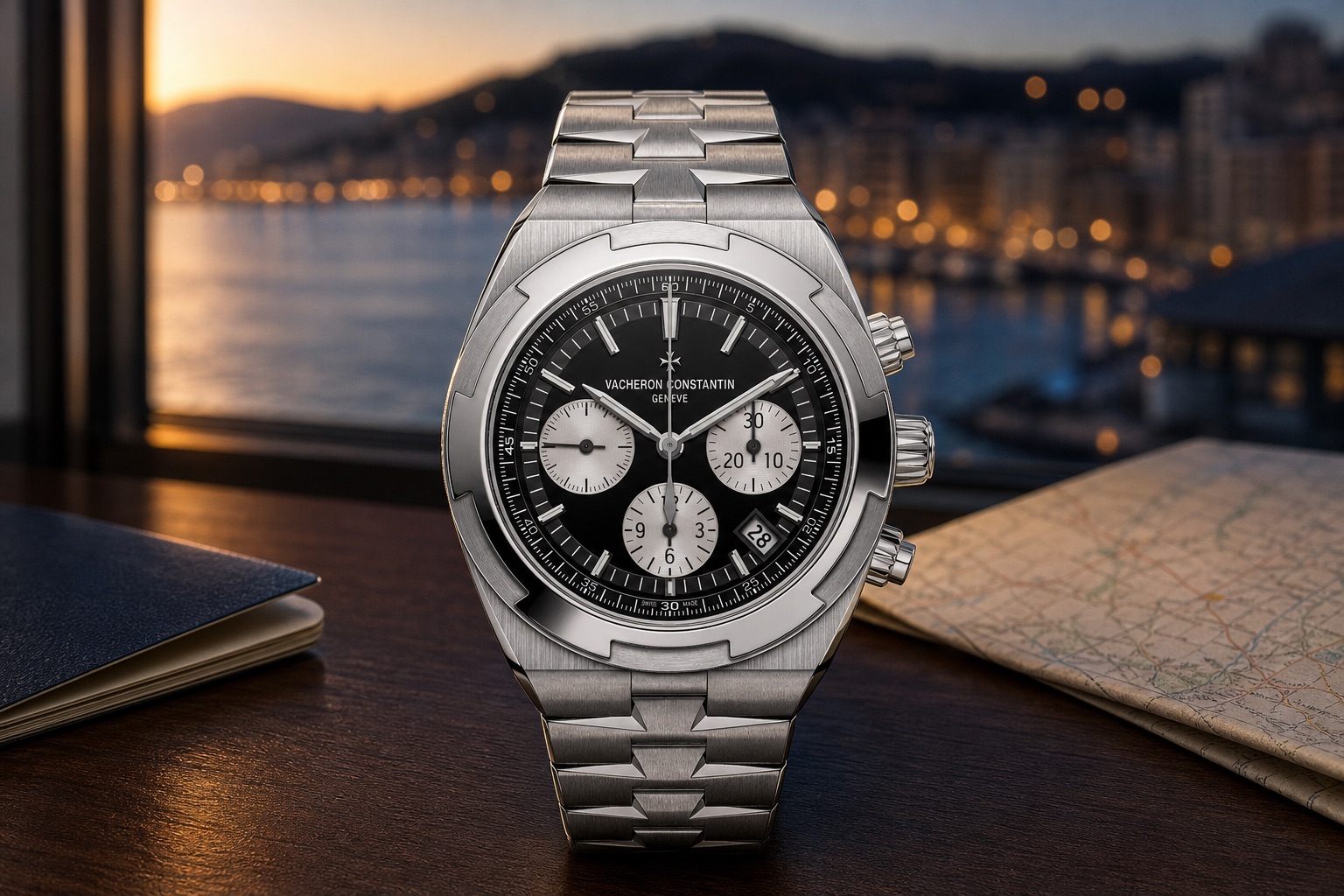
The Vacheron Constantin Overseas Chronograph 5520V/210A-B481 is the current steel version of that watch, with a black lacquered dial and silvered counters. It is 42.5 mm across, runs the in-house calibre 5200, carries the Hallmark of Geneva and comes with a bracelet and two straps you can swap without tools. On paper it's a refinement of the 2016 5500V, about a millimetre thinner. Vacheron hasn't said much else about what changed, so a good part of this article is about what can and can't be pinned down. I don't own one. I'd like to, which is a good reason to be careful about what the evidence supports.
Where it came from
The 222
The 222 is where the Overseas story starts, even though Vacheron never presented the Overseas as a straight successor. Antiquorum's lot essay says Vacheron made it to celebrate its 222nd anniversary in 1977 and credits the design to Jörg Hysek, born in 1953. Phillips agrees on Hysek and notes he was only 24 when the watch launched. One Sotheby's essay names Gérald Genta instead. Four auction and editorial sources against one is enough for me to call it Hysek's watch, and I'd read the Genta line as a mix-up with the man who drew the Royal Oak and the Nautilus.
How many were made is less settled. Antiquorum gives ceilings by metal: fewer than 520 in steel, fewer than 150 in steel and gold, fewer than 150 in gold. Phillips says about 500 in all across every metal and dial. Either way it was a small run, and the market has noticed. Phillips sold a 1978 steel 44018/411 in its New York sale of 2022 for US$69,300 against an estimate of $30,000 to $60,000. The original came in steel, in steel and gold, and in yellow gold, and Wallpaper gives the gold version as 37 mm. Two-tone examples aren't cheap either: Antiquorum estimated a steel-and-gold 44018 at €60,000 to €80,000 for its Monaco sale in July 2022. Vacheron brought the design back that same year as the Historiques 222, 45 years after the original.
The 222 matters to this article for a simple reason. It proved Vacheron could make a steel sports watch with an integrated bracelet and have collectors care about it decades later. It didn't prove Vacheron could sell one in volume, and I read the 19 years between the 222's launch and the Overseas as the company reaching the same conclusion.
The Overseas, 1996 to 2016
The first Overseas appeared in 1996, designed by Vacheron's young in-house designer Vincent Kaufmann working with the independent designer Dino Modolo, according to both Sotheby's and Watch Brothers London. Sotheby's calls it heavily influenced by the 222. Square Mile reads it differently: less a sequel than a first serious attempt at the idea for a new decade. Both readings hold up, I think. The integrated bracelet and the sporting intent came from the 222. The bezel was new: Square Mile credits the Overseas with replacing small notches with a bold take on the Maltese cross from Vacheron's logo, and I'd call that bezel the line's signature.
The first time-and-date models were the 37 mm reference 42040 and the 35 mm 42050. Watch Brothers London says the 42040 used calibre 1310, a chronometer-certified movement built on a Girard-Perregaux base. Vacheron itself puts the collection's theme down to travel, and its collection page traces that "openness to the world" back to François Constantin. Few sports watches have a brief as loose as that, and I think it's why the Overseas has never felt tied to diving or racing the way its rivals are.
A chronograph joined the range in 1999, generally given as reference 49140, though Sotheby's own 2021 lot mixes up 49140 and 49150 in the same essay and I wouldn't lean on the numbering. That Sotheby's lot, a steel 49140 from around 2000, carried an estimate of US$15,000 to $25,000. The second generation followed in 2004, led by a bracelet with Maltese-cross links and a case grown to 42 mm.
2016 and the 5500V
Vacheron relaunched the whole Overseas line at SIHH in January 2016, the collection's 20th anniversary. The chronograph became the 5500V: 42.5 mm by 13.7 mm, powered by the new in-house calibre 5200, with the date moved from a large window at 12 o'clock to a small one at 4:30 and the hands made smaller and thinner. Steel versions came with a bracelet, a rubber strap and a leather strap, each with a quick-release system that needed no tools. SJX put the launch price at US$28,900 in steel and US$49,000 in pink gold, and Monochrome gave €31,100 for steel in Europe. The launch dials were blue, silver and brown, the three that Revolution listed as already available when black arrived in 2018.
Two details from that launch are easy to miss and still matter. Deployant reported a soft-iron ring around the movement to make the watch anti-magnetic, and a column-wheel screw shaped like the Maltese cross. No source I read names a designer for the 2016 generation. The current Overseas campaign, "One of Not Many", is fronted by the adventurer and photographer Cory Richards. That's a modern framing for a line that has always been about travel more than any single sport.
The watch
AI-generated illustration.
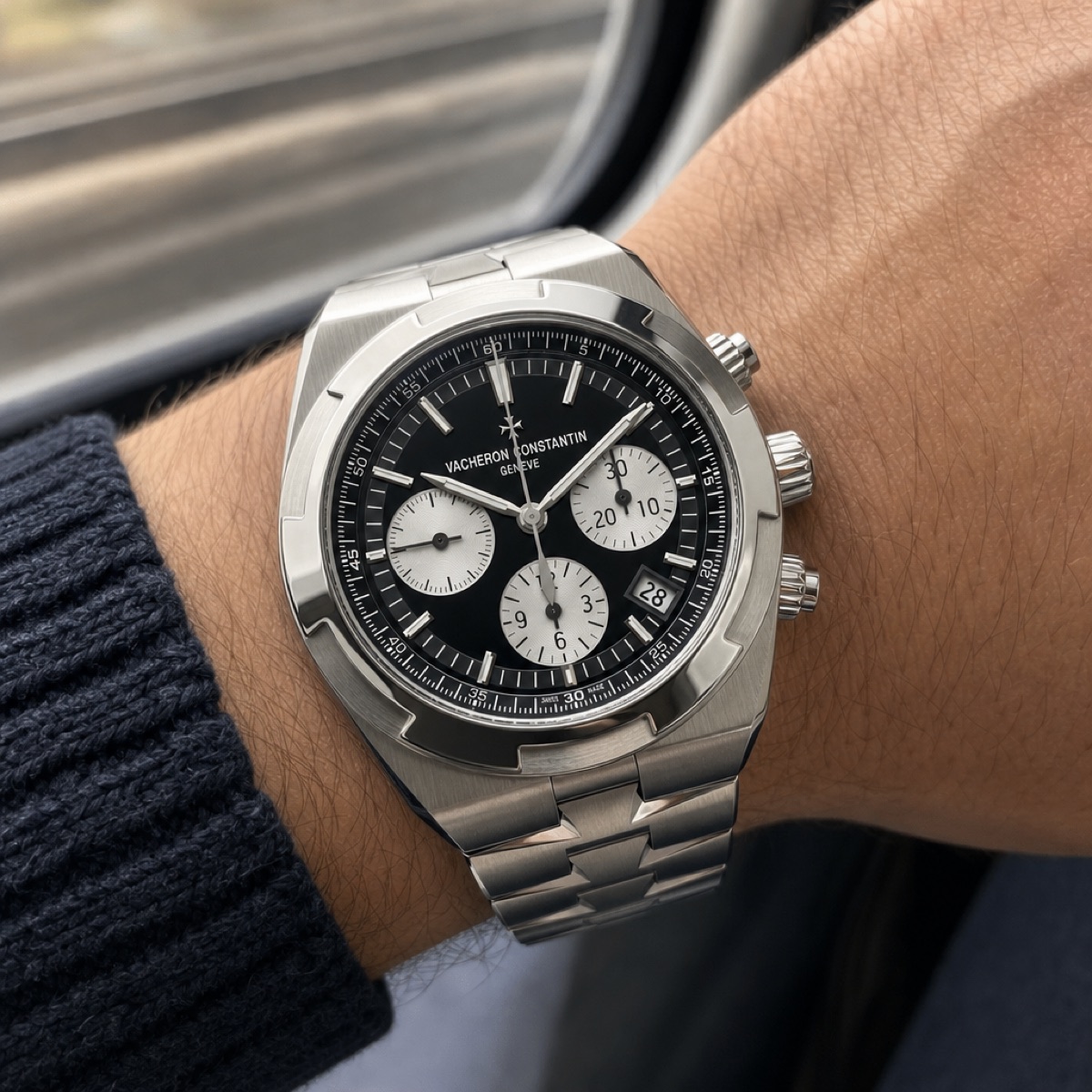
Everything in this table comes from Vacheron's own page for the 5520V/210A-B481, read in October 2026.
| Spec | Value |
|---|---|
| Reference | 5520V/210A-B481 (internal code X55AC481) |
| Case | Stainless steel, 42.5 mm diameter, 12.67 mm thick |
| Water resistance | 15 bar (150 m) |
| Caseback | Sapphire crystal, "Antimagnetic" marking |
| Dial | Opaque black lacquer, velvet-finished outer minute track, snailed silvered counters |
| Hands and markers | Applied 18K gold, with blue Super-LumiNova |
| Date | Window between 4 and 5 o'clock |
| Movement | Calibre 5200, self-winding, column-wheel chronograph |
| Movement size | 30.6 mm × 6.6 mm |
| Parts and jewels | 263 parts, 54 jewels |
| Frequency | 28,800 vph (4 Hz) |
| Power reserve | 52 hours |
| Functions | Hours, minutes, small seconds, date, 30-minute and 12-hour chronograph counters |
| Rotor | 22K gold, wind-rose decoration |
| Certification | Hallmark of Geneva |
| Bracelet | Steel, polished and satin-finished, triple folding clasp |
| Also in the box | Black grained calfskin strap, black rubber strap |
| Price | US$40,500 excluding tax (October 2026) |
The movement is the heart of it. The 5200 is a column-wheel chronograph with a vertical clutch, the layout most makers choose when they build a chronograph from scratch. It also carries the Hallmark of Geneva, the standard the canton introduced in 1886, which Vacheron ties to provenance, craftsmanship and reliability. Through the sapphire back you see a 22K gold rotor decorated with a wind rose, which Vacheron describes as a nod to travel. I like that it reads as a compass from across a table and as decoration up close.
The case is the other half. At 12.67 mm it's thin for an automatic chronograph with a date, and 150 m of water resistance means you can swim with it on the rubber strap. Vacheron lists no tachymeter on this reference, and the outer track is a plain minute scale. That keeps the black dial cleaner than most sports chronographs, and I think it's the right call for a watch that spends more time at dinner than at a racetrack.
One proportion is worth noticing. The movement is 30.6 mm across in a 42.5 mm case, which leaves room for the bezel, the bracelet attachment and the soft-iron ring that has protected the movement from magnetism since 2016. Most of what you're wearing is case, and the 6.6 mm movement thickness tells you how much of the 12.67 mm is crystal, dial, caseback and steel.
For me the strap system is the best argument for an Overseas over its rivals. In the steel version you get the bracelet and two straps, and each one clips on or off without tools. aBlogtoWatch describes a one-button quick release and a clasp that extends by 2 or 4 mm, which matters more than it sounds on a warm day.
How it changed
Read this table as approximate: the 5520V dates come from launch coverage and Vacheron's current pages, and I couldn't find when each steel reference switched over.
| Years | Reference | Dial (steel) | Thickness | Steel list price |
|---|---|---|---|---|
| 2016 | 5500V/110A | Blue, silver, brown at launch | 13.7 mm | US$28,900 |
| April 2018 | 5500V/110A-B481 | Black lacquer, white counters | 13.7 mm | US$30,300 |
| February 2023 | 5500V/110A-B686 | Silver sunburst, black counters ("panda") | 13.7 mm | US$32,400 |
| From April 2024 | 5520V/210 | Pink gold green (B966) first seen in coverage; steel B148, B481, B686 now listed | 12.67 mm | US$40,500 (Oct 2026) |
The black dial isn't new with this reference. SJX covered the black 5500V/110A-B481 in April 2018, a reverse panda with white counters on black lacquer, and Revolution reported the same US$30,300 price. Note the suffix: B481 then, B481 now. Only the prefix changed, from 5500V/110A to 5520V/210A.
Two more releases fill in the 5500V's late years. In October 2022 Vacheron launched a pink gold 5500V with a blue dial, the 5500V/110R-B952, in Shanghai. Its press page describes a pink gold bracelet with half Maltese cross-shaped links, still 42.5 mm by 13.7 mm, and Monochrome put it at CHF 74,000. Then in February 2023 came the panda, 5500V/110A-B686: a silver sunburst dial with black snailed counters on an otherwise unchanged steel watch, at US$32,400, the same price as the other steel chronographs at the time. Neither was a new reference in the sense that matters here. Both were new dials on the 2016 case.
The 5520V prefix first shows up in the coverage I found at Watches and Wonders in April 2024, on a pink gold watch with a green dial, the 5520V/210R-B966. Monochrome gave its thickness as 12.67 mm and called the 2024 Overseas group essentially the same watches as earlier years, with green as the new colour. aBlogtoWatch called it "the same Overseas case". Vacheron's own figures disagree with that by a millimetre: 13.7 mm for the 5500V on its press page, 12.67 mm for the 5520V on its product page. Both numbers come from the maker, so I trust the difference. What I can't tell you is where that millimetre went, because the movement is the same 5200 and Vacheron hasn't published an explanation that I could find.
The reference numbers are the other clue. Every steel watch I've seen carries an A in that middle block (110A, 210A) and every pink gold one an R. My reading is that the 210 marks the revised case, but Vacheron doesn't publish its reference key, so treat that as a guess.
The variations that matter
Dials
There are three steel 5520V chronographs, and Vacheron's descriptions show they're less alike than the colours suggest. The blue B148 has a sunburst satin-finished lacquer dial with a circular satin-finished inner minute track. The silver B686 is also sunburst, with the same inner track. The black B481 is described as opaque lacquer, with only the velvet outer track. On paper that means the blue and silver dials play with the light as you turn your wrist, while the black one stays flat and dark and lets the silvered counters do the work.
That's the main reason I'd pick the black one. Time+Tide found the dial on a pink gold and blue Overseas Chronograph reflective enough to slow down reading it. An opaque dial with bright counters avoids most of that. The trade-off is that the black B481 shows less of the finishing that makes the sunburst dials look expensive in photographs.
Is the 5520V B481 dial different from the 2018 5500V B481? SJX called the 2018 counters white, and Vacheron calls the current ones silvered. That could be two descriptions of the same dial or a real change, and I couldn't find a hands-on that put the two side by side. If you're choosing between them, look at both in person.
The date at 4:30
The 2016 redesign moved the date from a big window at 12 o'clock to a small one between 4 and 5, and the 5520V keeps it there. Reviewers still argue about it. Time+Tide called the 4:30 date controversial and said they'd have kept the big date at 12. Monochrome's 2016 report listed it alongside the smaller, thinner hands as part of the new dial.
I think the move was right. On the black B481, a small date window between the counters is easy to miss, and that's what I'd want on a dial that already has three subdials and a minute track. If you check the date every morning, the big date on the older chronographs was easier to read, and that's a fair reason to prefer them.
Straps and the box
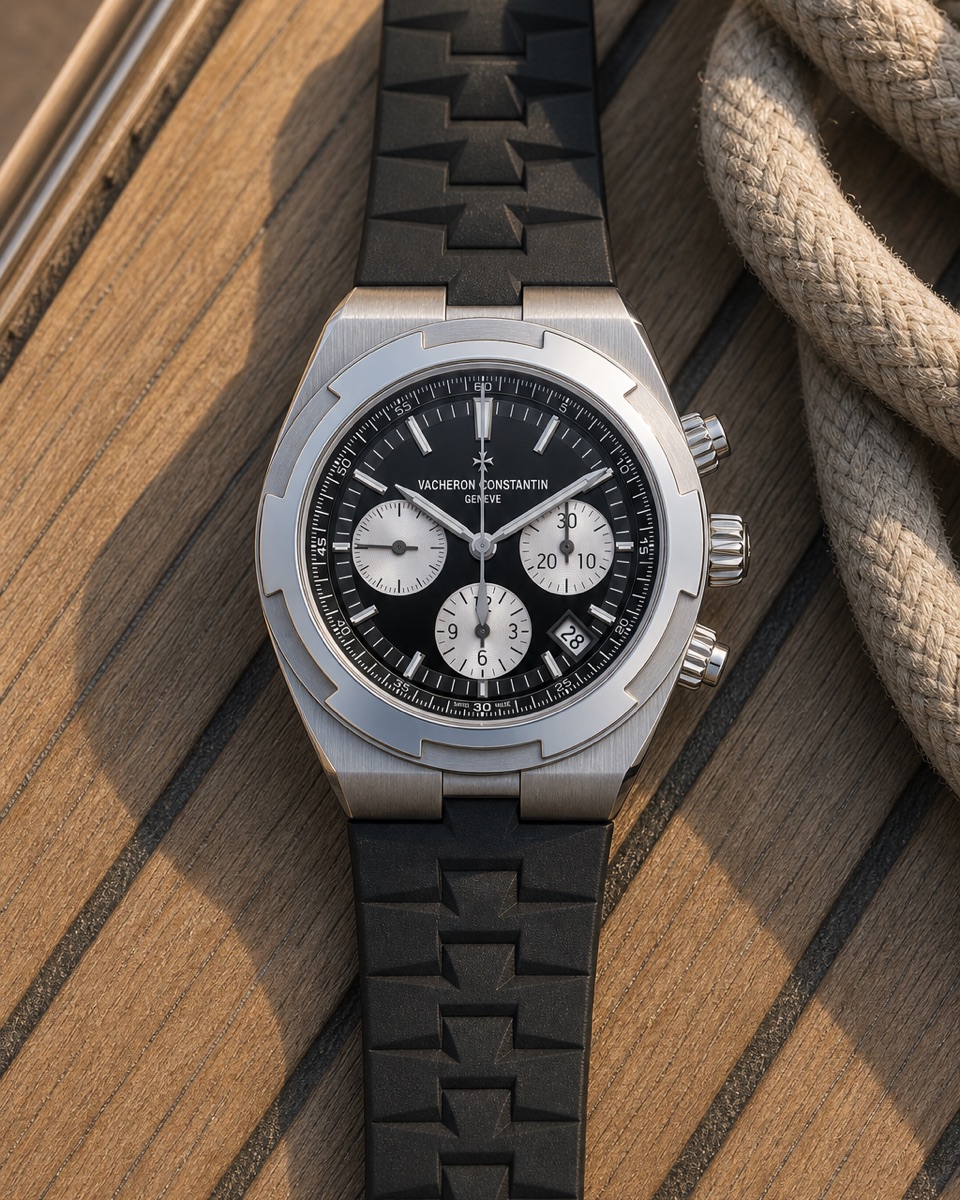
What comes in the box has changed, and it's an easy way to tell a full set. The 2018 5500V B481 shipped with the steel bracelet, a black alligator strap and a black rubber strap. Vacheron lists the 5520V B481 with the bracelet, a black grained calfskin strap and a black rubber strap. The blue B148 gets dark blue calfskin and rubber, and the silver B686 gets black. In pink gold, the green B966 ships with green calfskin and green rubber. The aBlogtoWatch hands-on put that one at US$79,500.
AI-generated illustration.
Case
Every 5520V whose specification I could check uses the same case: 42.5 mm, 12.67 mm thick, 150 m, with a sapphire back. The five 5520V references on Vacheron's site are all steel or pink gold. The titanium Overseas Chronograph Everest you may see alongside it is a separate reference, 5510-000T-B923, limited to 150 pieces in 2021. It isn't a 5520V variant and shouldn't be sold as one.
Co-branded and special dials
I looked for retailer-signed dials, boutique editions and named factory errors on the 5520V and found none. Searches for Tiffany, Bucherer and boutique-exclusive versions turned up older first-generation limited editions and a dealer listing for a 25-piece Latin America 5500V, which I couldn't confirm beyond the listing. If a 5520V with a signed or special dial appears for sale, I'd want Vacheron's paperwork before believing it.
Why it matters
The 222 was Vacheron's late entry into a category its two closest rivals had already defined. Since 2016 the Overseas chronograph has run on a movement Vacheron developed itself, and the 5520V keeps that formula intact. It's the same movement, the same strap system and the same layout in a slimmer case. In my view that's the right instinct for a watch at this level. The 5500V was already good, and the update took a millimetre out of the case without chasing novelty.
The objection is price. Steel list price went from US$28,900 in 2016 to US$32,400 in 2023 and US$40,500 today, and the watch inside hasn't fundamentally changed. You're paying for an in-house, Hallmark of Geneva movement and for the strap system. Whether that's worth $40,500 is a personal call, and I'd understand anyone who decided it isn't.
What I'd check before buying one
- The reference on the papers. 5520V/210A-B481 and the earlier 5500V/110A-B481 share the dial suffix. The prefix tells you which case you're getting, and the thickness is the visible difference.
- The straps. A full 5520V B481 set has the bracelet, a black calfskin strap and a black rubber strap. A black alligator strap suggests a 5500V set.
- The caseback. Vacheron lists an "Antimagnetic" marking on the back, along with the 22K gold wind-rose rotor behind the sapphire.
- The quick-release system. Each strap and the bracelet should come off with a press, no tools. A stiff or loose interface is worth a service estimate.
- The bracelet finish. Vacheron finishes the steel bracelet with both polished and satin-brushed surfaces, so refinishing that blurs the line between them shows.
Sources
- Vacheron Constantin, Overseas Chronograph 5520V/210A-B481 (product page, October 2026)
- Vacheron Constantin, Overseas Chronograph 5520V/210A-B148
- Vacheron Constantin, Overseas Chronograph 5520V/210A-B686
- Vacheron Constantin press lounge, Overseas Chronograph 5500V/110R-B952
- Antiquorum, Vacheron Constantin ref. 44018 "222"
- Phillips, Vacheron Constantin 44018/411 "222"
- Phillips, Vacheron Constantin Historiques 222 4200H/222A-B934
- Sotheby's, Overseas Chronograph ref. 49140
- Watch Brothers London, Overseas first generation
- Wallpaper, Vacheron Constantin Historiques 222
- Vacheron Constantin, Overseas collection
- Square Mile, the history of the Vacheron Constantin Overseas
- Monochrome, SIHH 2016 Overseas Chronograph 5500V
- SJX, hands-on with the Overseas Chronograph 5500V
- SJX, Overseas automatic and chronograph with black dials (2018)
- Revolution, Overseas Chronograph and Self-Winding with black dials
- Monochrome, pink gold and blue Overseas Chronograph 5500V (2022)
- Deployant, Vacheron Constantin at SIHH 2016
- Monochrome, Overseas in green and gold, Watches and Wonders 2024
- aBlogtoWatch, hands-on with the green Overseas in rose gold
- aBlogtoWatch, Overseas Chronograph panda dial (2023)
- Time+Tide, Overseas Chronograph hands-on
- Wrist Enthusiast, Overseas Chronograph Everest
- Hommes Singapore, Cory Richards on "One of Not Many"