Audemars Piguet
AI-generated illustration.
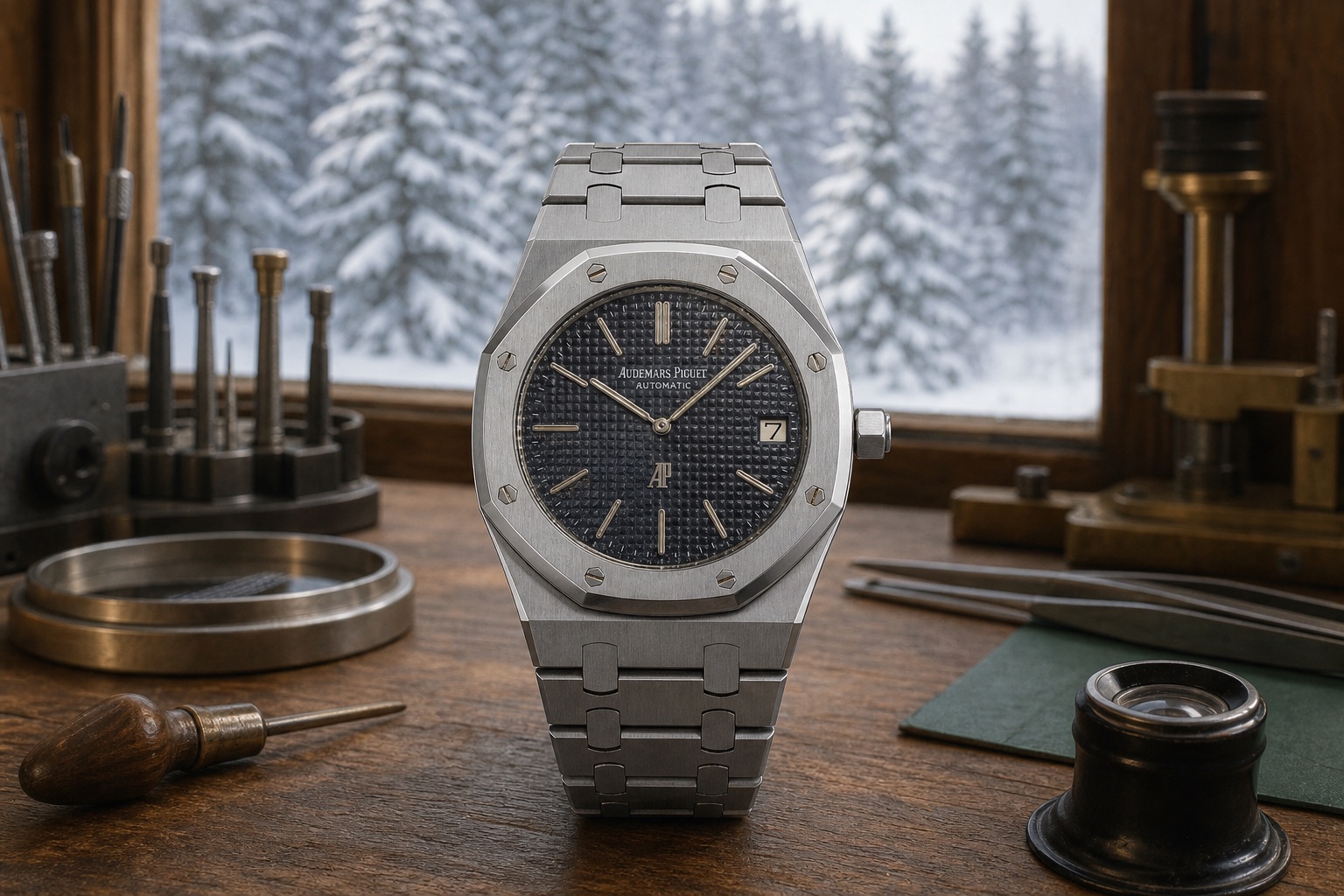
Audemars Piguet makes most of its money from one design. Morgan Stanley estimates that the Royal Oak and its offshoots brought in about 88% of AP's sales in 2025, a year in which the company took around CHF 2.6 billion and became the third-largest Swiss watch brand by turnover. That's an odd place for this company to have ended up. Until 1951 it made nothing but one-off watches, and much of its best early work went out under other names. The 1899 Universelle, at the time the most complicated pocket watch in the world, was sold by a firm in Glashütte. A minute-repeating wristwatch it built in 1892 is presented by Omega as its own first. In 1971 AP made 6,217 watches in 237 models. The Royal Oak, launched the next spring, was the first AP watch ever made in quantities of more than 1,000.
The thread I see is a workshop of complication specialists in a farming valley that spent most of a century behind other people's names, found its own with a steel watch in 1972, and has bet almost everything on it since. What makes the story easier to tell is how frank AP's own archive is. Its history site, AP Chronicles, says the founding year was picked around 1903 for a leaflet, that its best-known thin movements were unfinished blanks bought from LeCoultre, and that the Royal Oak's famous commercial failure is a misconception. I lean on that archive a lot below, because for much of AP's history it's the only source there is, and I say where a claim needs someone other than AP behind it.
Timeline
Dates are from AP's own archive unless the era sections say otherwise. Where sources split on a year, those sections give both.
| Year | Event |
|---|---|
| 1875 | Jules Louis Audemars opens a workshop in Le Brassus, the year AP now counts from |
| 1881 | Audemars and Edward Auguste Piguet sign a ten-year partnership contract, 17 December |
| 1882 | "Audemars, Piguet & Cie" is registered as a name and trademark, 6 December |
| 1892 | AP sells a minute-repeating wristwatch movement to Louis Brandt & Frère, later Omega |
| 1899 | The Universelle movement goes to Union in Glashütte, which sells it under its own name |
| 1907 | A new building at 16 Route de France, still the head office; the firm becomes a Société Anonyme |
| 1926 | More than 1,000 watches sold in a year for the first time |
| 1931–35 | Sales fall below 50 watches a year after AP's main US customer goes bankrupt |
| 1948 | First Basel fair; LeCoultre becomes the main supplier of movement blanks |
| 1951 | Reference numbers and series production begin |
| 1955 | Reference 5516, a perpetual calendar with a leap-year display |
| 1967 | Calibre 2120, an automatic 2.45 mm thick |
| 1972 | The Royal Oak 5402 is shown at the Basel fair in April |
| 1986 | Quartz reaches half of AP's output; the 25643 automatic tourbillon |
| 1987 | Georges Golay dies; Stephen Urquhart and Georges-Henri Meylan run AP together |
| 1992 | AP takes 52% of Renaud & Papi in Le Locle |
| 1993 | The Royal Oak Offshore 25721; the first AP boutique, in Geneva |
| 2012 | François-Henry Bennahmias becomes chief executive |
| 2019 | The Code 11.59, launched at AP's last trade fair for seven years |
| 2022 | The Royal Oak 16202, with AP's own calibre 7121 |
Complications under other names, 1875–1918
Le Brassus is a village in the Vallée de Joux, a high valley in the Swiss Jura where, as AP describes it, most houses and farms had a small workshop under the roof. Neighbours made springs, wheels, gongs and hammers, and an établisseur collected their parts and had them assembled into movements. AP's view is that this network made the valley the centre of complicated watchmaking from the 19th century on, and that the most complicated movements of the era, whether signed in Geneva, Paris, Besançon or London, came from there. That's an interested party talking about its own valley, but it sets up everything that follows.
Jules Louis Audemars, born in 1851, and Edward Auguste Piguet, born in 1853, grew up in Le Brassus. Both were repasseurs, the finishers who assembled and adjusted movements made by others, the trade AP calls the most prestigious in the industry at the time. Piguet's name appears in the records of the village's biggest firm, Louis Audemars & Fils, from 1872 to 1876. Audemars married in 1874, spent a little over a year in Gimel, and came home in the autumn of 1875, aged 24, to set up a workshop under the rafters.
That's the 1875 on AP's dials and anniversaries, and the evidence for it is thin. AP's own chronicle says that in the absence of any archives prior to 1881 what's known is three short adverts Audemars placed in the local paper between December 1875 and December 1876, offering "watches of all kinds". The partnership came later. On 17 December 1881 Audemars and Piguet signed a contract to run for ten years from 1 January 1882. Audemars put in 18 movements, and Piguet put in CHF 10,000, which AP reckons was the price of a house. On 6 December 1882 the firm registered its name and trademark as Audemars, Piguet & Cie. Audemars kept the workshop and Piguet took the commercial and financial side.
So which is the founding? When the partners first printed a founding date, in a leaflet for retailers around 1903, they chose 1875. I'd call 1881 the founding of Audemars Piguet and 1875 the opening of Audemars's workshop, and I give AP credit for publishing the evidence that lets you tell the two apart.
What they made was complicated from the start. The first production register covers about ten years and 1,625 watches: three quarters have at least one complication and more than half have a repeater. Growth was slow, from about a hundred watches a year from a handful of watchmakers in the 1880s to about 500 a year from roughly 25 artisans in the 1910s.
Selling them was harder. In the 1880s and 1890s four watch brands in Le Brassus alone carried the Audemars name, and a 1904 AP advert asked retailers not to confuse it with the other Audemars firms. So the partners sold to companies that already had customers. AP names Vacheron Constantin and Patek Philippe in Geneva, Dent in London, Tiffany in New York and Cartier in Paris, plus retailers such as Gübelin, Wittnauer and Shreve, and says they "often added their own signature, leaving the manufacturer in the shadows". Some of that list is AP's word alone, but the auction record backs the main names. Antiquorum sold a split-seconds chronograph made in 1893 for Tiffany, and Christie's a 1927 platinum minute-repeating wristwatch with case and movement signed by AP and the dial signed Cartier.
Two watches from these years show how far into the shadows the best work went. In 1892 AP sold movement 2416, a minute repeater 29.3 mm across, to Louis Brandt & Frère, the Biel firm that became Omega, and the finished wristwatch is in the Omega Museum. AP calls it one of the first minute repeater wristwatches. Omega's page for the same watch calls it the world's first minute-repeating wristwatch, by Louis Brandt, and the text of that page I could read doesn't mention AP. Both accounts fit the facts if the movement was AP's and the watch was Brandt's. I found no independent historian who settles the "first".
The second is the Universelle. In 1899 AP took an extraordinarily complicated movement blank from the workshop of Louis Elisée Piguet, finished it, and sent it to Germany, where the Union Dürrstein company in Glashütte finished and sold it as the "Universal Uhr". By AP's count it has 1,168 components and 19 complications, and it was first shown at the Leipzig watch fair on 12 August 1900. Phillips, writing about the Glashütte firm, says that at the time it ranked as the most complicated pocket watch in the world. AP's heritage department bought it back in 2016 after four years of restoration, and it's now the centrepiece of the company museum.
By 1907 AP had a new building at 16 Route de France, still its head office, and had become a Société Anonyme, with the LeCoultre and Capt families joining the founders as owners. Audemars died a month before the 1918 armistice and Piguet a year later. Their sons Paul Louis Audemars and Paul Edward Piguet took over, one running the workshops and the other the business, the same split as their fathers. The first era comes down to this: the trade knew AP's name, and buyers mostly didn't.
The two Pauls and the Depression, 1918–1945
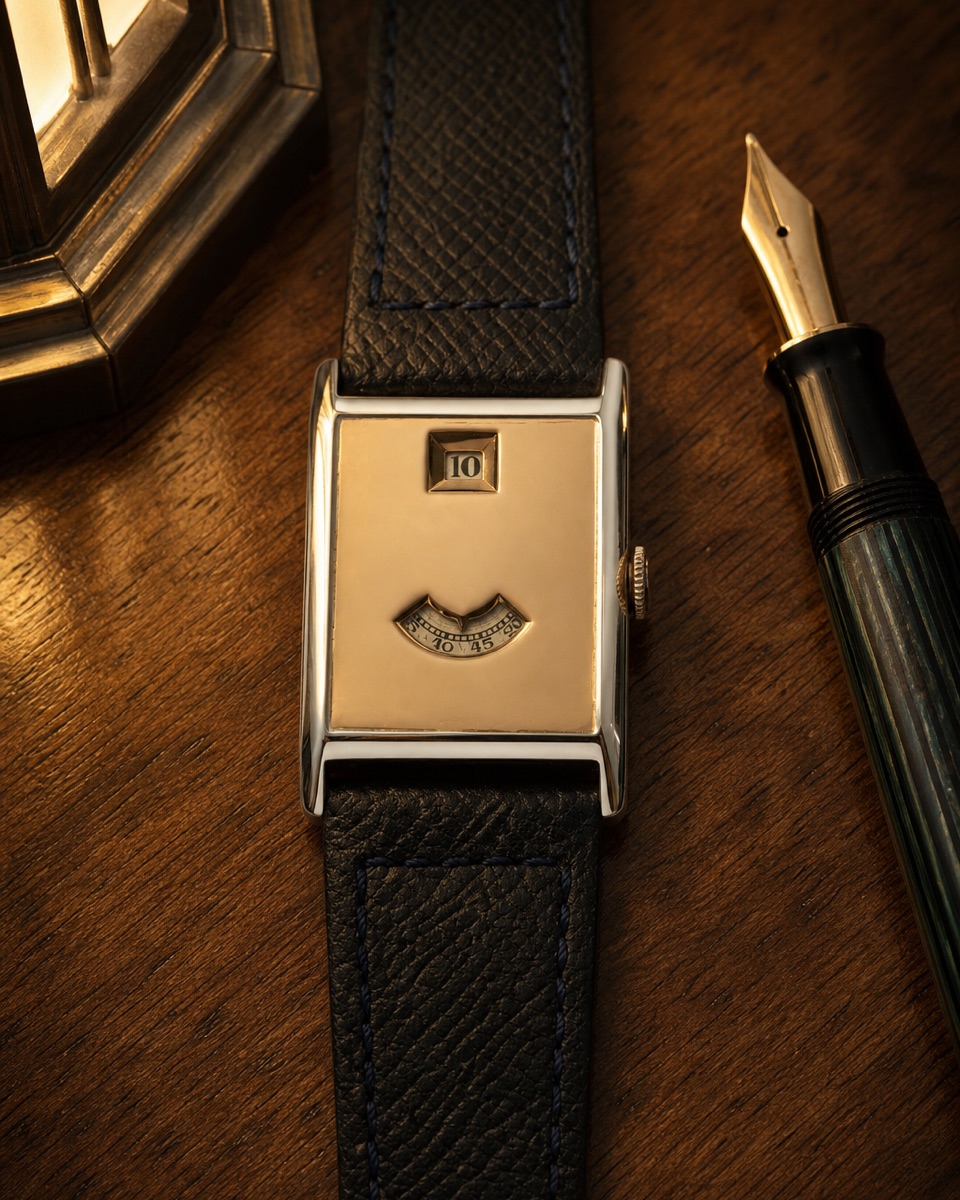
The 1920s went well. AP made its first calendar wristwatches, jumping hours and Art Deco shapes, and kept going smaller. In 1921 it made a chiming watch 15.8 mm across, which it calls the world's smallest, and in 1927 the smallest movement of its day, a record that LeCoultre beat two years later, as AP's own account notes. In 1926 AP sold more than 1,000 watches in a year for the first time, and its 33 artisans made it the largest watch firm in Le Brassus. It would be 26 years before it sold that many again.
AI-generated illustration.
The reason was New York. AP's main customer was a distributor there, Metric Watch, which went bankrupt after the 1929 crash owing CHF 425,000, almost a year of AP's sales. From 1931 to 1935 AP sold fewer than 50 watches a year. The two Pauls kept a dozen artisans employed, applied for government loans and tax exemptions, launched two cheaper sub-brands called Audiguet and APCO, and opened talks with Universal, Rolex, Omega and Movado. AP stopped advertising for a decade to save money. It counts 15 consecutive years of losses, from 1930 to 1945.
Those figures are AP's alone, and the one other source I found tells it a little differently. Antiquorum's house history of the brand calls 1932 the worst year and says that by 1933 the economic situation had greatly improved, with most of AP's output going to the United States by the start of the war. I can't reconcile the two from what I read. AP's sales figures point to a longer bottom than Antiquorum's.
What the bad years did produce was the openworked and extra-thin work that later defined AP. With few orders to fill, the workshops made skeletonised watches, jumping hours and miniatures while they waited for the market to come back. In 1945 AP had about 30 artisans making more than 500 watches a year, and profits were still a long way off. That spring Jacques-Louis Audemars, the founder's grandson, offered an accountant's job to Georges Golay, 23, whom he knew from the Le Brassus gymnastics club. Golay would run the company from the mid-1960s until his death.
Thin watches and a reference system, 1948–1971
AP's modern shape dates from 1948, a year of major decisions by its own account. It went to the Basel fair for the first time, dropped the "& Co" from its dials, closed the two sub-brands and made LeCoultre its main supplier of movement blanks. People from SAPIC, a holding company with stakes in LeCoultre and Vacheron Constantin, joined the board, and one of them, Jules César Savary, chaired it until his death in 1966. The founding families kept ownership.
From 1951 AP stopped giving each movement the same number as its case and started giving its watches a model number, a reference. That's the end of the one-off era on paper. In 1952 sales passed CHF 1 million and 1,000 watches, and three years later AP sold more than 2,000.
The work that defined these years was thin. In 1953 calibre 2003 replaced an earlier Frédéric Piguet blank of the same size, 9 lignes across and 1.64 mm thick, and AP is open that the 2003's blank was made by LeCoultre. In 1953 only 5% of AP watches had an extra-thin calibre; in 1958, 77% did. If you've read that AP made "the thinnest wristwatch" in 1946, I couldn't find the watch. A Sotheby's article repeats the claim, but no source I read names a 1946 reference or calibre, and AP's own chronicle dates the movement to 1953.
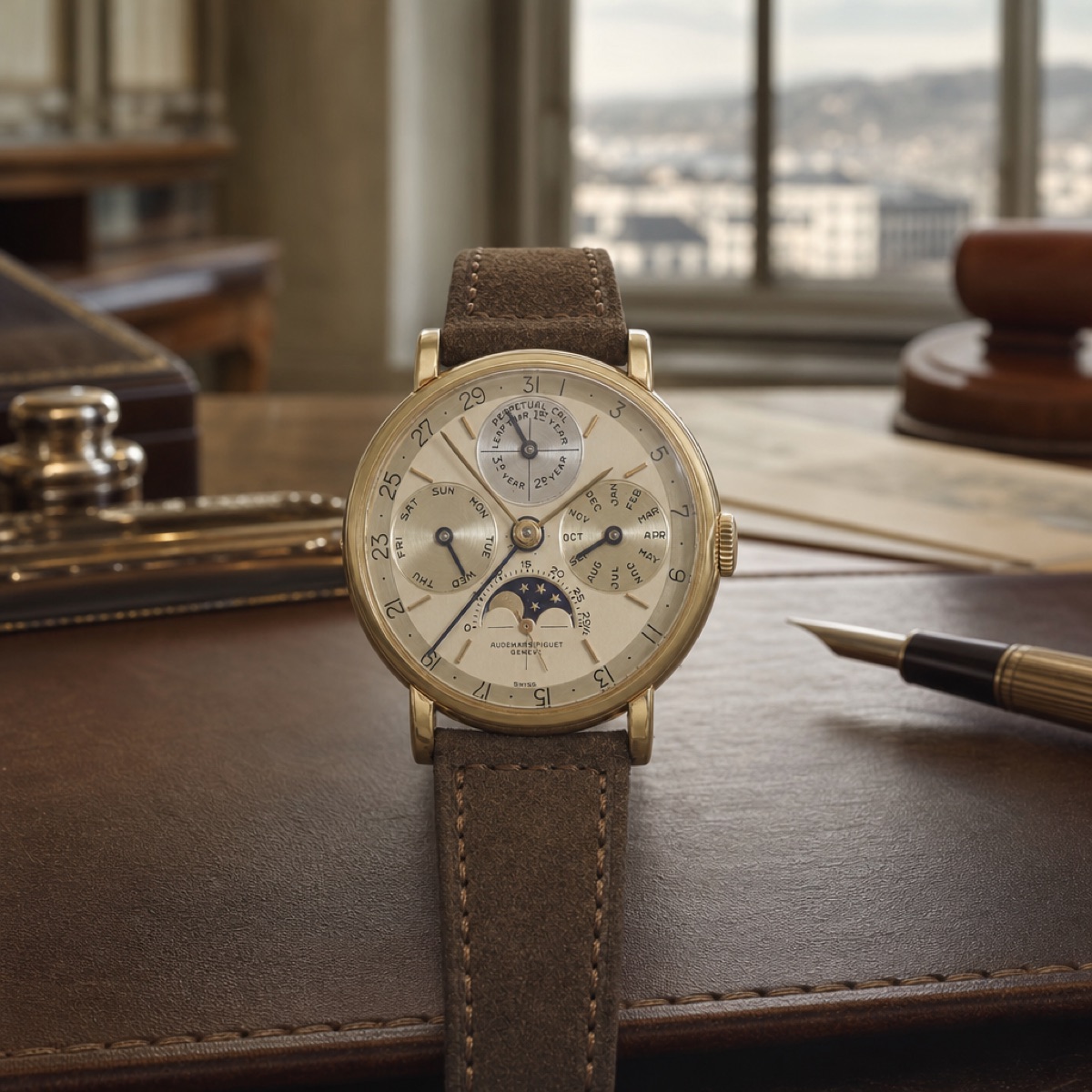
The complication that matters from this era is reference 5516 of 1955. Phillips calls it the first serially produced perpetual calendar wristwatch to display a leap year, and notes that no other brand offered one until Patek Philippe's reference 3450 in 1981. SJX agrees, and adds that Patek's one-off perpetual calendar wristwatch of 1925 and Breguet's of 1929 had no leap-year indication. "Serial" is generous, though. Phillips counts nine made; SJX says 12, of which nine had the leap-year display. And the example in AP's heritage collection was sold in 1959 to Vacheron Constantin, so even this watch first went out to another house.
AI-generated illustration.
Golay rose in the meantime: sales director in 1962, then managing director, the first from outside the founding families. AP's own pages say from 1966 in one place and in 1967 in another. In 1967 came calibre 2120, an automatic 2.45 mm thick with its winding mass turning on a rail around the movement instead of sitting on top of it. AP describes it as jointly developed by LeCoultre, AP and Vacheron Constantin. Revolution, writing about the LeCoultre calibre 920 it's based on, says LeCoultre never used the movement itself and sold it in ébauche form to AP, Patek Philippe and Vacheron Constantin. Phillips calls it the thinnest automatic movement ever made, a record it held into the early 2000s. I found no rival claim.
By about 1970 AP had 84 employees, 67 of them at the bench, made 5,500 watches a year and turned over nearly CHF 10 million. In 1971 it made 6,217 watches in 237 models. Fifty-five of those models were one-offs and 145 were made in runs of fewer than ten. It was a small, very good maker of thin gold dress watches, and the next watch it launched was large, steel and expensive.
The Royal Oak, 1972–1986
The Royal Oak started with a request from AP's sales agents. A 1969 agreement with SSIH, the Omega group, let AP use SSIH's general agents to distribute its watches, and some of them came back with a proposal. One was Carlo de Marchi of Italomega in Turin, whom AP counts among the initiators behind the Royal Oak and who is said to have suggested the name. Golay took the brief to the designer Gérald Genta. As Genta remembered it for the rest of his life, Golay rang at 4 pm and told him a distributor wanted "a steel sports watch that has never been done before", and that he needed the sketch "for tomorrow morning". AP's archive dates that first sketch to the night of 10–11 April 1970, two years before the launch.
AP showed it at the Basel fair in April 1972 as "the most expensive steel watch in the world", to a lot of criticism. It cost CHF 3,300 that year, against CHF 2,990 for a gold AP dress watch with calibre 2003 in the same catalogue. Publications of the next few years put it between CHF 3,650 and 3,750, which is why you'll see different launch prices quoted. Inside was the 2121, the date version of the 2120, and that movement's 28 mm width is what made the case 39 mm, large for 1972. The nickname "Jumbo" came from Desco, the distributor that introduced the Royal Oak in 1973, whose "Jumbo Size" referred to an example made for a sumo wrestler who needed a 25 cm bracelet.
Whether it sold is argued. The 40th-anniversary book by Martin K. Wehrli and Heinz Heimann says the two main markets took three full years to sell their quotas of 400, until Fiat's boss, Giovanni Agnelli, appeared in public wearing one in 1974. AP's archive now calls that commercial failure a widespread misconception: 490 Royal Oaks sold in 1972, a record for AP, and the first 1,000 went in less than two years. Both versions can be read off AP's own numbers. Italy, the market that asked for the watch, sold just over half the 400 it ordered in 1971, and between 1972 and 1976 the Royal Oak never made up more than 7% of AP's watches, nor 6% of its turnover. My read is that it sold well for a watch nobody had seen before, and that it was still a small part of a small company.
Its influence came faster than its sales. Phillips sums it up in one line: AP began the race with the Royal Oak in 1972, IWC's Ingenieur and Patek Philippe's Nautilus followed in 1976, and Vacheron Constantin's 222 in 1977. Genta drew the first three, and a young Jörg Hysek drew the 222. The Royal Oak, the earliest Nautilus and the 222 all ran on versions of the same LeCoultre 920.
The quartz years hit AP from both sides. It made quartz watches itself: Model 6001, presented in 1974 after five years of quiet work with SSIH, of which AP made just over 350 by 1978. Quartz went from 7% of AP's watches in 1979 to 30% the next year, and in 1986 half of them were quartz. Management refused to put quartz in the Royal Oak and made a related line, reference 6005, with studs where the screws would be. Meanwhile the Royal Oak itself became a collection: a women's model, the 8638, in 1976, gold and two-tone versions in 1977, and 27 new models between 1977 and 1981.
The other thing AP did in those years was complications, at a time when few buyers were asking for them. In 1978 it introduced calibre 2120/2800, a self-winding perpetual calendar 3.95 mm thick that AP calls the thinnest of its era. On 5 April 1984 it put that movement into the Royal Oak as the 5554, soon renumbered 25554, and sold about 270 by 1992. In 1986 came reference 25643, a rectangular dress watch 5.3 mm thick that Phillips calls the world's very first automatic tourbillon wristwatch and the first serially produced tourbillon wristwatch; 401 were made up to 1999. Those are big claims, and the Phillips essay is the only source I found for them that isn't AP. Either way, AP came out of the 1980s leaning on two things, complications and the Royal Oak.
The Offshore and the co-directors, 1987–2011
Golay died suddenly in October 1987, after what Georges-Henri Meylan later called a small operation, and Meylan and Stephen Urquhart, the sales director, ran AP together for the next ten years. Meylan describes a small company: about CHF 70 million in turnover, around 5,000 watches a year, and "virtually no complete movements" made in-house, with most bought from Jaeger-LeCoultre.
Over the next decade they bought the supply chain AP had been renting. In 1988 AP invested in Jaeger-LeCoultre, which was in difficulty at the time, and it held 40% when that stake went to Richemont in 2000. Meylan says the sale generated significant financial resources and came with a ten-year supply of movements. AP bought the Geneva case maker Centror in 1991 (AP). In 1992 it took 52% of Renaud & Papi, a complications workshop in Le Locle founded in 1986 by two young watchmakers from AP's own benches, Giulio Papi and Dominique Renaud. The banks wouldn't lend them money to grow, and AP would, on condition that it obtain 52 per cent. Papi had left AP at 21, when he saw it would be years before he'd be allowed near a grand complication.
Renaud & Papi kept working for other brands. Papi told Europa Star the ideal order book was half AP and half everyone else, and that for Richard Mille it did "practically everything". That's a part of modern watchmaking that rarely carries AP's name, which suits its first century.
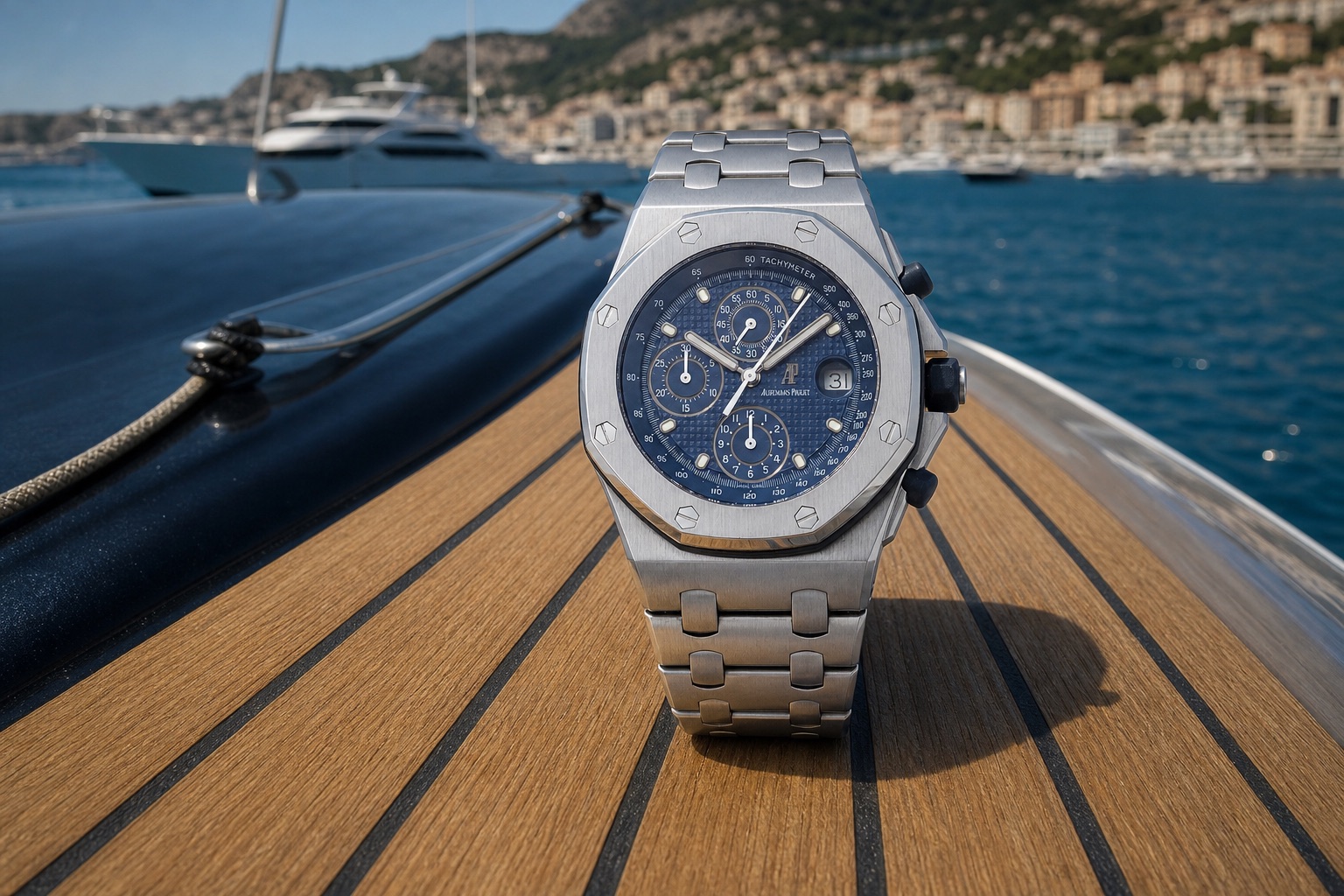
The Royal Oak needed help by then. Phillips, interviewing the designer, says sales of AP's steel sports watch had been in steady decline when Urquhart asked Emmanuel Gueit, then 22, for a 20th-anniversary model. AP says the push came from the German market, which wanted a watch with the "Offshore spirit". The Royal Oak Offshore 25721 appeared at Basel in 1993: a 42 mm chronograph at CHF 16,600, twice the price of a standard Royal Oak. Genta was furious. By Monochrome's account, which draws on AP's archive, he told Gueit, "You have spoilt my watch, you're a murderer!" It sold slowly at first, 716 pieces worldwide in 1993–95. Then it took off: AP counts 10,896 of the 25721 over more than 20 years, against 6,050 for the 5402.
AI-generated illustration.
The Offshore also took AP into celebrity marketing. In 1998 it made Arnold Schwarzenegger a black-cased prototype for the film End of Days, logged in its archive as "Destination Schwarzenegger 25 September 1998", and in 2005 Jay-Z got a 100-piece Offshore edition, sold with an engraved iPod. Europa Star credits those partnerships with making AP an icon in the USA, where François-Henry Bennahmias had been running the business since 1999.
The original Jumbo nearly didn't make it through the decade. Its successor, the 15002, sold 186 pieces, a stock of 350 movement blanks hadn't moved in three years, and AP's orders were so small that there were rumours LeCoultre would stop making the movement. AP's answer was the 15202, presented on 30 March 2000, which kept the original movement and the 39 mm case alive. In 2002 it added the Royal Oak Concept for the watch's 30th anniversary, a tourbillon in alacrite with a Renaud & Papi movement, limited to 150 pieces. The company was growing underneath all this: it had opened its first boutique, in Geneva, in 1993, and by 2000 it had 355 employees and capacity for 18,500 watches a year (AP). Meylan ran AP alone from 1997 until 31 December 2008. His successor, Philippe Merk, left in 2012 over what Europa Star reported as "strategic differences".
Owning the shop, 2012–2026
Bennahmias took over in 2012, first on an interim basis. Europa Star put AP's turnover that year at CHF 600 million with 1,200 staff, and Bennahmias told it he wanted AP to become "the watchmaking Apple", a company that sets its own standards. He started by cutting. The Millenary and Jules Audemars collections, which had never been commercial successes, were phased out, and the Royal Oak, which turned 40 in 2012, took over. AP says that from that anniversary on, the 15202 set the watchmaking world on fire.
Then he cut the shops. In 2018 he told Reuters that AP wanted to totally control the distribution of its watches, dropping multi-brand retailers within three to five years. Bilanz noted that the move also hit Bucherer, Europe's biggest watch retailer. AP had already gone from about 700 points of sale in 2000 to 300 in 2010. By early 2025 it was down to 82, of which 52 were AP boutiques, alongside the AP House, a format it launched in 2018. It stopped going to trade fairs after the 2019 SIHH and stayed away until it agreed to return to Watches and Wonders in 2026.
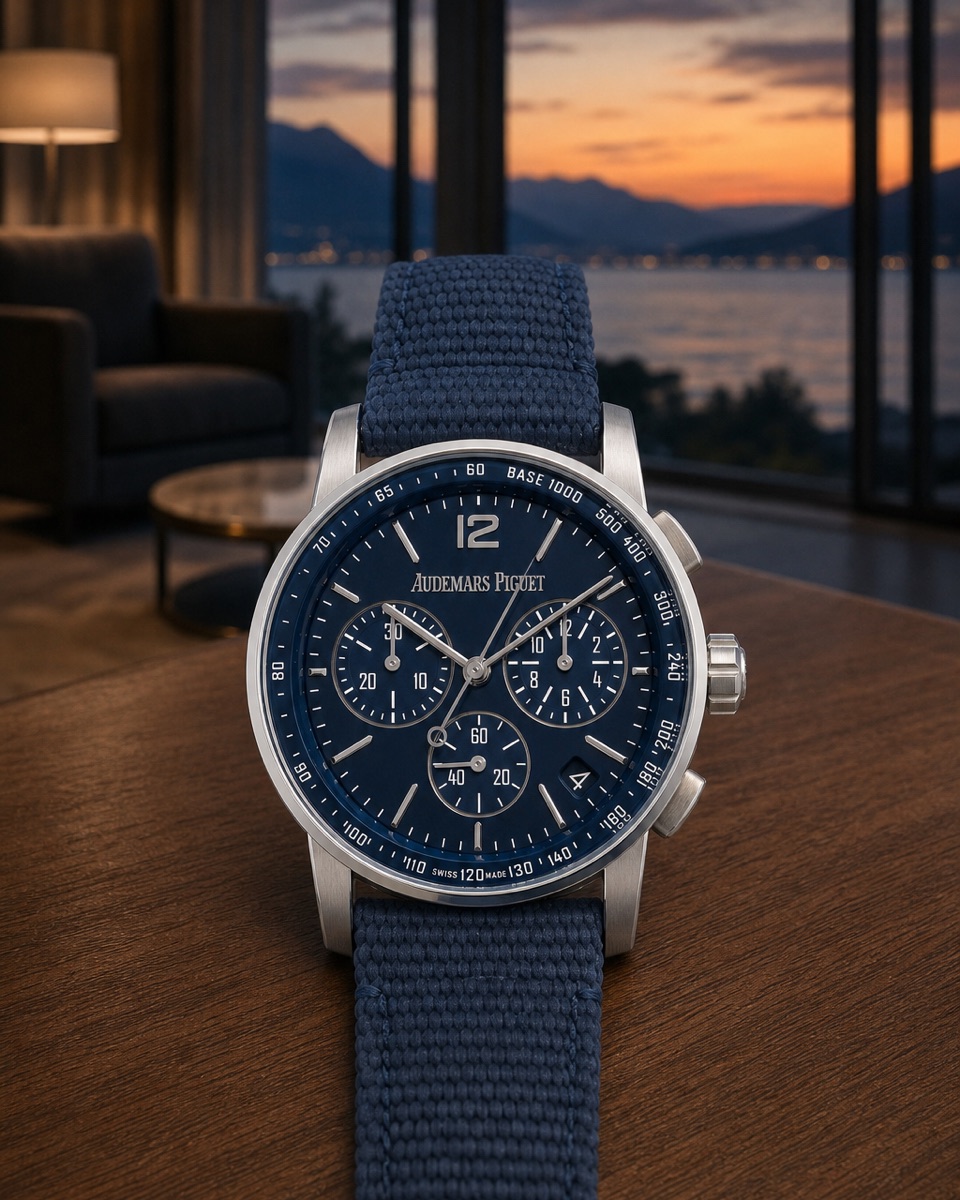
Commercially, it worked. AP says sales passed CHF 1 billion in 2018 and doubled in the next four years, Covid included, and SJX says Bennahmias quadrupled AP's annual revenue over his tenure. The one big product bet went badly at first. The Code 11.59 was launched in January 2019 as AP's most important product launch in decades, and Bloomberg reported that "the online reaction was swift and brutal: It's a dud." AP kept at it. By 2023 Bennahmias said the line made close to 15 per cent of revenue, and Morgan Stanley estimated 12% for 2025. It's the only line outside the Royal Oak family that shows up in those estimates at all.
AI-generated illustration.
In 2022, the Royal Oak's 50th year, the 15202 gave way to the 16202 with calibre 7121, an AP design that replaces the cal. 2120/2121 after half a century. AP had long since taken production of the old movement in-house, but the design was LeCoultre's. Demand peaked around then. In September 2023 Bloomberg reported that a WatchCharts index of AP prices was down almost 20 per cent in a year, though more than three quarters of second-hand AP models still sold above retail.
Ilaria Resta, whose career was at Firmenich and Procter & Gamble, became chief executive in January 2024. Her first two years included the 150th anniversary, with calibre 7138, a perpetual calendar movement that sets every function from a single crown. They also included a report in September 2025 that she was leaving, which AP's board called unfounded, and sales growth she put at 12% for January to August 2025 and at 10% for the year in a December interview.
What Audemars Piguet gave watchmaking
The luxury steel sports watch is the obvious contribution. Sotheby's calls the Royal Oak the first high-end sports watch crafted from stainless steel, and within five years Patek Philippe, IWC and Vacheron Constantin all had their own. The octagon became distinctive enough to defend in court: in a case National Jeweler reported in January 2014, a US judge awarded AP treble damages totaling $9.8 million against a company selling cheap copies of its bezel.
The second is complications in series. The 5516 put a leap-year display on a catalogue perpetual calendar 26 years before Patek did, calibre 2120/2800 made a thin automatic perpetual calendar, and the 25643, on Phillips's account, made the automatic tourbillon a production watch. Each took something rare and put it in a catalogue, even if the catalogue numbers were tiny.
The third is the work done behind other names: the Universelle, the Brandt repeater, the Tiffany and Cartier pieces, and in the modern era Renaud & Papi's movements for Richard Mille. And there's sound. AP introduced its patented Supersonnerie in 2015 after eight years of research with the EPFL, the federal technology institute in Lausanne, to make its minute repeaters louder.
The last is how it sells. Morgan Stanley's report says AP has fully exited multi-brand wholesale, with about 90% of sales through 72 of its own stores, while Rolex and Patek still sell through authorised dealers who take a cut. I think that's the change the rest of the industry will study longest, more than any single watch.
Significant references
Before 1951 AP gave its watches movement numbers, not references, so the first row uses the movement number.
| Reference | Model | Years | Why it matters |
|---|---|---|---|
| Movement 6142 | "Universelle" pocket watch | 1899 | 1,168 components, 19 complications; sold under Union Glashütte's name |
| 5516 | Perpetual calendar | 1955–1957 | First serially made perpetual calendar wristwatch with a leap-year display |
| 5402 | Royal Oak | 1972–2002 | The steel luxury sports watch; AP's first model past 1,000 pieces |
| 5554 / 25554 | Royal Oak Perpetual Calendar | 1984–1992 | The thin 2120/2800 perpetual calendar in the Royal Oak case |
| 25643 | Tourbillon Automatique | 1986–1999 | Called the first automatic tourbillon wristwatch by Phillips; 401 made |
| 25721 | Royal Oak Offshore | 1993–2016 | The 42 mm chronograph that outsold the original |
| 15202 | Royal Oak "Jumbo" Extra-Thin | 2000–2021 | Kept the 1972 case and movement alive; the 2010s' hottest Royal Oak |
| 25980 | Royal Oak Concept | 2002 | Alacrite tourbillon by Renaud & Papi; started the Concept line |
| 15210 | Code 11.59 by Audemars Piguet Selfwinding | 2019– | AP's first new collection in decades, and a rough launch |
| 16202 | Royal Oak "Jumbo" Extra-Thin | 2022– | AP's own calibre 7121 replaces the LeCoultre-designed 2121 |
Audemars Piguet today
As of 2026, AP is still owned by its two founding families, joined over the years by others, including descendants of the Lecoultre and Golay families. Alessandro Bogliolo, formerly chief executive of Tiffany, has chaired the board since 11 November 2022, and Resta runs the company. AP says it employs almost 3,000 people and could make around 50,000 watches in 2025. Morgan Stanley estimates it sold about 53,000 for CHF 2.6 billion, up 9% on 2024.
It's still buying its supply chain. In August 2025 AP took a majority stake in Inhotec, a long-time supplier of movement parts, and in January 2026 it opened L'Arc, a 321-metre building in Le Brassus that brings together nearly 700 staff from several sites. With Le Locle and the case and bracelet works at Meyrin, it plans to go from about 50,000 watches a year to 70,000, a bet one analyst told Bilanz he was skeptical of. This year it launched The Watch Keepers, its own certified pre-owned platform, in Europe and Switzerland first.
The risk is the one this article opened with. On Morgan Stanley's estimate, close to nine francs in ten come from the Royal Oak family, a design drawn in one night in 1970. I can't claim to be above it: both APs on my own wish list, a 15500ST and the openworked 15407ST, are Royal Oaks. Resta's answer so far is more capacity, more of AP's own shops, and for 2026 a new collection called Neo Frame. Whether a company that spent its first century signing other people's watches can now sell more than one of its own is the question its next decade answers.
Sources
- Audemars Piguet, AP Chronicles. "The epic AP saga".
- Audemars Piguet, AP Chronicles. "Before 1875".
- Audemars Piguet, AP Chronicles. "Royal Oak: Birth of an Icon".
- Audemars Piguet, AP Chronicles. "1976–1982: from enfant terrible to full-fledged collection".
- Audemars Piguet, AP Chronicles. "The Royal Oak 'Jumbo' Models".
- Audemars Piguet, AP Chronicles. "5402, First Royal Oak Model".
- Audemars Piguet, AP Chronicles. "25554, First Royal Oak Perpetual Calendar".
- Audemars Piguet, AP Chronicles. "25721, First Royal Oak Offshore".
- Audemars Piguet, AP Chronicles. "Calibre 2120".
- Audemars Piguet. "The 'Universelle', simply complicated", 3 February 2023.
- Audemars Piguet. "The art of chiming".
- Omega. "1892: the World's First Minute-Repeating Wristwatch by Louis Brandt & Fils".
- Phillips. Dürstein and Cie Grand Complication, 1895.
- Antiquorum. Audemars Piguet No. 4857, made in 1893 for Tiffany & Co., Geneva, 10 April 1994.
- Christie's. Audemars Piguet platinum minute-repeating wristwatch retailed by Cartier, 1927, Important Watches, sale 2212, lot 55.
- Antiquorum. Audemars Piguet, lot 227/290.
- Sotheby's. "The Great Evolution of the Audemars Piguet Royal Oak".
- Phillips. Audemars Piguet reference 5516, 1957.
- SJX. "Hands-On with the First Ever Perpetual Calendar Wristwatch with a Leap Year Indicator", August 2015.
- Phillips. Audemars Piguet reference 5273 with calibre 2120, Geneva Watch Auction: SIX, lot 112.
- Revolution. "I Am Legend: The Jaeger-LeCoultre Calibre 920".
- Phillips. Vacheron Constantin 222 "Jumbo", New York, lot 73.
- Phillips. Audemars Piguet reference 25643 in platinum, Geneva, May 2024.
- Europa Star. "A lakeside conversation with the Meylan family", May 2026.
- Europa Star. "Renaud & Papi, the training ground".
- Phillips. "The Audemars Piguet Royal Oak Offshore, the man who made it and the watch that honours it", October 2018.
- Monochrome. "The History of the Audemars Piguet Royal Oak Offshore".
- Phillips. Royal Oak Offshore "End of Days" prototype, New York, lot 125.
- Europa Star. "Jay-Z celebrates music career with Audemars", April 2005.
- Europa Star. Interview with François-Henry Bennahmias, December 2012.
- Phillips. Royal Oak Concept 25980AI, STYLED, lot 110.
- SJX. "An Industry Insider's Take on François-Henry Bennahmias' Success at Audemars Piguet", June 2022.
- Reuters, via Yahoo Finance. "Swiss watchmaker Audemars Piguet to boost revenue by taking over sales", 6 September 2018.
- Bilanz. "Audemars Piguet verabschiedet sich von den Händlern".
- Monochrome. "Audemars Piguet and ten new brands to join Watches and Wonders Geneva 2026".
- SJX. "Audemars Piguet Names Ilaria Resta CEO", May 2023.
- The National (Bloomberg). "Audemars Piguet spent seven years on a new collection and the reviews are not good", January 2019.
- The National (Bloomberg). "Audemars Piguet expects record sales this year", 6 September 2023.
- SJX. "Audemars Piguet Introduces the Royal Oak 'Jumbo' Extra-Thin Ref. 16202", January 2022.
- Europa Star. "Audemars Piguet resets its calendar for its 150th anniversary", 2025.
- Luxury Tribune. "Ilaria Resta, CEO of Audemars Piguet: 'These rumours are unfounded'", 9 September 2025.
- cash.ch. "Audemars-Piguet-Chefin: Haben Umsatz um 10 Prozent gesteigert", December 2025.
- Sotheby's. "The Six Most Expensive Audemars Piguet Royal Oak Watches".
- National Jeweler. "Audemars nets royal victory in trademark case", January 2014.
- Revolution. "What we can learn from Morgan Stanley's ninth annual Swiss watch report", 2026.
- SJX. "State of the Industry: Vontobel on the Redrawn Watch Market", March 2026.
- WatchTime Germany. "Audemars Piguet: Jasmine Audemars hört auf", 24 August 2022.
- Il Sole 24 Ore. "Rolex, Cartier and Audemars Piguet on the podium", March 2026.
- SJX. "Audemars Piguet Advances Vertical Integration with Inhotec", August 2025.
- Luxury Tribune. "Audemars Piguet inaugurates its new Arc manufacture in Le Brassus", 22 January 2026.
- Bilanz. "Rekordziel: Audemars Piguet plant 70'000 Uhren jährlich", 30 January 2026.
- Monochrome. "Audemars Piguet launches The Watch Keepers", 2026.
- Luxury Tribune. "Audemars Piguet unveils its 2026 strategy in the heart of the Alps", 4 February 2026.
- Europa Star. "Audemars Piguet announces new CEO", July 2008.