Casio
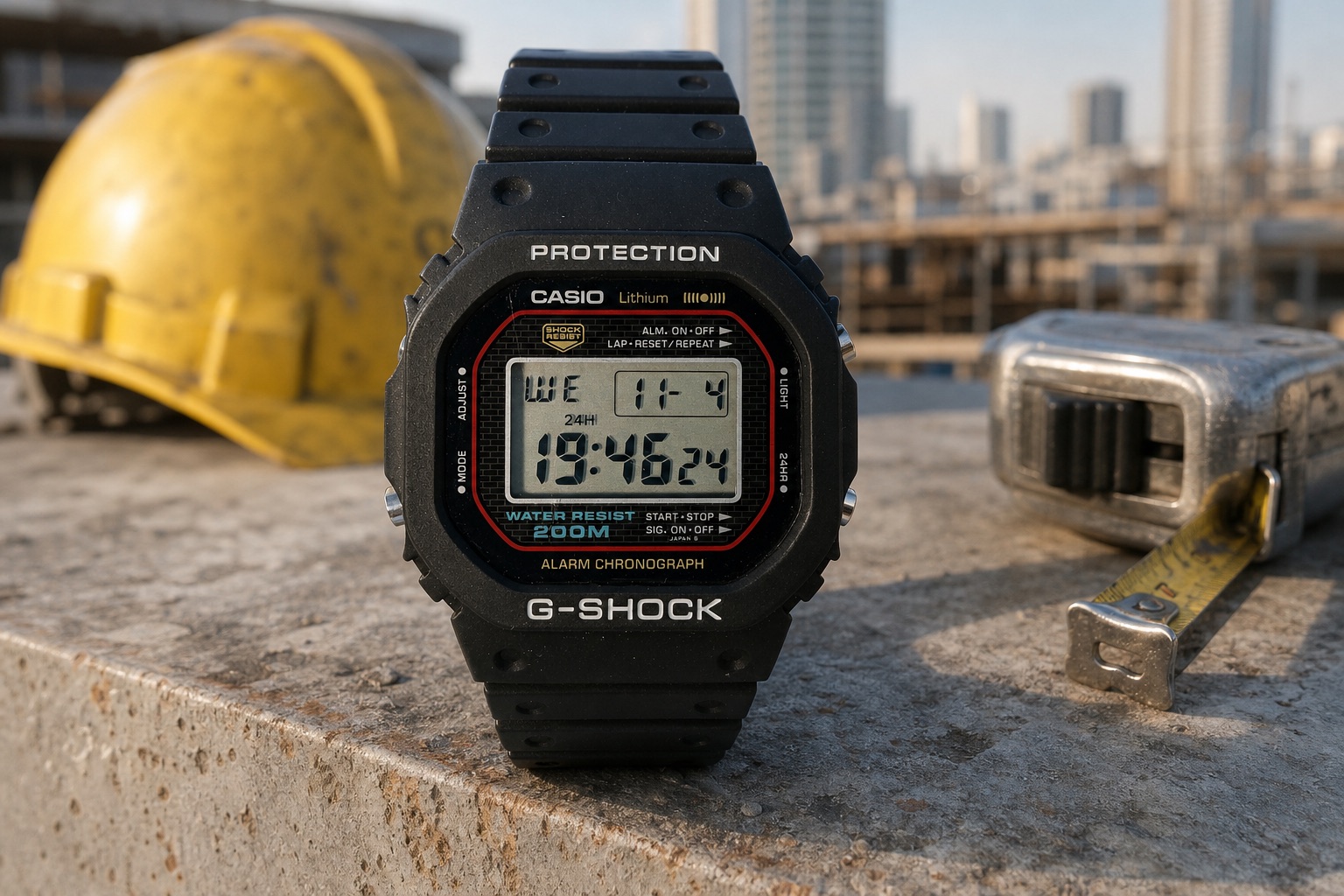
AI-generated illustration.
Casio's first product was a ring. In 1946 the Kashio brothers' workshop in Mitaka, Tokyo, turned out the yubiwa pipe, a finger ring that held a cigarette so a man could smoke it down to the nub while he worked, and the profits paid for the calculator that made the company (Casio). Its first watch, in 1974, was a calculator too, in the founders' own description: Toshio Kashio's pet theory was that "Watches simply add up seconds" (Casio). Fifty-two years later the company still thinks that way, and the watches have become the company. In the year to March 2026, Casio's watch segment brought in ¥184.9 billion of ¥276.2 billion in sales and made ¥27.1 billion of operating profit, more than the ¥23.0 billion the whole group made after corporate costs (Casio). Everything else Casio does, taken together, loses money.
That inversion is the story. Casio entered watches with no watchmaking heritage, was told by an incumbent to "leave watchmaking to the pros" (Casio), and treated the watch as a piece of consumer electronics with a strap. The approach produced one genuinely new category, the shock-resistant G-SHOCK of 1983, and a long list of "world's firsts" that turn out, on inspection, to be narrower than the folklore. Casio did not make the first digital watch, the first solar watch, the first radio-controlled watch or the first Bluetooth watch, and in its own careful wording it doesn't claim to have. What it did was sell more digital watches than anyone, survive the crash that killed its American rivals, and then, as its calculators, phones and cameras fell away, discover that a watch built to survive a ten-metre drop had become the only business it had left.
My read is that Casio is the most important watch company that most watch enthusiasts don't think of as one. The G-SHOCK has outsold most Swiss brands' entire histories: more than 160 million by Casio's count (Casio). This is the history of how that happened, including the two near-bankruptcies, the 1997 bust, the ransomware attack, and the 2025 handover that took the company out of the founding family's hands.
Timeline
These are the best-supported dates I found. Where sources split on a year, the era sections say so.
| Year | Event |
|---|---|
| 1946 | Tadao Kashio founds Kashio Seisakujo in Mitaka, April; the yubiwa pipe |
| 1957 | 14-A relay calculator goes on sale and Casio Computer Co., Ltd. is incorporated, both in June |
| 1965 | 001 electronic calculator, after transistor rivals put Casio "on the brink of bankruptcy" |
| 1972 | Casio Mini, ¥12,800; a million sold in ten months |
| 1974 | Casiotron QW02, Casio's first watch, November |
| 1978 | F-100, the first Casio watch in a resin case |
| 1980 | C-80, the first Casio calculator watch |
| 1983 | G-SHOCK DW-5000C, April |
| 1984 | US hockey-puck commercial; Databank CD-40; the 100 millionth Casio watch |
| 1987 | DW-5600C, the square that sold for nine years |
| 1989 | F-91W |
| 1990–1992 | DW-5900C sells abroad, is re-imported, and starts the Japanese G-SHOCK boom |
| 1993–1995 | Frogman, Baby-G, DW-6900, Pro Trek and Casio's first radio-controlled watch |
| 1996 | MRG-100, the first full-metal G-SHOCK |
| 1997 | Peak: 6 million G-SHOCKs sold worldwide, 2.4 million in Japan |
| 1998–2002 | Tough Solar, radio control, and a ¥24.9 billion group loss with 3,000 job cuts |
| 2004 | Oceanus |
| 2008 | Multi-Band 6 |
| 2010 | Phones and LCDs leave the group after two years of losses |
| 2017 | 100 millionth G-SHOCK shipped, August |
| 2018 | GMW-B5000 full-metal square; compact cameras dropped; Kazuo Kashio dies |
| 2019 | GA-2100, the "CasiOak" |
| 2023 | DW-5000C shape registered as a 3D trademark; first president from outside the family |
| 2024 | Ransomware attack in October; Ring Watch and the watch business's 50th anniversary |
| 2025 | Shin Takano becomes CEO; Casio's first mechanical watch |
Four brothers and a relay calculator, 1946–1974
Casio was a machine shop before it was anything else. Tadao Kashio, born in Kochi prefecture in 1917, was a lathe-operator's apprentice from 14, and in April 1946 he set up Kashio Seisakujo in Mitaka with three employees, making "microscope parts and gears" on subcontract (Casio, Casio). The yubiwa pipe was his brother Toshio's idea, Tadao turned it, and their father Shigeru went out and sold it. It was a hit, and the company says the proceeds "would later go towards the capital needed for development of a new kind of calculator" (Casio). Tadao also used the money to buy a forest, which he sold later to fund the relay machine when the banks got nervous (Casio).
Toshio was the inventor. He had read a biography of Edison at twelve, joined the Ministry of Communications at fifteen and came to the workshop in 1946 (Casio). In 1949 the brothers saw imported electric calculators at a trade exhibition in Ginza, machines that cost as much as a car, and decided to build a better one (Casio). Kazuo joined in 1950 and Yukio in 1952, and the division of labour that lasted forty years was set: Toshio had the ideas, Yukio drew the plans, Tadao and Kazuo built and sold (Casio). The first attempt, a solenoid machine finished in 1954, was shown to a trading company and rejected as five years out of date because it couldn't do continuous multiplication. Toshio then insisted on starting over with telephone-exchange relays. A Sapporo backer withdrew when the prototype failed at its demonstration; a stationery wholesaler, Uchida Yoko, took it on instead (Casio).
The 14-A went on sale in June 1957: fourteen digits, four functions, 341 relays, a ten-key pad in place of the full keyboard every rival used, and a price of ¥485,000 (Casio). Casio calls it "the world's first compact all-electric calculator". The Information Processing Society of Japan, which has no stake in the claim, calls it "the first commercial relay-based calculator" and notes it won an invention award in 1958 (IPSJ). The two Tier A sources disagree on its weight, 140 kg in Casio's spec block and 120 kg in the 1958 catalogue IPSJ quotes; the machine was revised after launch. Casio Computer Co., Ltd. was incorporated the same month to sell it, with the brothers' father as president at their request, and under its kanji name, 樫尾計算機; the katakana "Casio" came by a board decision in October 1960 (Casio). The story that the brothers chose "Casio" after Cassiopeia because "Kashio" lacked a sense of speed appears only in nippon.com's visit to the Toshio Kashio museum, not on any Casio page I could find (nippon.com).
Casio's own history is unusually candid about what came next. Sharp's transistor calculator of 1964 and Canon's that followed "put Casio on the brink of bankruptcy"; stock piled up at the dealer, and the sales force nearly walked out of a 1965 briefing before Kazuo showed them the unfinished electronic machine (Casio). The 001 shipped in September 1965, Casio dropped Uchida Yoko and took its fifty dealers in-house, and the "calculator wars" began: more than fifty companies in a market worth over ¥100 billion by 1970 (Casio). Casio won them with price. Its own table runs from the 14-A at ¥485,000 to the Casio Mini of August 1972 at ¥12,800, a third of rivals' prices and a quarter of their size; a million were delivered in ten months and ten million in all (Casio). The company listed on the Tokyo Stock Exchange's second section in 1970 and moved to the first in 1972.
Then it looked for something else to make. Casio's own account of the logic is worth quoting, because it explains everything that follows: a digital watch "consist[s] of a counter that measures pulses from a crystal oscillator, in other words, a simple adding machine that shows a running calculation of each second", and that let Casio reuse the LSI chips it had built for calculators (Casio). Nobody in the company had made a watch. The Japanese industry "was closely integrated from the production to sales levels", the president of an established watch group told Toshio and Yukio to turn back while they could, and the metal-case makers refused to supply a newcomer for fear of losing their existing customers (Casio, Casio). Casio sold through electronics shops and department stores instead, and when it couldn't get metal cases, it made plastic ones.
A calculator on the wrist, 1974–1982
The Casiotron QW02 went on sale in November 1974 at ¥58,000, which Casio says was "nearly a whole month's starting salary for a university graduate" (Casio). Its selling point was an automatic calendar that knew which months had thirty days. That is the whole of the "first" Casio claims for it: "the world's first digital watch with an automatic calendar", in the company's words, and even that is qualified, because the QW02 didn't handle February 29 and a later model did (Casio). The first digital watch as such was Hamilton's Pulsar P-1 of 4 April 1972 (Guinness World Records). Casio's pages are careful about this; the dealer blogs that copy them are less so. I found no independent source that has checked the calendar claim against prior art, so it stays a maker's claim here.
The late 1970s were the digital-watch crash. The business historian Pierre-Yves Donzé counts some thirty American watch and electronics companies, Timex, Benrus, Fairchild and Texas Instruments among them, that launched digital watches and "failed to survive on the international market mainly because they lacked a clear marketing strategy and a reasonably strong commercial organization" (Watchonista). Casio had both, from the calculator wars, and it rose straight through the shakeout. Donzé's figures put Casio's watch turnover at ¥4.8 billion in 1976 and ¥58.7 billion in 1981, and its share of Japanese watch production at 2.2% in 1976, 18.7% in 1985 and 28.7% in 1992. Among the Japanese firms that adopted digital technology in 1973 and 1974, Seiko's Hattori, Ricoh, Citizen and Orient, he writes, "The only newcomer to acquire some fame on the Japanese (and afterwards international) watch market was Casio". Watches went from a tenth of Casio's production to more than a third in the early 1980s and settled at about a quarter of turnover.
What Casio sold in those years was function. The Hachioji factory switched from calculators to Casiotrons in 1976, the X-1 of that year added a stopwatch and world time, and the F-100 of December 1978 was the first Casio in a plastic case, which the company credits with popularising resin "at a time when metal was the norm" (Casio, Casio). Then came the gadgets: the C-80 calculator watch in February 1980, the AQ-500 analogue-digital "Janus" in November 1982, a touchscreen calculator watch and a thermometer watch in 1983, and the W-27 of the same year, the first solar Casio (Casio, Casio). The Databank CD-40 of January 1984 stored ten telephone numbers, and Hodinkee Japan reckons the calculator and Databank watches sold about six million in five years (Hodinkee Japan). In August 1984, nine years and nine months after the Casiotron, Casio shipped its hundred millionth watch (Casio). No Swiss company had ever counted that fast.
Project Team Tough, 1981–1989
The G-SHOCK began with a broken watch. Kikuo Ibe, an engineer who had joined Casio in 1976, dropped the watch his father had given him for high school and it "smashed into pieces" (Dezeen). In 1981 he proposed a watch that wouldn't break if dropped, and Casio dates Project Team Tough to that year (gshock.casio.com). How big the team was depends on who you read. Fratello says three people were selected in 1981; nippon.com, from an interview with Ibe, says "an eight-member unit"; Hodinkee Japan says eight engineers were assigned in 1982, when it became an official project (Fratello, nippon.com, Hodinkee Japan). Three at the start and eight once formalised would reconcile them, but nobody says so.
The target was "triple 10": a ten-metre drop, ten bar of water resistance, a ten-year battery. Ibe tested by throwing prototypes out of a toilet window at Casio's Hamura research centre, about ten metres up; more than a hundred failed in the first year, and his own count of destroyed prototypes is "More than 200" (nippon.com, Dezeen). The answer came from watching a child bounce a rubber ball in a park: a module floating inside a hollow case, touching it only at points, with urethane around the whole thing. Casio describes the result as "a hollow case structure supporting the core module at certain points and a covering of urethane around the entire case" (gshock.casio.com). I looked for the patent and couldn't find it. Google Patents has nothing relevant under Casio's name for 1980 to 1984 or under Ibe's, which probably means a different transliteration or classification; the article can't cite a number.
The DW-5000C went on sale in April 1983 at ¥11,400 (Casio, nippon.com). You'll see ¥11,800 on fan sites; I found no source for it. The price mattered because Casio's other digitals sold for about ¥3,300 and a customer had warned Ibe that "anything priced above 4,000 yen wouldn't sell". Japan, where thin dress watches were the fashion, "showed only tepid interest", and the watch trade was openly hostile: "Repairs were a lucrative part of the watch business", Ibe told nippon.com, and an unbreakable watch was bad for it. The buyers Casio found were in America, and they were firefighters, police and construction workers.
What turned it was an advert. In 1984 a US commercial showed an ice-hockey player slapping a G-SHOCK into the goal instead of a puck, and when viewers cried foul, in Casio's words, "a popular TV program recreated the scenario to verify the watch's strength" (Casio). The watch in the advert was the DW-5200C, which collectors call "The Hero" for saving the line, and the programme has never been named by Casio, by Ibe or by anyone I could find, so I won't name it either (Fratello). The line grew from there: the low-temperature WW-5300C in 1984, the DW-5500C mud-resistant "G-SHOCK II" in 1985, and in 1987 the DW-5600C, the square that "delivered strong sales for nine years through 1996" and is the shape most people still picture (gshock.casio.com).
AI-generated illustration.
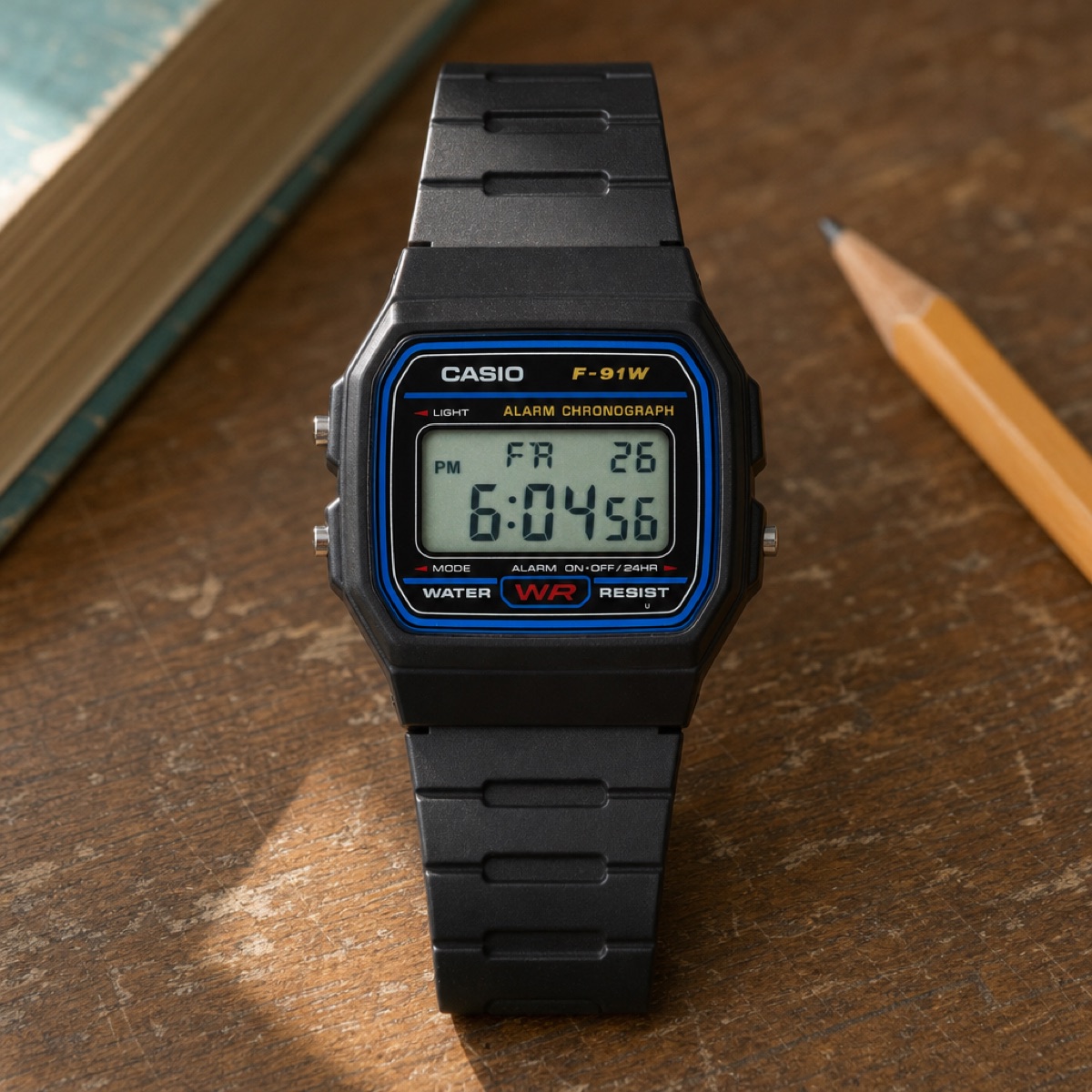
The other watch from this decade that matters is the cheapest. The F-91W arrived in 1989 at about US$20 and is still made, at a little over $10 (IEEE Spectrum). Casio calls it "a record-breaking bestseller" and gives no number (Casio). IEEE Spectrum is blunter: "Casio has never provided sales figures for its watches, nor has it revealed its manufacturing output", and the figure you'll see everywhere, three million a year, is "a commonly cited estimate" with no primary source. The 1991 launch date that circulates comes from a Wikipedia error. I think the F-91W is a better emblem of Casio than the G-SHOCK is: an unremarkable, accurate, indestructible object sold by the tens of millions with no story attached, which is exactly what the Kashios set out to make.
The boom and the bust, 1990–2001
The G-SHOCK became a fashion object by accident and abroad. The DW-5900C, the "three-eye", was released outside Japan in 1990 and "made an especially big hit with skateboarders on the US West Coast"; Japanese clothing shops started re-importing it, Japanese magazines ran American street style, and Casio finally released it at home in 1992 (gshock.casio.com, Casio). Casio's own figures for Japan are the only hard ones: "about 10,000 in 1990 to about 700,000 by 1995". Then, in Casio's words, "In 1997, 6.0 million G-SHOCK watches were sold around the world, which includes 2.4 million units shipped in Japan" (Casio).
The product range filled out in the boom. The DW-6300 Frogman of 1993 was the first G-SHOCK diver to meet the ISO 200-metre standard, the first with an asymmetric case and the first with a nickname (gshock.casio.com). Baby-G followed in December 1994, the round DW-6900 in March 1995, and the Pro Trek brand in January 1995, a year after the ATC-1100 had put an altimeter, barometer, compass and thermometer in one watch (Casio, Fratello). Casio's first radio-controlled watch, the FKT-100L, was sold only in Germany from June 1995, because Germany had a time signal and Japan's was still experimental; Junghans had beaten everyone to the radio-controlled wristwatch with the Mega 1 in 1990 (Casio, Royal Museums Greenwich). Keanu Reeves wore a DW-5600C in Speed in 1994, the first collaboration came with Stüssy in 1997 on the DW-6900, and BAPE followed a year later (Hodinkee Japan, Complex). In 1996, "in the 13th year since the debut of the G-SHOCK, the watch goes full-metal" with the MRG-100, built to reach adults who wouldn't wear a resin watch (gshock.casio.com).
Then it fell. Casio's own diagnosis, written twenty years later, is the most interesting sentence in its history: "After hitting a peak in 1997, G-SHOCK shipment numbers began to decline. This may have been due to the launch of many collaborative models and too much focus on the watch as a fashion symbol", at the expense of what it calls the core feature, shock resistance (Casio). A Blog to Watch, after a visit to Casio, heard a plainer version: "everyone who wanted a G-Shock had one" (A Blog to Watch). How far it fell, Casio doesn't say. The International Directory of Company Histories links the G-SHOCK slump to poor group results in fiscal 1999, and by the year to March 2002 Casio was reporting a net loss of ¥24,928 million, which it blamed mainly on digital cameras and PDAs, and cutting 3,000 jobs (FundingUniverse, Casio, The Register).
The response was to go back to engineering. Tough Solar arrived on the DW-9300 Raysman in 1998, radio control on the GW-100 in 2000, and both together on the GW-300 in 2002 (gshock.casio.com). Casio named watches one of three strategic businesses in its 2002 annual report, with solar radio-controlled Wave Ceptor watches as the plan (Casio). None of this was first: Citizen's Crystron Solar Cell of 1976 was the first analogue solar watch and Ragen's Synchronar the first solar watch of any kind in 1972 (Seiko Museum). What Casio did was put the technology into watches that cost a tenth of its rivals' and sell them by the million.
Radio, solar and the collapse of everything else, 2001–2015
The 2000s were the decade Casio's watches became its best business while the rest of the company fell apart. The Wave Ceptor WVA-300 of November 2001 was the first solar radio-controlled Casio sold worldwide; Oceanus, launched in November 2004, was the analogue flagship, a full-metal radio-solar chronograph whose movement was built in a clean room at Yamagata Casio, the company's own factory in the north of Honshu (Casio, Casio). In June 2008 the GW-9200 Riseman brought Multi-Band 6, reception from six time-signal transmitters including China's, which Casio calls a world's first with the footnote "Based on a Casio survey as of May 2008" (gshock.casio.com). Every Casio "first" from here on carries that footnote, and I've come to read it as honesty: the company is telling you it checked, and how.
The numbers tell the other story. In the year to March 2009 Casio's phone business turned over ¥163.2 billion, twice the ¥80.4 billion its watches did, and the group posted a net loss of ¥23.1 billion (Casio). A year later the operating loss was ¥29.3 billion and the net loss ¥20.9 billion, "primarily due to the sharp decline in sales of cellular phones", while watches and electronic dictionaries, in the company.s words, "remained highly profitable" (Casio). The phone business was folded into NEC Casio Mobile Communications in June 2010 and the TFT-LCD business handed to a Toppan joint venture in April (Casio). The fiftieth-millionth G-SHOCK had shipped in December 2009, in the middle of all this (Casio).
The watch line kept moving. The oversized GA-110 of 2010 became, by Casio's own 2019 ranking as reported by G-Central, the best-selling G-SHOCK of all time worldwide, with the GA-100 second and the DW-6900 third (G-Central). The GB-6900 of March 2012 was the first G-SHOCK to talk to a phone, over Bluetooth Low Energy; Casio claims the first Bluetooth 4.0 watch, which is defensible, and Sony Ericsson and Fossil had sold a Bluetooth 2.0 watch in 2006 (Casio, PhoneArena). A new watch plant opened in Thailand in April 2012. The GPW-1000 of July 2014 combined GPS and radio time signals, another footnoted first (Casio). For the thirtieth anniversary in 2013 Casio staged "Shock the World" in New York with Eminem performing and Ibe in the audience (Casio America). In June 2015 Kazuo Kashio, president since December 1988, handed the job to his son Kazuhiro (Casio).
The company that watches carry, 2015–2026
Casio's one attempt at a smartwatch proper, the Android Wear WSD-F10 announced in January 2016, came and went; I found no Casio statement ending the line, only a 2024 notice withdrawing app support (Casio). The hundred-millionth G-SHOCK, an MRG-G1000B, left the Yamagata factory in August 2017 (Casio). In the year to March 2018 Casio booked the cost of "withdrawing from the compact digital camera market", the business the QV-10 had started in 1995 (Casio). Kazuo Kashio died on 18 June 2018, aged 89 (SCMP/AP).
AI-generated illustration.
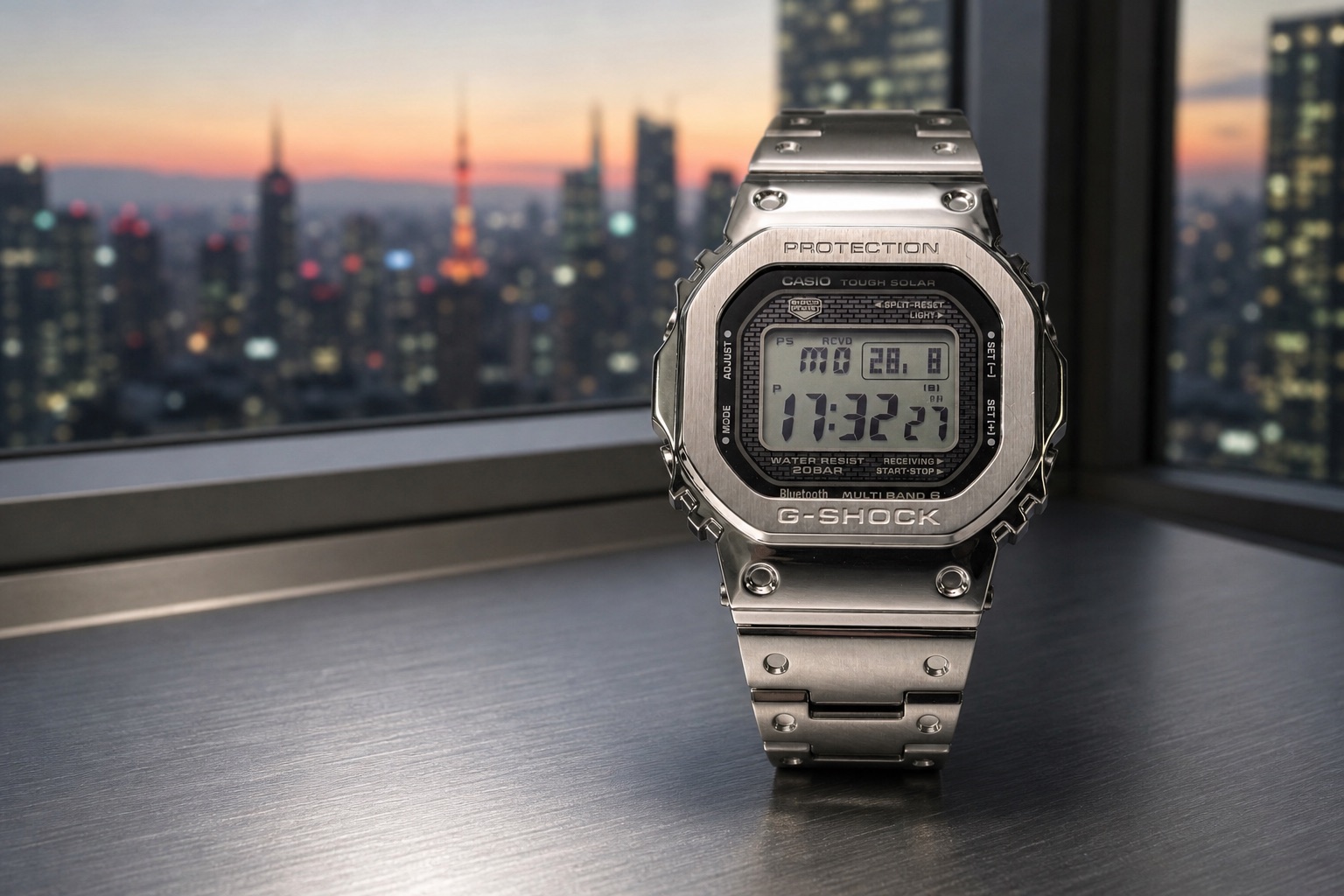
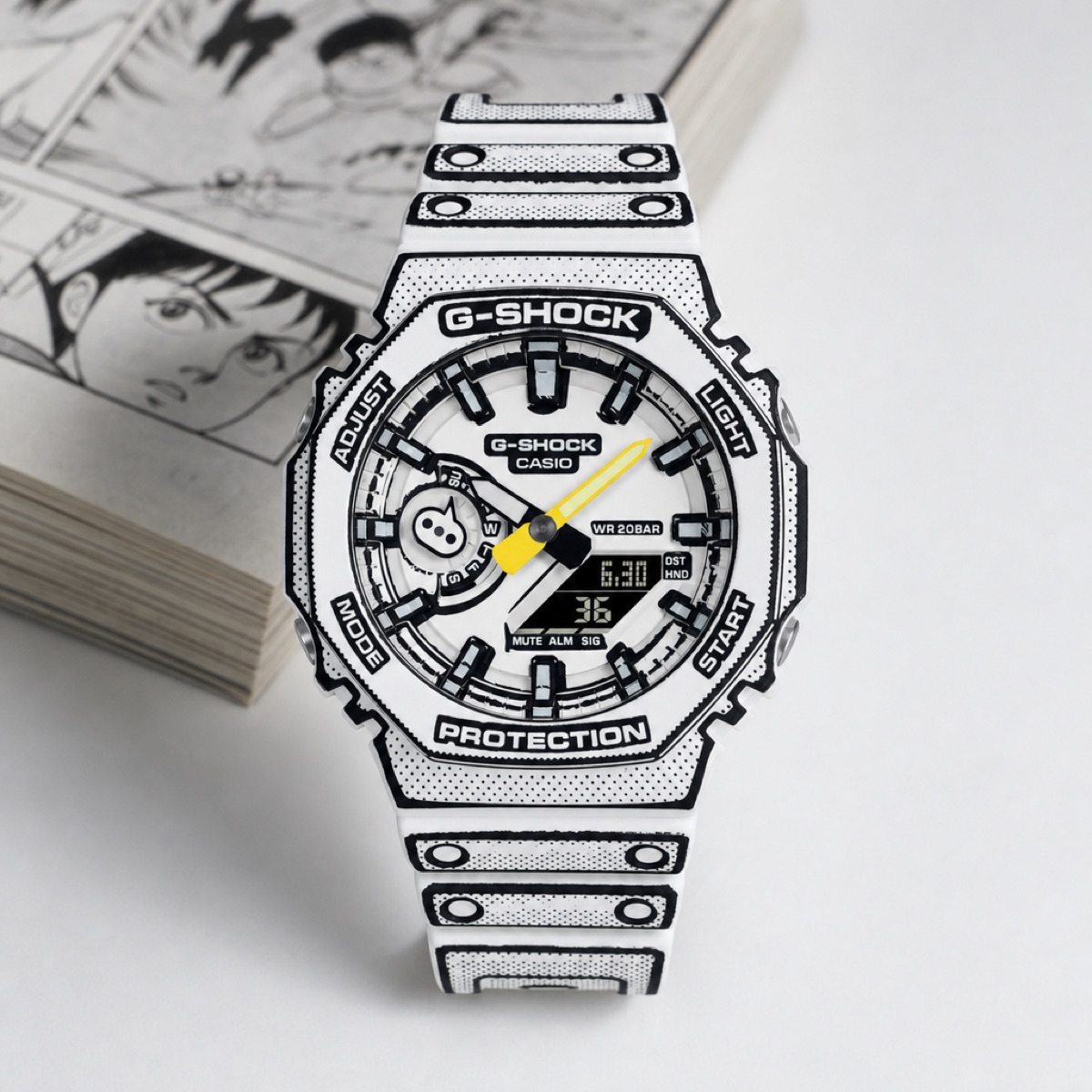
The watches themselves went two ways at once. Upmarket, the GMW-B5000 of April 2018 was "the first full-metal take on the first-ever G-SHOCK", the 1983 square in stainless steel with Bluetooth, launched at Baselworld alongside a solid-gold one-off Casio wouldn't sell (gshock.casio.com, SJX). The MRG-B5000 of 2022 put the same shape into titanium at ¥396,000 to ¥462,000 (Impress Watch). Downmarket, in August 2019, came the GA-2100: an analogue-digital G-SHOCK 11.8 mm thick in a carbon-reinforced case, with "the octagonal form of the very first G-SHOCK" and, as SJX put it, a bezel "immediately reminiscent of the Royal Oak" (gshock.casio.com, SJX). The black version sold out from late 2019, counterfeits appeared within months, and by 2020 it was, in Time+Tide's words, "the first time that a regular production G-Shock collection started selling above it's recommended retail price on the secondary market" (Time+Tide). The nickname "CasiOak" is the internet's. I own the two manga-print versions Casio released in 2024, the white and the blue.
AI-generated illustration.
The fortieth anniversary in 2023 brought two things that matter more than the anniversary models. On 26 June the Japan Patent Office registered the shape of the DW-5000C, with no logo or text, as a three-dimensional trademark, number 6711392, "the first time a 3D trademark has ever been registered in Japan for the shape of a wristwatch alone"; Casio put cumulative G-SHOCK shipments at more than 140 million in the same release (Casio). And in April 2023 Yuichi Masuda, who had joined in 1978 and led the project team that produced the G-SHOCK, became the first president from outside the Kashio family since 1957 (Casio, SJX). That December a one-off gold G-SHOCK, the G-D001, sold at Phillips in New York for $400,050 against an estimate of $70,000 to $140,000, the most anyone has paid for a Casio (Phillips).
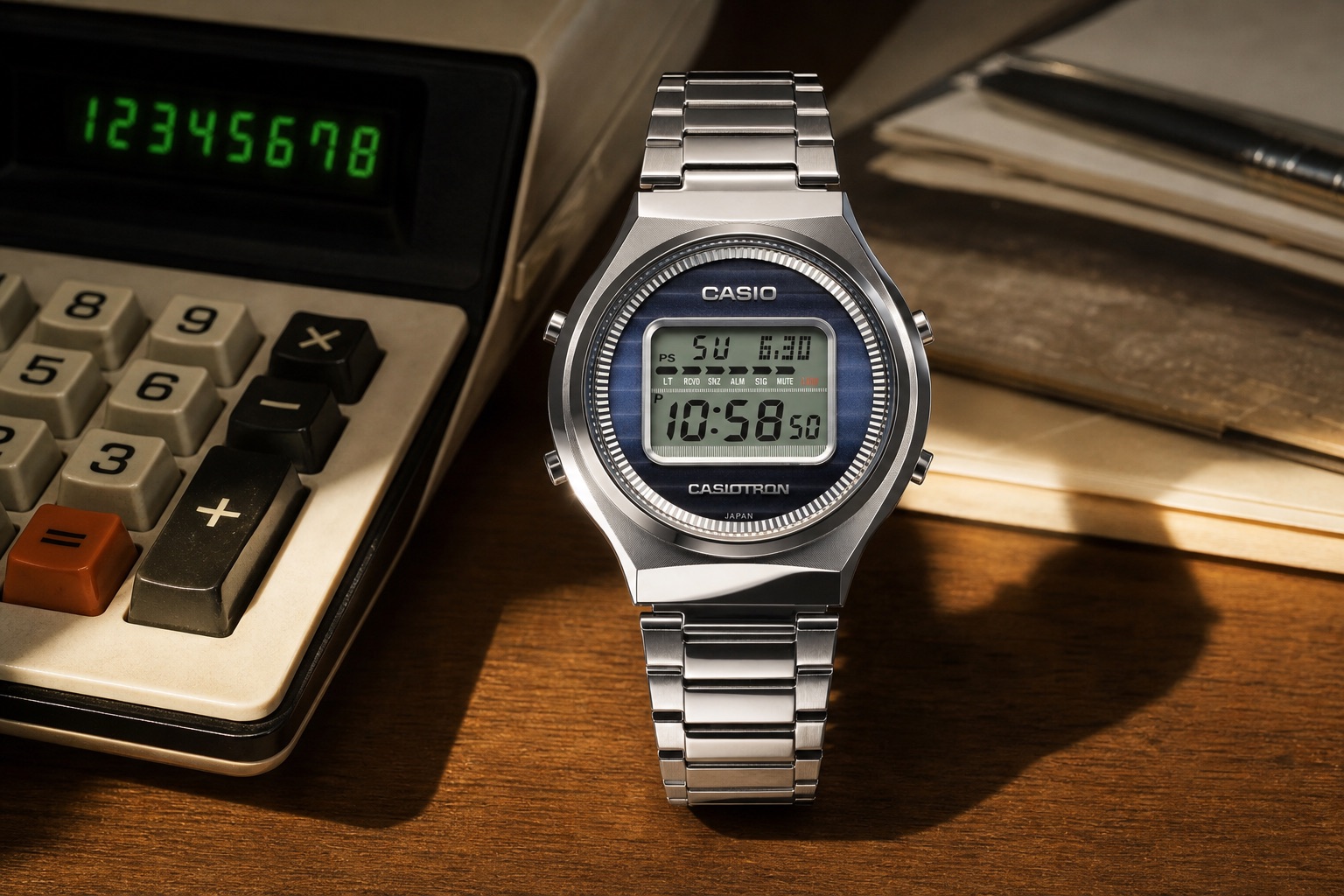
Then the bad year. On 5 October 2024 Casio's servers were "illegally accessed from overseas" in a ransomware attack. The company's own investigation, published in January 2025, blamed "deficiencies in the company's measures against phishing emails and its global network security system", counted 6,456 employees, 1,931 business partners and 91 customers whose data leaked, and said Casio "has not responded to any unreasonable demands from the ransomware group" (Casio). The results for the year admit that procurement, production and shipments were partly suspended until systems were restored (Casio). The same year was the watch business's fiftieth, marked with the TRN-50, a 4,000-piece reissue of the 1974 Casiotron at the original ¥58,000 list price before tax, and with the Ring Watch CRW-001, a working digital watch the size of a finger ring, which Casio America tied back to the yubiwa pipe of 1946 (Casio, Casio America).
AI-generated illustration.
The leadership changed again in 2025. On 27 June Shin Takano, the chief financial officer, became president and CEO; Masuda moved to adviser, and Kazuhiro Kashio went from representative director and chairman to director and chairman, giving up his representative rights (Casio). Headcount fell from 8,801 to 8,259 over the year under a restructuring that cost ¥8.3 billion in extra retirement payments (Casio). In July 2025 Casio released its first mechanical watch, the Edifice EFK-100, and in November a G-SHOCK the size of a ring (Casio). Fifty-one years after it told the watch industry it didn't intend to compete with it, Casio had started making the thing the industry made.
What Casio gave watchmaking
The first thing is a category. Before 1983 a watch was a delicate instrument, and shock protection meant Incabloc springs around a mechanical balance. Casio built a watch to be dropped, from the structure out, and the industry followed: Timex's Ironman, Luminox, Suunto and every "tactical" watch since sell the idea Ibe's team proved. The Japan Patent Office's 2023 decision that the DW-5000C's shape alone identifies its maker is as good a measure of that as exists (Casio). The National Museum of Nature and Science registered the DW-5000C as an Essential Historical Material for science and technology in 2019, as it had the Casio Mini in 2008 and the AL-1 calculator in 2014 (Impress, Casio).
The second is price. Casio didn't set the floor of the digital-watch market; Texas Instruments' sub-$10 watches did, briefly, before TI left the business. Casio stayed. The F-91W at $10 to $20, made continuously since 1989, is the reference point against which every other watch's price is a choice.
The third is a list of firsts that are narrower than the folklore, and I think it's worth being exact about them, because Casio is. Casio's own claims, each on its own page, are: first digital watch with an automatic calendar (1974), first Casio calculator watch (1980, and Casio says "Casio"), first solar radio-controlled watch for six transmitters (2008, "based on Casio survey"), first watch with Bluetooth 4.0 (2012), first GPS-and-radio hybrid (2014). The firsts that belong to others are the digital watch (Hamilton Pulsar, 1972), the solar watch (Ragen Synchronar, 1972; Citizen for analogue, 1976), the radio-controlled watch (Junghans Mega 1, 1990) and the Bluetooth watch (Sony Ericsson and Fossil, 2006) (Guinness World Records, Seiko Museum, Royal Museums Greenwich, PhoneArena). The one clean Casio first I could confirm independently is the PRT-1GP of 1999, the first watch with built-in GPS, which the same national museum registered in 2021 (Gizmodo, Fashionsnap).
Then there are the places Casio's watches turned up. NASA approved the DW-5600 in its C and E versions for astronauts' use on the Shuttle and the International Space Station, according to collectSPACE; I found no NASA document, so that rests on one specialist source (collectSPACE). US Navy photographs show SEALs wearing G-SHOCKs, and the specialist site Watches of Espionage says digital watches are what gets issued, but I found no contract or stock number, so "worn by" is as far as the evidence goes (Watches of Espionage). The darkest entry is the F-91W. The Guardian's reading of the leaked Guantánamo detainee files in 2011 found the watch treated as "the sign of al-Qaida" by the analysts there, with 32 detainee records citing the black F-91W and 20 the steel A-159W, on the grounds that the watch had been handed out at bomb-making courses (The Guardian). A watch that tens of millions of people owned was being used as evidence against the ones who were detained.
And there is the culture, which Casio stumbled into and then learned to run. Marty McFly's calculator watch, Keanu Reeves's DW-5600C in Speed, Stüssy in 1997, BAPE in 1998, Ye in a pink G-SHOCK and Pharrell in one set with diamonds on the cover of Complex in September 2007 (Complex). Casio's own verdict on the 1990s, that it had chased fashion and forgotten toughness, is the rare case of a watch company diagnosing its own hype.
Significant references
| Reference | Model | Years | Why it matters |
|---|---|---|---|
| QW02 | Casiotron | 1974 | Casio's first watch, with an automatic calendar; ¥58,000 |
| C-80 | Calculator watch | 1980 | First Casio calculator watch; the CA-53W descends from it |
| DW-5000C | G-SHOCK | 1983 | The first G-SHOCK; its shape is now a 3D trademark |
| DW-5200C | G-SHOCK | 1984 | The hockey-puck watch; "The Hero" that kept the line alive |
| DW-5600C | G-SHOCK | 1987–1996 | The square everyone pictures; sold nine years; worn in Speed |
| F-91W | 1989– | $20 in 1989, still made; Casio's "record-breaking bestseller" | |
| DW-5900C | G-SHOCK | 1990–1992 | The three-eye that started the Japanese boom by re-import |
| DW-6300 | G-SHOCK Frogman | 1993 | First ISO 200 m G-SHOCK diver; first with a nickname |
| DW-6900 | G-SHOCK | 1995– | Front-button round case; Casio's best seller in Japan; first collaboration |
| MRG-100 | MR-G | 1996 | First full-metal G-SHOCK, aimed at adults |
| GA-110 | G-SHOCK | 2010– | Casio's best-selling G-SHOCK worldwide, by its 2019 ranking |
| GMW-B5000 | G-SHOCK Full Metal | 2018– | The 1983 square in steel; the start of the upmarket squares |
| GA-2100 | G-SHOCK | 2019– | The "CasiOak"; first regular G-SHOCK to trade above list |
Casio today
As of November 2026, Casio Computer Co., Ltd. is a listed company on the Tokyo Stock Exchange's Prime market with no parent and no controlling family stake: the disclosed Kashio family trust held about 2.9% of the shares at March 2025, trust banks hold the big nominee blocks, and the founding family's remaining presence on the board is Kazuhiro Kashio as director and chairman (Casio). Shin Takano has been president and CEO since June 2025. The group reported sales of ¥276.2 billion for the year to March 2026, of which watches were ¥184.9 billion, and in July 2026 it raised its forecast for the current year to ¥300 billion of sales and ¥34 billion of operating profit, citing the watch strategy and a refund of US tariffs (Casio, Casio).
The watch business runs on two brands, G-SHOCK and what the company now calls CASIO WATCH, the cheap steel and resin digitals and analogues like the A158WA that are selling in India, Brazil and ASEAN; the mid-term plan to March 2029 wants watch sales of ¥207 billion and ¥32.5 billion of operating profit, with Edifice mechanicals and ring watches as the new lines (Casio). Casio says G-SHOCK "sells more than six million units annually", has shipped more than 160 million in all, and is sold through about 2,300 branded stores (Casio). Watches are assembled at Yamagata Casio in Japan, which the company calls its "mother factory", and at plants in Thailand and China; Casio doesn't say what share comes from where (Casio). Europa Star, visiting in 2026, put it simply: watches are "more than 60% of total group revenue" and "the company's primary profit engine" (Europa Star).
Sources
- Casio, corporate history, 1946–1969
- Casio, corporate history (Japanese)
- Casio, Product History chronology
- Casio, history chapters 1970–, 1990–, 2000–, 2010–, 2020–
- Casio UK, company history 1970s, 1980s, 1990s
- Casio, The Four Kashio Brothers: story 1, story 2, story 3, story 5, story 7, Toshio profile
- Casio, Watch 50th Heritage 1970s (archived), 1980s (archived)
- Casio, Brand History of G-SHOCK
- Casio, 100 millionth G-SHOCK release, September 2017 (reproduced) and via PR Newswire
- Casio, 3D trademark release, 9 August 2023
- Casio, ransomware investigation results, 7 January 2025
- Casio, TRN-50 release, 15 February 2024 (Japanese)
- Casio, WSD-F10 release, 6 January 2016
- Casio, Annual Report 2002, Annual Report 2009, results FY March 2010, CSR Report 2011, Oceanus
- Casio, results FY March 2018, FY March 2025, FY March 2026, Q1 FY March 2027
- Casio, Medium-Term Management Plan, May 2026, Integrated Report 2025, executive changes, 22 April 2025
- Casio, securities report FY March 2025 (EDINET)
- Casio America, 30th anniversary release, 7 August 2013, CRW-001 release, 19 December 2024
- IPSJ Computer Museum, Casio 14-A
- Pierre-Yves Donzé, "The Casio digital revolution", Watchonista
- nippon.com, Ibe Kikuo and the development of the G-Shock, the Toshio Kashio museum
- Dezeen, interview with Kikuo Ibe, 2016
- Hodinkee Japan, the world's rarest G-Shock and Kikuo Ibe, calculator watches, Speed
- Fratello, the best G-Shocks of the 1980s, 40 years of G-Shock
- SJX, Yuichi Masuda interview, 2019, GMW-B5000 at Baselworld 2018, GA-2100, 2019
- A Blog to Watch, Casio headquarters visit, 2016
- Time+Tide, GA2100-1A hands-on
- IEEE Spectrum, Casio F-91W
- The Guardian, Guantánamo files: the Casio wristwatch, 2011
- collectSPACE, NASA and the G-Shock DW5600, 2020
- Watches of Espionage, the watches of Navy SEALs
- Complex, how G-Shock became a streetwear staple
- Phillips, New York Watch Auction: NINE, lot 79, G-D001
- Guinness World Records, first electronic digital watch
- Seiko Museum, solar-powered watches
- Royal Museums Greenwich, Junghans Mega 1
- PhoneArena, Sony Ericsson MBW-100, 2006
- Gizmodo, early smartwatches: Casio PRT-1GP
- Fashionsnap, PRT-1GPJ registered as an Essential Historical Material, 2021, Travel Watch Impress, DW-5000C registered, 2019
- Impress Watch, MRG-B5000BA, 2022
- G-Central, Casio's three top-selling G-Shocks, 2019
- FundingUniverse, Casio Computer Co., Ltd. history
- The Register, Casio cuts 17% of workers, 2001
- SCMP/AP, Kazuo Kashio dies aged 89, 2018
- Europa Star, Casio: a democratic vision in a luxury-led era, 2026