Rolex
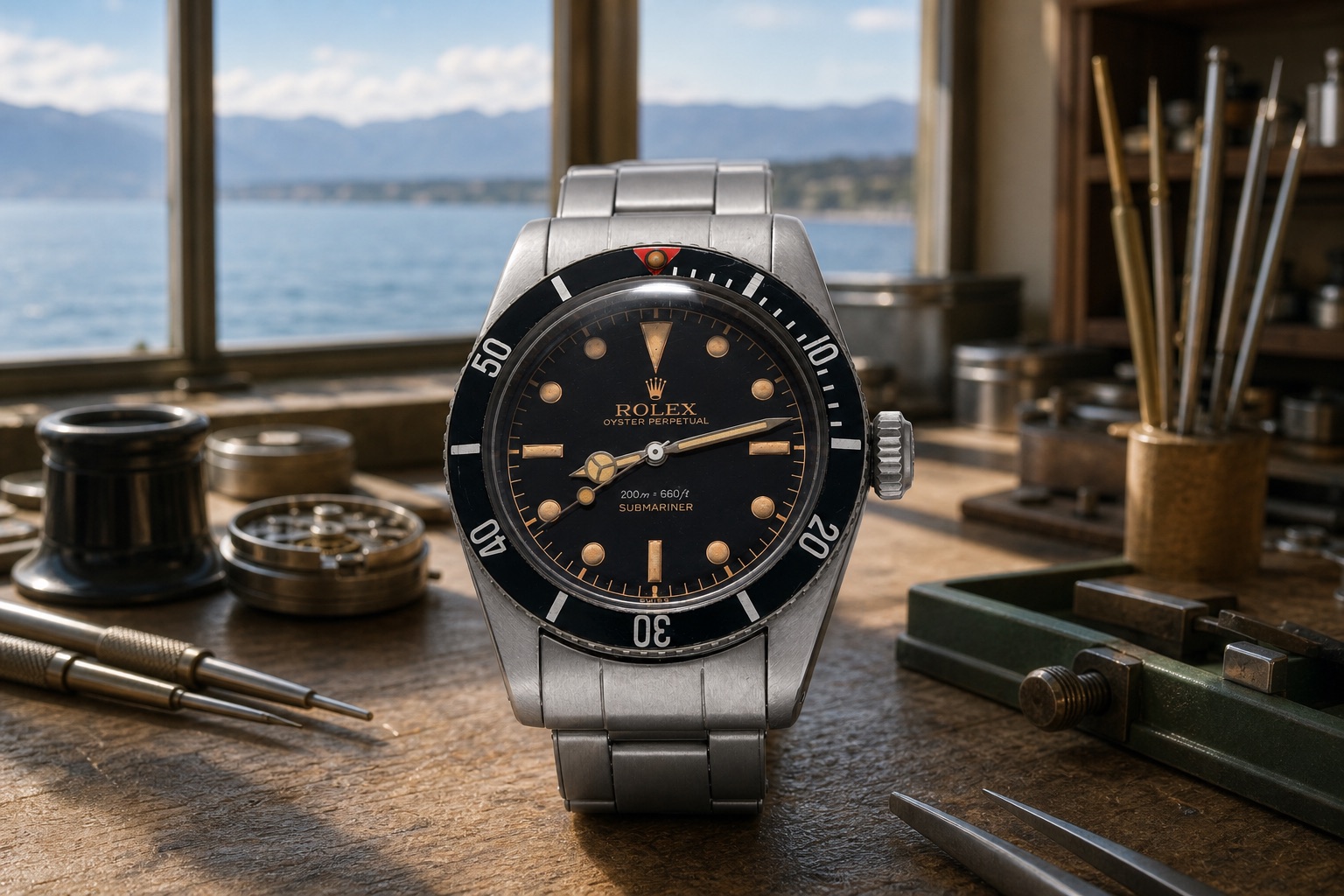
AI-generated illustration.
Rolex sold about a third of the Swiss watch industry's value in 2025, by Morgan Stanley and LuxeConsult's estimate: roughly CHF 11 billion at wholesale and about 1.15 million watches. Rolex publishes none of these numbers, so they're estimates, but the gap isn't close: Cartier, in second place, is put at 8.7%. Rolex is the biggest name in the business by a distance.
It started as something much smaller and much less Swiss. Wilsdorf & Davis, founded in London in 1905, was an importer. It bought watches from a movement maker in Bienne and sold them to British jewellers, and if a name went on the dial it was usually the jeweller's (Boettcher). Hans Wilsdorf, the partner who ran it, "freely admitted that he was not a watch maker," in the summary of the researcher David Boettcher, and thought "as a marketing person" (Boettcher). Rolex didn't own the factory that made its movements until 2004 (Time Files).
That's the thread I'd follow through the whole history. I think Rolex invented less than its reputation suggests. The screw-down crown on the first Oyster was bought from two other watchmakers, and someone else sold a self-winding wristwatch before the Perpetual. What Rolex did better than anyone was prove things in public and keep telling the story: chronometer certificates, a Channel swimmer, mountaineers, a bathyscaphe at the bottom of the Challenger Deep. The business historian Pierre-Yves Donzé argues that until the 1950s Rolex "was a mid-sized company that followed the same strategies as its competitors," and that the legend only took shape in the 1960s, under Wilsdorf's successor (swissinfo). This is that history, including the parts Rolex's own history page leaves out.
Timeline
These are the best-supported dates I found. Where sources split on a year, the era sections say so.
| Year | Event |
|---|---|
| 1905 | Hans Wilsdorf and Alfred Davis found Wilsdorf & Davis in London to import Swiss watches |
| 1908 | "Rolex" registered as a Swiss trademark, 2 July |
| 1914 | A small Rolex wristwatch passes the Class A trial at Kew, 15 July |
| 1915 | Britain puts a 33⅓% duty on imported watches; the firm becomes The Rolex Watch Company Ltd |
| 1919–1920 | The business moves to Geneva; Montres Rolex SA is set up in January 1920 |
| 1926 | Wilsdorf acquires the Perregaux and Perret screw-crown patent; the Oyster |
| 1927 | Mercedes Gleitze wears an Oyster on her vindication swim, 21 October |
| 1931–1933 | Aegler files the self-winding patents; the Perpetual reaches the market |
| 1945 | Hans Wilsdorf Foundation set up; the first Datejust, reference 4467 |
| 1953–1956 | Submariner, Explorer, GMT-Master and Day-Date |
| 1960 | Trieste reaches the Challenger Deep with a Rolex outside, 23 January; Wilsdorf dies |
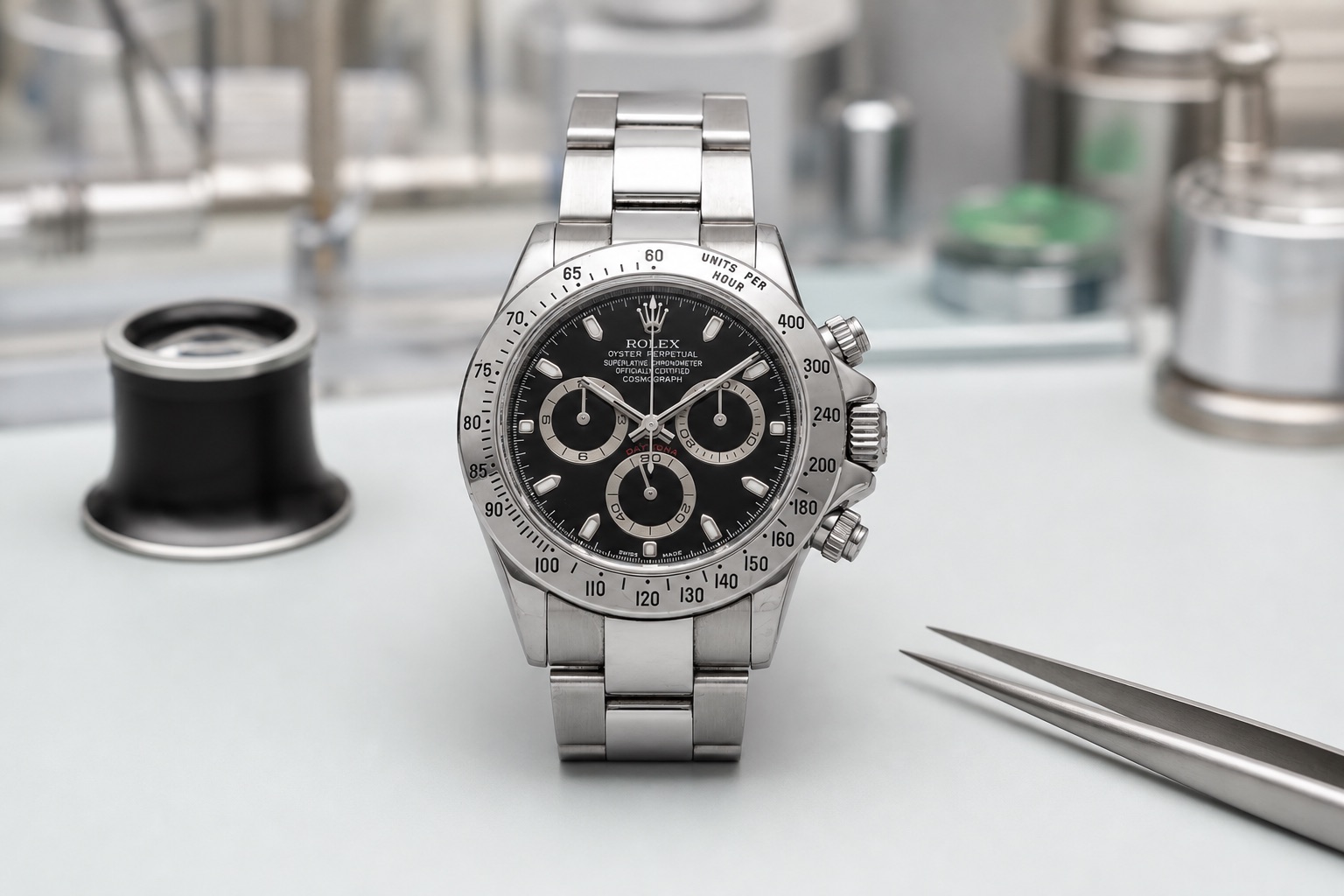
| 1963 | The Cosmograph, later the Daytona |
| 1967 | Sea-Dweller and the helium escape valve patent |
| 1970 | Quartz Date 5100, on the shared Beta 21 movement |
| 1977 | Oysterquartz, with Rolex's own quartz movement |
| 1988 | Automatic Daytona 16520, on a Zenith-based movement |
| 1998–2004 | Rolex buys its bracelet maker, its dial maker and finally its movement maker |
| 2000 | First in-house chronograph movement, the 4130 |
| 2022 | Certified Pre-Owned; plans for a CHF 1 billion factory at Bulle |
| 2023 | Rolex agrees to buy Bucherer, its biggest retailer |
A London importer, 1905–1919
Wilsdorf came to watches through trade. He was born in Kulmbach, Bavaria, in 1881, lost both parents young, and at 19 took a job as the English-language correspondent of Cuno Korten, a watch exporter in La Chaux-de-Fonds. In 1903 he moved to London (Boettcher, Fratello). His partner is a much thinner figure. Boettcher, who has done the most work on the early firm, describes Alfred James Davis as an investor introduced through Wilsdorf's solicitors, and says Davis married Wilsdorf's sister Anna in 1908. Most histories call Davis a brother-in-law from the start, which on Boettcher's dates he wasn't yet.
The two founded Wilsdorf & Davis "on 22 June 1905 as equal partners, with its address at 83 Hatton Gardens" (Boettcher). It was a wholesaler. The firm bought Swiss watches, the best of them with small lever movements from Aegler in Bienne, and sold them on to retailers. "In the early twentieth century, British retailers usually refused to have a brand name on the watches they sold," Boettcher writes, and Fratello says it took nearly twenty years before every watch the company sold carried its name on the dial (Fratello).
Aegler wasn't Rolex's factory in any sense that involved ownership. In the early years Wilsdorf was one of many customers, and Aegler also supplied Gruen in the United States (Boettcher). The two firms swapped shares in the 1920s, bought them back in the 1930s and signed an exclusive arrangement in 1936 (Time Files). The Aegler and Borer families kept the company.
The name came three years in. Wilsdorf & Davis registered Rolex as a Swiss trademark on 2 July 1908, through its office in La Chaux-de-Fonds (Boettcher). Where the word came from is less settled than the story you'll usually read. Wilsdorf later said a genie whispered it in his ear on the top deck of a horse-drawn omnibus in Cheapside (Airmail). His own 1946 company history lists what he wanted from a name (short, easy to remember, pronounced the same in every European language) and, in Boettcher's words, "doesn't reveal where the name came from." The "horological excellence" acronym on dealer sites has no source that I could find.
Wilsdorf's first move to set his watches apart was precision, tested in public. In 1910 Aegler sent a Rolex wristwatch to the rating office in Bienne, and it came back with a First Class certificate. Antiquorum, repeating Rolex's account, calls it "the first wristwatch to be officially certified as a 'chronometer' in Switzerland" (Antiquorum). Boettcher, reading the records, says it wasn't the first watch of its size to get such a certificate, and that the Bienne standard "was lower than required for a Kew Class A certificate" (Boettcher).
Kew came in 1914. A small ladies' bracelet watch, serial 492282, had already failed once that year. Resubmitted, it was tested from 1 June to 15 July in five positions and three temperatures and passed Class A with 77.3 marks out of 100 (Boettcher, WatchTime). Boettcher calls it "the first time that a Kew A certificate had been awarded to a wristwatch." It wasn't the best watch tested that year: Paul Ditisheim scored 94.0 (Boettcher). I like the result more for that. A small importer put a ladies' watch through a public trial, failed, and sent it back until it passed.
The First World War moved the company out of Britain. From 29 September 1915 Britain charged a customs duty of "thirty-three and one-third per cent. of the value" on imported watches and their parts (Hansard). That November the London firm was incorporated as The Rolex Watch Company Limited (Boettcher). Checking and dispatch shifted to Bienne, so watches for other countries no longer had to pass through London. In 1919 Wilsdorf moved the business to Geneva, and on 16 January 1920 Montres Rolex SA was established there with Wilsdorf, Hermann Aegler and Emile Béha on the board. Davis was still a director in August 1919 and wasn't on the Geneva board in January 1920. Boettcher found no document that says how he left.
The Oyster and the Perpetual, 1920–1945
In Rolex's telling, the company's founding product is the Oyster of 1926, "the first truly waterproof watch-case in the world" in an Antiquorum essay that repeats the line (Antiquorum). The patent record tells a more interesting story. The screw-down crown that made the case work was patented by two La Chaux-de-Fonds watchmakers, Paul Perregaux and Georges Perret, who filed on 30 October 1925 (Google Patents). The rights passed to the case maker C.R. Spillmann on 19 July 1926 and to Wilsdorf five days later, according to the trade-gazette record Boettcher reproduces (Boettcher), and the American version, filed that October, names Perret "assignor to Hans Wilsdorf" (Google Patents). Wilsdorf filed his own crown patent in Switzerland on 18 October 1926 (Google Patents).
The waterproof wristwatch wasn't new either. Donzé argues that the idea "had already been around for decades," and swissinfo's account of his work adds that the Oyster "was also just one model among many, for Rolex had not decided on a particular product" (swissinfo). What the earlier screwed cases lacked was a seal at the winding stem. WorldTempus says those cases "did not seal well at the stem opening," and that the Perregaux and Perret crown was the fix (WorldTempus). So what Wilsdorf had in 1926 was a sealed case that worked and the right to sell it.
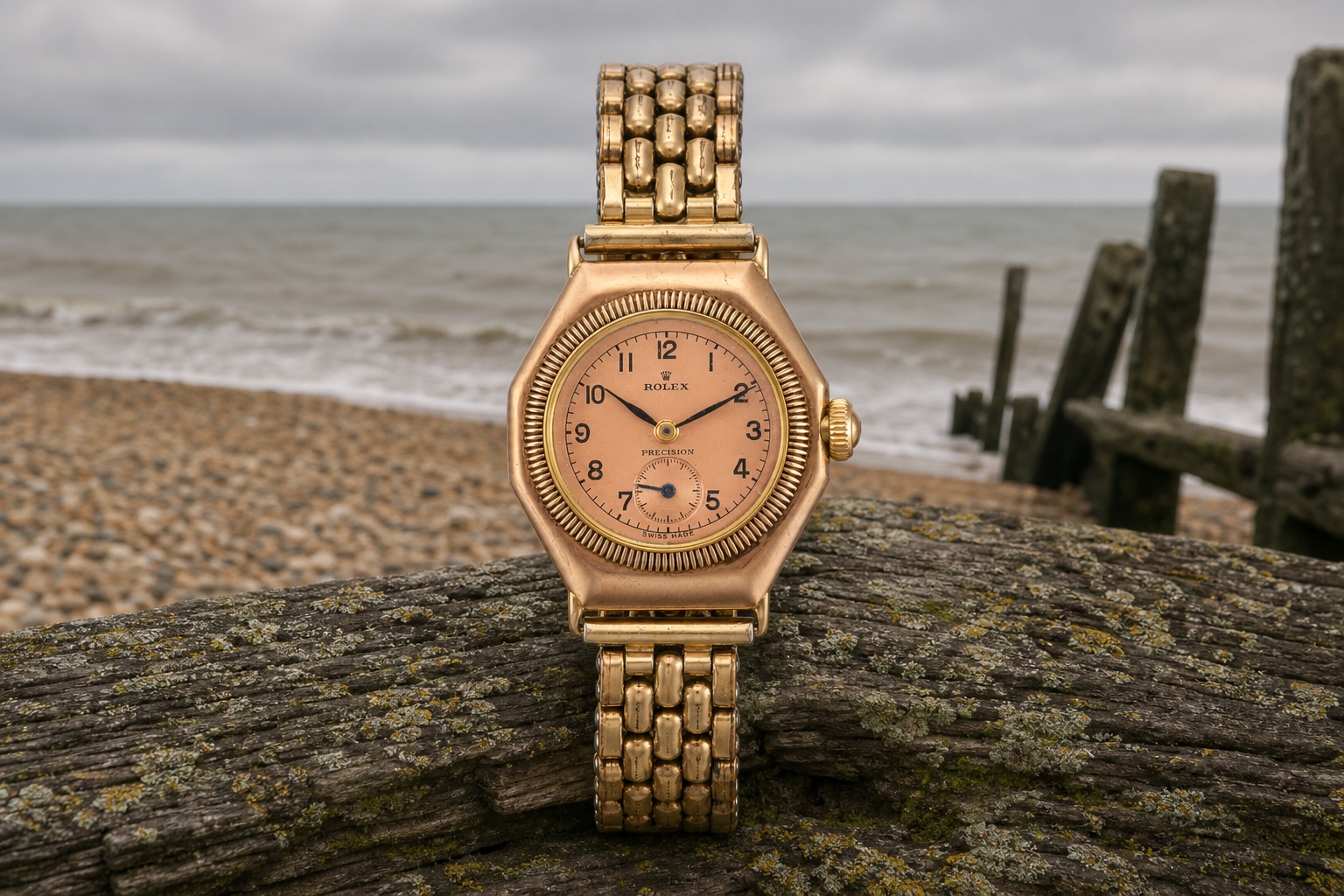
AI-generated illustration.
Then he proved it where people would see. In October 1927 Mercedes Gleitze swam the Channel. When another swimmer's false claim cast doubt on her crossing, she went back into the water on 21 October for what became known as the vindication swim, with an Oyster worn round her neck (Hodinkee Japan, Fratello). "Gleitze did not succeed in swimming completely across the channel," as Fratello puts it. After more than ten hours in cold water she had to give up. The watch kept running, and a few weeks later Rolex was advertising it in the Daily Mail (Hodinkee Japan). That became the method: give a watch to someone doing something hard, then advertise the watch.
The other half of the modern Rolex, the self-winding Perpetual, has the same shape. Rolex dates it to 1931 (Antiquorum). The patents were filed by Aegler, the first on 14 August 1931 and the next in January 1932 (Google Patents, Google Patents), and Sotheby's says the "Bubbleback made its debut in 1933" (Sotheby's). It wasn't the first self-winding wristwatch. John Harwood patented one in Switzerland in 1923, with a weight that swung through a limited arc between spring buffers (Google Patents), and Fortis started selling Harwood automatics on 13 July 1926 (Europa Star). The Perpetual's rotor turned all the way round. Fortis, which has no reason to flatter Rolex, says full-rotor systems "most notably Rolex's Perpetual rotor" became "the industry standard." Fratello credits the design to Aegler's technical director Emile Borer (Fratello). The patents I read name the Aegler company, and the American filing names Hermann Aegler (Google Patents).
The Depression hit an exporter hard. When the pound was devalued in 1931, Rolex's total exports fell by two thirds, which in Wilsdorf's words "spelled catastrophe for the firm" (Fratello). The answer was more promotion. Rolex ran adverts with the actress Evelyn Laye's Oyster-wearing wrist plunged into a fish tank (Fratello).
The Second World War produced the best and the worst stories told about Wilsdorf. British prisoners of war whose Rolexes had been confiscated could write to Rolex for a replacement, and Wilsdorf pledged that they needn't pay "until the war ended" (Fratello). The same British state was watching him. Papers from 1941 to 1943 in the National Archives, reported by the Telegraph in August 2025, call him "most objectionable" and "suspected of espionage." A 1941 report by the British consul in Geneva said he was "well known for his strong Nazi sympathies," citing a brother "reported to be an active member of [Joseph] Goebbels' propaganda ministry," and doubted that the prisoner-of-war watches were generosity. In 1943 MI5 concluded that he should not be blacklisted (The Telegraph, via Yahoo).
Donzé's book cites a Geneva police report describing Wilsdorf as a "fervent admirer" of Hitler's regime who was not active in propaganda himself. In interviews Donzé has said there is so little evidence that the allegations are hard to weigh (Time Files). Rolex told the Telegraph it had "commissioned an independent, authoritative team of historians" to research Wilsdorf's role in the period. I found no published findings by November 2026. I'm not going to settle the question here, and as far as I can tell nobody has yet.
Wilsdorf had no direct descendants, and in 1945 he set up the Hans Wilsdorf Foundation, which received all his shares when he died (Coronet, Revolution). Britannica dates the foundation to 1944. 1945 also brought the watch that put the pieces together. "Rolex released its very first Datejust, reference 4467, in 1945 to celebrate the firm's 40th anniversary," Phillips writes, with a date window at 3 o'clock on a self-winding Oyster (Phillips). Note what the anniversary counts from: the London partnership of 1905, not the Rolex name of 1908.
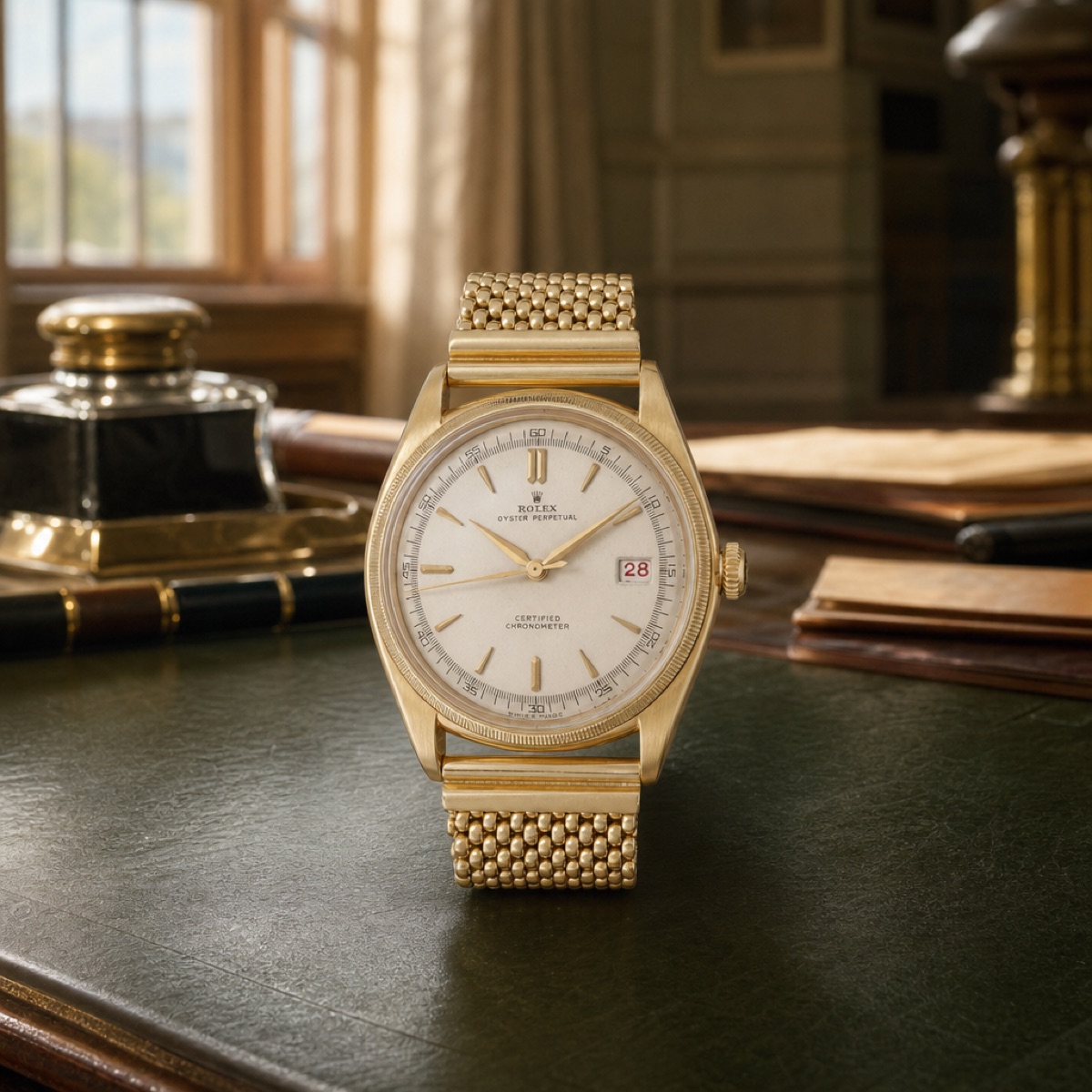
AI-generated illustration.
Tool watches, 1945–1960
The professional watches of the 1950s are the ones collectors build around now, and Donzé's point is that Rolex made them before it was a legend. They came fast. The Submariner reference 6204 was "first created in 1953 and officially launched in 1954 at the Basel Spring Watch Fair" (Sotheby's), and it was rated to 100 m. Blancpain's Fifty Fathoms got there a few months earlier, rated to 91 m (Fratello), so the Submariner was the deeper watch and the second one. The push came from René-Paul Jeanneret, a diver and friend of Jacques-Yves Cousteau who sat on Rolex's board (Monochrome). By 1955 there was the 6538, with an oversized 8 mm crown and no crown guards, made for only four years (Phillips).
Everest is where the gap between the record and the advert is widest. Rolex had backed the Swiss expedition of 1952, lending each climber a watch to be returned to Geneva for testing (Phillips), and it equipped the British expedition of 1953 with Oyster Perpetuals. Who wore what at the summit on 29 May 1953 is disputed. Phillips writes that Hillary and Tenzing got there "with a steel Rolex reference 6098 on the wrist." The Clockmakers' Museum says the watch Hillary gave it around October 1953 was a Smiths De Luxe, presented "after wearing it on his ascent up the mountain" (Outdoor Journal). Smiths supplied fifteen watches to the expedition (Fratello). Rolex itself now says only that the climbers were equipped with Oyster Perpetuals (Fratello). Either way, Rolex wasted no time: Phillips has sold a reference 6350 with "Explorer" on the dial and "IV.53" stamped inside its caseback (Phillips).
The GMT-Master 6542 followed in 1954, "designed for pilots" (Phillips) and, in Sotheby's words, designed "in collaboration with Pan American World Airways" (Sotheby's). Fratello says Rolex itself gives 1955. The auction houses all repeat the Pan Am story, but I found no Pan Am document behind it. The Day-Date, in gold or platinum only, was shown at Basel in 1956; Phillips has sold one made in the last quarter of 1955, before the launch (Phillips).
Tudor got its company in these years too. The name The Tudor had been registered for Wilsdorf in 1926 (Watchonista). In 1946 he set up a separate company so that his agents could sell a watch "at more modest prices than our Rolex watches" (Fratello).
The decade ended at the bottom of the sea. On 23 January 1960 Jacques Piccard and Don Walsh took the bathyscaphe Trieste to the floor of the Challenger Deep with an experimental Rolex Deep Sea Special fixed to the outside. Rolex puts the depth at 10,916 m (La Cote des Montres); a later example sold by Phillips is engraved "10908 meters" (Phillips). The watch that rode the hull went to the Smithsonian, given by Rolex that year (Phillips, Smithsonian). Wilsdorf died on 6 July 1960, aged 79 (Fratello), and his shares passed to the foundation.
From tool to status symbol, 1963–1992
André Heiniger, who had joined in 1948, took over in 1963 or 1964; sources split on the year (Antiquorum, Revolution). This is the period Donzé credits with the legend. Rolex worked with the advertising agencies J. Walter Thompson and De Garmo on a message that "spoke less about the machinery inside the watch and more about the people who wore it," in the words of a Coronet review of his book. Revolution says Heiniger's marketing turned Rolex watches from practical instruments into status symbols, and that he is "often credited" with the line "Rolex is not in the watch business. We are in the luxury business" (Revolution). I couldn't find a primary source for the quote, which is a pity, because it describes the next thirty years well.
The products of the period show how slowly that took. The Cosmograph, the chronograph that became the Daytona, arrived in 1963 with a manually wound Valjoux movement, and Phillips is blunt that it "was not an immediate commercial success upon release" (Phillips). It took until the late 1980s for collectors to catch up. When they did, they caught up hard: a 1968 reference 6239 that had belonged to Paul Newman sold at Phillips in New York in October 2017 for $17,752,500 (Phillips).
The Sea-Dweller of 1967 was a tool watch in the strict sense, rated to 610 m (Phillips) and, in Christie's words, "the first watch from the brand designed specifically for saturation diving" (Christie's). Phillips calls it "the first ever integration of a helium escape valve." Rolex filed its valve patent on 6 November 1967 (Google Patents). One researcher argues that Doxa developed a valve independently and tested it at Comex nine days after Rolex's filing; I couldn't confirm that beyond his blog (Perezcope). What the record does show is a Rolex letter of 1972 about an exclusive agreement with Comex (Phillips).
Then quartz arrived, and Rolex hedged. It had its first quartz patent in 1952, joined the Swiss consortium developing the Beta 21 movement, and "then opted to pursue an in-house quartz movement" (Christie's). The Quartz Date 5100 used the same Beta 21 as the other members' watches. It debuted on 5 June 1970, and all 1,000 numbered pieces sold (oysterquartz.net). Revolution calls it "the first Rolex to feature a sapphire crystal." In 1972 Rolex "bowed out of the CEH and began to develop their own quartz movement" (Revolution). The result was the Oysterquartz of 1977, with Rolex's own movement (Christie's).
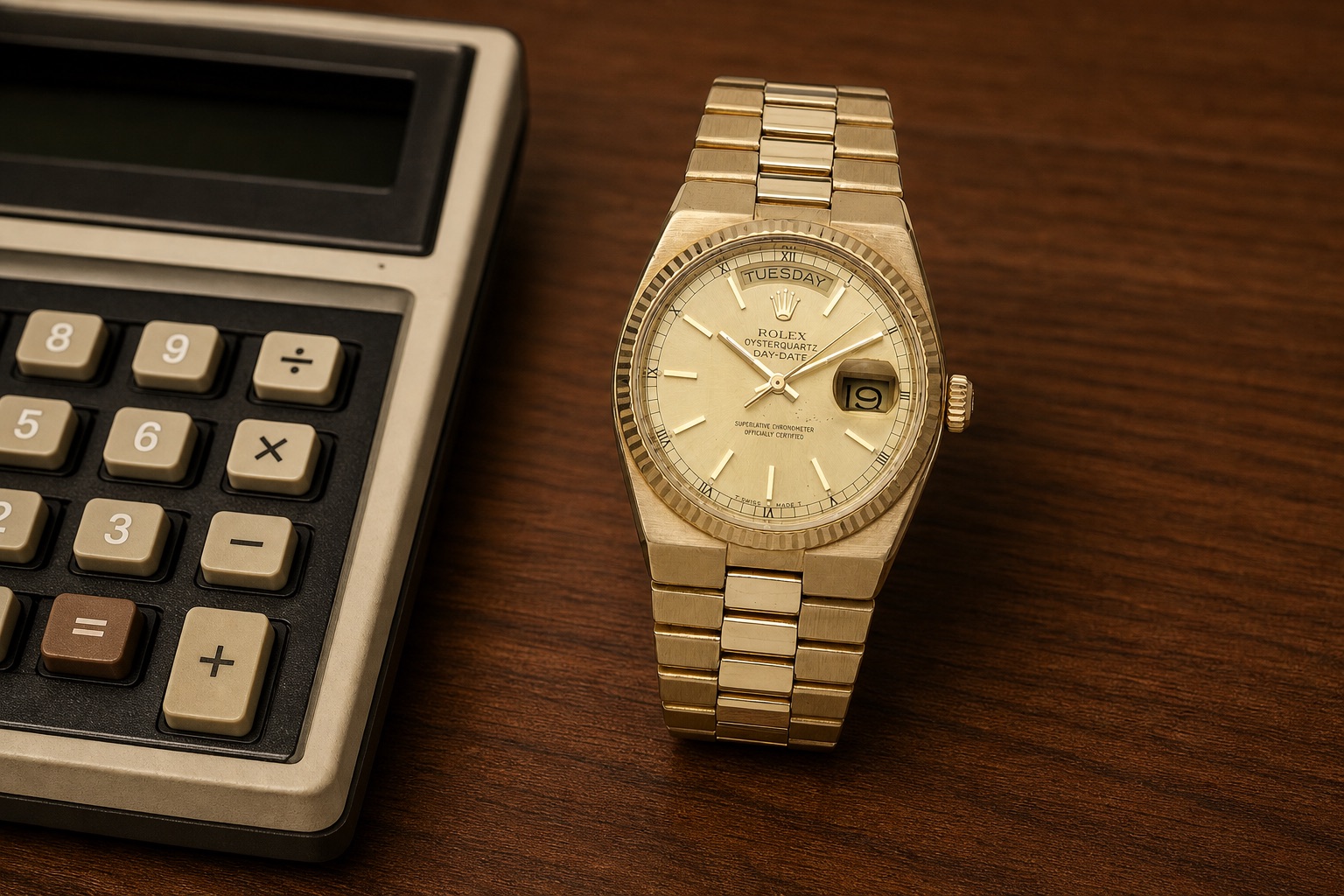
AI-generated illustration.
The rest of the industry had a much worse time. The Christian Science Monitor reported in 1982 that Swiss watchmaking "sustained a 30,000 employee drop between 1970 and 1981," and that ASUAG, the country's largest watch group, had 41% of its workforce on short time (Christian Science Monitor). Rolex, meanwhile, bought a building in downtown New York in 1977 for $15 million, and in swissinfo's account of Donzé's research it "emerged almost unscathed from that crisis" (swissinfo). I found no report of Rolex lay-offs in those years. That isn't proof there were none, but it fits.
Rolex moved its mechanical watches up at the same time. Phillips says it introduced the sapphire crystal in 1977 on gold Day-Dates and Datejusts (Phillips). In 1988 it finally gave the Daytona an automatic movement. The 16520 used a Zenith El Primero "substantially modified by Rolex" (Phillips), on a supply deal Phillips calls "one of the most lucrative contracts in the watchmaking industry" at the time (Phillips).
Buying the supply chain, 1992–2008
Patrick Heiniger succeeded his father in 1992 (Revolution), and his era answered a question most people never think to ask: how much of a Rolex did Rolex make? Less than you'd assume, until surprisingly late. In June 2000 Le Temps reported that Rolex had bought Beyeler & Cie, the Geneva dial maker that had supplied it for about sixty years, and noted that Rolex had bought the bracelet maker Gay Frères two years earlier (Le Temps, Europa Star). By 2006 the group also included the case maker Genex and the crown maker Boninchi (WatchTime). I couldn't confirm when those two were bought.
The biggest purchase came last. Before 2004, Time Files writes, Rolex and its movement maker in Bienne "were separate entities, with different owners." That year Harry Borer sold Manufacture des Montres Rolex SA to Rolex in Geneva (Time Files). I found no published price. In Geneva, about 19 production sites scattered in and around the city were being merged into three, in a building programme that was nearly finished by 2006. Heiniger called it a strategic decision "to secure our autonomy and keep control over the essential components of our watches" (WatchTime, my translation from the German). The same report describes a foundry where Rolex mixes its own gold alloys.
The watches changed along with the factories. In 2000 the Daytona's Zenith movement gave way to Rolex's "first in-house self-winding chronograph cal. 4130" in the 116520 (Phillips). I own two 116520s, and after my GMTs it's the watch I like most. Rolex also patented its own Parachrom hairspring alloy, filed in 1999 (Google Patents), which SJX reads as a way round its dependence on Nivarox, the Swatch Group's hairspring maker (SJX).
AI-generated illustration.
Scarcity, 2008–2026
After the Heinigers, Rolex went through three chief executives in six years. Bruno Meier, the former finance chief, ran it from 2008 or 2009 to 2011, and Gian Riccardo Marini from 2011 to 2014 (Revolution). In April 2014 Rolex named Jean-Frédéric Dufour, then running Zenith (swissinfo). In late 2015 it tightened its own Superlative Chronometer standard to −2/+2 seconds a day after casing, against the −4/+6 that COSC allows an uncased movement (Time+Tide).
Then the watches got hard to buy. By 2021 Fratello's Robert-Jan Broer wrote that "you can barely buy a Rolex," and that the shortage was "not limited anymore to steel (sports) models, but nearly to any models and any materials" (Fratello). I know that market from the buying side. In 2018 I wanted a GMT-Master II 116710LN for my dad's retirement, and I had a hell of a time finding an authorised dealer who'd sell me one. The secondary market cooled after that. The Bloomberg Subdial index of the fifty most-traded watches fell 23% in the two years to June 2024 (Fortune).
Rolex's answer, as I read it, was to move into the second-hand trade and then into retail. Its Certified Pre-Owned programme started on 1 December 2022, with a two-year guarantee from the date of resale (Rolex press release, reprinted). On 24 August 2023 it announced it would buy Bucherer, "a partner of the brand since 1924," because Jörg Bucherer had no direct descendants (WatchTime). European and Swiss competition authorities cleared the deal in July 2024 (Coronet). Dufour has said Rolex has "no intention to grow further than that. It was an opportunity, and we had to do it" (Coronet).
Prices kept climbing through all of it. Morgan Stanley and LuxeConsult estimate the average Rolex went from CHF 11,500 in 2021 to CHF 13,140 in 2024 (Revolution), and in January 2026 Rolex raised prices by almost 6% on some models (Fratello). The same estimators say Rolex trimmed its volumes by about 2% in 2025 (The Hourmarkers). Whether the scarcity is a choice or a constraint is the question Rolex buyers keep asking. On the evidence I've got, it's some of both, and Rolex isn't saying which.
What Rolex gave watchmaking
Rolex's contribution was rarely the first idea and often the version that stuck. The Oyster combined a bought crown patent with a screwed case. The Perpetual's free rotor wasn't the first automatic, but it's the arrangement Fortis, a rival, calls the industry standard. The Datejust put a date window on that self-winding, waterproof watch, and Rolex followed it with smaller things that also stuck: the Cyclops magnifier over the date, patented in 1952 (Google Patents), and the Day-Date's calendar mechanism, patented by its engineer Marc Huguenin in 1955 (Google Patents).
Several of its famous firsts don't survive a close look. Rolex says the Day-Date was the first wristwatch to spell out the day of the week in full, and the auction houses repeat it (Phillips). Rolex's own patent of 1950 already shows day names appearing through an opening in the dial (Google Patents), though I couldn't establish whether they were written out in full. The helium escape valve is contested, as above, and so is the waterproof watch.
Its plainest contribution is industrial: certified precision at scale. In 2012 Rolex received 798,935 chronometer certificates from COSC, "46.1 percent of all certificates" issued that year (WatchTime). The other contribution is the one Donzé writes about: a way of selling watches through the people who wear them, from Mercedes Gleitze onwards. I think Rolex showed the rest of the industry how to sell that way.
Significant references
Neither the first Oyster nor the first Perpetual has a reference number I could pin to a reliable source, so the table starts in 1945. The eras cover both.
| Reference | Model | Years | Why it matters |
|---|---|---|---|
| 4467 | Datejust | 1945 | The first Datejust: a date window on the self-winding Oyster |
| 6204 | Submariner | 1953–1955 | First reference with "Submariner" on the dial; launched at Basel in 1954 |
| 6542 | GMT-Master | 1954–1959 | A second time zone for airline pilots, linked to Pan Am |
| 6511 | Day-Date | From 1956 | The gold and platinum flagship, with the day written out |
| 6239 | Cosmograph | 1963–1969 | The first Daytona; a slow seller, then $17.75 million at auction in 2017 |
| 1665 | Sea-Dweller | 1967–1983 | 610 m and a helium escape valve for saturation divers |
| 5100 | Quartz Date | 1970–1972 | Shared Beta 21 movement; Rolex's first sapphire crystal |
| 19018 | Oysterquartz Day-Date | 1977–c. 2001 | Rolex's own quartz movement, after it left the consortium |
| 116520 | Cosmograph Daytona | 2000–2016 | First in-house Rolex chronograph movement, the 4130 |
Rolex today
As of 2026, Rolex is still wholly owned by the Hans Wilsdorf Foundation, a Geneva charity that holds 100% of the shares (Coronet). Its general secretary said in 2024 that it has "around 300 million francs available for charitable purposes every year," most of it spent in Geneva. Dufour was still chief executive in November 2025, the latest date I could confirm (Coronet).
Rolex says it makes all its watches in Switzerland, at four sites: Acacias in Geneva for development and assembly, Bienne for movements, Plan-les-Ouates for cases and bracelets, and Chêne-Bourg for dials and ceramic bezels. A fifth is under construction at Bulle (Rolex, archived), a CHF 1 billion project due to open in 2029 (swissinfo). At the end of 2025 it employed 15,346 people worldwide, 10,542 of them in Switzerland, by figures Rolex gave Coronet (Coronet).
The estimates at the top of this article are the only numbers there are: about CHF 11 billion and 1.15 million watches in 2025, and 32.9% of Swiss watch value (The Hourmarkers). At Watches & Wonders in April 2026, Rolex marked a hundred years of the Oyster (Monochrome). It's the right watch to celebrate, and the best summary of the company: a bought idea, made to work, then proved in public for a hundred years.
Sources
- David Boettcher, "Hans Wilsdorf and Rolex", VintageWatchstraps
- David Boettcher, "Kew watch trials", VintageWatchstraps
- David Boettcher, "The Rolex Oyster case", VintageWatchstraps
- Time Files, "How it took Rolex a century to own its movement manufacture"
- Time Files, "The new Rolex history book the French-speaking watch world is talking about"
- swissinfo, "How Rolex became the king of the industry through discretion"
- Coronet, review of Pierre-Yves Donzé, The Making of a Status Symbol
- Fratello, "A brief history of time: Rolex, part one (1905–1945)"
- Fratello, "A brief history of time: Rolex, part two (1945–1960)"
- Fratello, the Rolex given to Sir Edmund Hillary
- Airmail, "Rolex Rewinds"
- WatchTime, 100 years of Rolex chronometers
- Hansard, HC Deb 30 September 1915, clocks, watches etc.
- Google Patents, CH114948 (Perregaux and Perret)
- Google Patents, US1661232 (Perret, assignor to Wilsdorf)
- Google Patents, CH120848 (Wilsdorf)
- Google Patents, CH157995 (Aegler)
- Google Patents, CH160803 (Aegler)
- Google Patents, US1981297 (Hermann Aegler)
- Google Patents, CH106583 (Harwood)
- Google Patents, CH298953 (Cyclops)
- Google Patents, CH323982 (Day-Date calendar)
- Google Patents, US2591819 (Huguenin calendar)
- Google Patents, CH492246 (Rolex waterproof watch, 1967)
- Google Patents, US6503341 (Parachrom)
- Antiquorum, Rolex lot essay
- Antiquorum, early Rolex made for the English market
- Britannica, Rolex
- Christie's, Sea-Dweller 1665 Mk1
- WorldTempus, history of watches under water
- Hodinkee Japan, Mercedes Gleitze's 1927 Oyster
- Sotheby's, Rolex Bubblebacks
- Europa Star, Fortis marks the centenary of the Harwood
- The Telegraph via Yahoo, "Rolex founder suspected Nazi spy"
- Coronet, the Hans Wilsdorf Foundation
- Revolution, Rolex CEO history
- Phillips, Datejust lot essay
- Sotheby's, Submariner 6204
- Monochrome, Submariner history part 1
- Phillips, Submariner 6538
- Phillips, Rolex 6098 worn by Norman Dyhrenfurth
- Outdoor Journal, the Smiths watch on Everest
- Phillips, Explorer 6350
- Phillips, GMT-Master 6542
- Sotheby's, the GMT-Master collector's guide
- Phillips, Day-Date 6511
- Phillips, Day-Date lot essay
- Watchonista, the origins of Tudor
- La Cote des Montres, Trieste and Rolex, 1960
- Phillips, Deep Sea Special
- Phillips, "Conquering the deep with Rolex"
- Smithsonian, Rolex experimental Deep Sea Model #3
- Phillips, manual-wind Daytonas
- Phillips, Paul Newman's Daytona 6239
- Phillips, Sea-Dweller 1665
- Perezcope, the Doxa helium release valve
- Christie's, Oysterquartz lot essay
- oysterquartz.net, the Quartz Date 5100
- Revolution, the Rolex Oysterquartz
- Christian Science Monitor, 24 November 1982
- Phillips, Day-Date 18038 and the sapphire crystal
- Phillips, Daytona 16520
- Phillips, five key dates of the Zenith El Primero
- Le Temps, Rolex buys Beyeler & Cie, June 2000
- Europa Star, acquisitions in 2000
- WatchTime (Chronos), Rolex's manufacture in Geneva, 2006
- Phillips, Daytona 16520 and the 4130
- SJX, the Parachrom hairspring
- swissinfo, Rolex names Dufour CEO, 2014
- Time+Tide, the Superlative Chronometer standard
- Fratello, stainless steel Rolex watches not available, 2021
- Fortune, the Subdial index, July 2024
- Rolex Certified Pre-Owned press release, reprinted
- WatchTime, Rolex acquires Bucherer
- Coronet, antitrust authorities sign off on Bucherer
- Coronet, Dufour at Dubai Watch Week, November 2025
- Fratello, Rolex prices for 2026
- The Hourmarkers, Morgan Stanley and LuxeConsult Swiss watch report for 2025
- WatchTime, chronometers in 2012
- Rolex, "A unique approach" (archived)
- swissinfo, Rolex plans a new factory at Bulle, 2022
- Coronet, inside the Rolex workforce, 2026
- Monochrome, the new Rolex models of 2026