Rolex Cosmograph Daytona 16520
- Make
- Rolex
- Reference
- 16520
- Model
- Cosmograph Daytona
- Variants
- 16523, 16528
- Production
- 1988–2000
- Case diameter
- 40 mm
- Calibre
- 4030
- Case material
- Steel
- Water resistance
- 100 m (328 ft)
For its first 25 years the Daytona was a hand-wound watch. Rolex launched the reference 6239 in 1963 on a Valjoux movement, and every Daytona that followed it, through the 6263 and 6265, still had to be wound by hand. Christie's puts the delay plainly: "It was not until 1988 — more than 20 years after the launch of the Daytona — that Rolex decided to improve" the movement. The improvement was the Rolex Cosmograph Daytona 16520, shown at Baselworld that year, and it was the first Daytona that wound itself.
What makes the 16520 unusual in Rolex's history is where its movement came from. Rolex didn't have an automatic chronograph calibre of its own, so it took Zenith's El Primero, rebuilt more than half of it, and called the result the calibre 4030. Twelve years later the in-house 4130 replaced it in the 116520, which makes the 16520 the first self-winding Daytona and the last one built around another maker's movement. Collectors call it the "Zenith Daytona" for that reason. In between, it went through five dials, three bezels and three bracelets, and one batch of its black dials started turning brown in a way nobody planned. That last one, the "Patrizzi" dial, gets its own section below.
Where it came from
The manual Daytonas weren't the success they are now. Christie's is careful about it: "It is often claimed that Daytona watches were initially slow to sell, which is true to some extent." Wind Vintage says Rolex's flagships outsold the Daytona by a wide margin and that "advertisements primarily for the Daytona were infrequent before 1988". Nobody I read publishes sales figures for the 6263 and 6265, so the slow-seller story is better treated as reputation than as data. What's documented is that the 6263 and 6265 ran from 1971 to 1988 and that the line had waited a long time for an automatic movement. A Sotheby's essay adds a detail I like: the Daytona was "initially intended to be called 'Le Mans'" (Sotheby's).
The movement Rolex chose had a near miss of its own. Zenith announced the El Primero in January 1969 as the first high-frequency automatic column-wheel chronograph (WorldTempus, Phillips). Then Zenith was sold to the American Zenith Radio Corporation in 1971, and its new owners, Phillips' Arthur Touchot writes, saw mechanical chronographs as too expensive and out of date next to quartz. The tooling was to be disposed of. Charles Vermot, a Zenith engineer, hid the presses, plans and parts in an attic instead. Phillips dates it to 1976; WorldTempus says Zenith decided to stop mechanical production in 1975 and disposed of the machinery the following year. In a 1991 interview for the Swiss broadcaster RTS, republished by Grail Watch, the retrieval comes in 1984.
You'll often read that Vermot's hidden tooling is what brought Rolex to Zenith. The interview doesn't mention Rolex at all, and the only versions I found that link the two are dealer pages hedged with "it is believed". What is documented is the deal itself: a ten-year contract under which Zenith delivered its first movements to Rolex in 1988 (WorldTempus). Wind Vintage says Rolex had the contract prepared "by 1986", but I found no signing date. Nor did I find Rolex's own reason for buying in a movement over waiting for one of its own, so anything you read about that is inference.
The launch is better recorded. Four Phillips essays, Sotheby's, Monochrome and Revolution all give 1988, and Phillips places it at Baselworld 1988. One Phillips Hong Kong essay says 1989, which I think is a slip, and Wind Vintage says production began in late 1987, ahead of the release. No source I read names a designer, and none gives a launch price. The earliest price I can give is a secondary one: an Antiquorum sale in New York on 15 December 1998, while the watch was still in production, sold one for USD 5,750.
The watch
| Spec | Value |
|---|---|
| Case | Stainless steel Oyster case, three-body, screw-down caseback and pushers, Triplock crown between crown guards |
| Diameter | 40 mm in most catalogues (39 mm and 38.5 mm in some; none say how they measured) |
| Thickness | 12 mm |
| Crystal | Sapphire |
| Bezel | Steel, engraved tachymeter; the first bezels stop at 200 units, later ones run to 400 |
| Movement | Calibre 4030, self-winding chronograph based on the Zenith El Primero 400, 31 jewels, 28,800 vph |
| Power reserve | Sources give 50, 52 and 54 hours |
| Water resistance | 100 m |
| Dial | "Oyster Perpetual, Superlative Chronometer, Officially Certified, Cosmograph", with "Daytona" in red; black or white |
| Bracelet | Oyster 78360 with 503 end-links, then 78390 with 503B, then 78390A with 803B |
The table comes from auction catalogues. Rolex's own site doesn't carry a discontinued reference, and I couldn't reach any Rolex material from the period. The case figures, Triplock crown, sapphire crystal and 100 m rating are from two Antiquorum catalogue entries, one from 2011 and one from 1998. The 40 mm case was a real jump, since Monochrome notes the Daytona "went from 36/37mm to 40mm in diameter" with this reference (Monochrome).
The movement is where the 16520 earns its interest. Revolution says Rolex "made in excess of 200 modifications to the base calibre" (Revolution), and Sotheby's says that "for reliability and ease-of-service purposes, Rolex replaced more than half of the components" and "decreased the beating rate from a fast 36,000 beats per hour to a more conventional 28'800" (Sotheby's). Those are two different measures, a count of changes and a share of parts, and they shouldn't be blended into one. The Antiquorum entry lists a free-sprung Breguet balance spring and Microstella regulating screws. BeckerTime adds that the El Primero's date was removed. That's a single dealer source, though the 16520's dial has no date window, which fits.
Why cut the El Primero's famous 36,000 vph? Writers offer durability and consistency with Rolex's chronometer range, but those are their readings, and I found no Rolex statement. My read is simpler: Rolex wanted the 4030 to run like the rest of its catalogue.
The run ended in 2000, when the 116520 arrived with the calibre 4130, Rolex's first in-house chronograph movement. One Sotheby's essay appears to put the end in 1999, saying the 16520 was "discontinued this year and replaced with the reference 116520 in 2000". Everyone else gives 2000. Wind Vintage puts the transition in the middle of that year.
How it changed
The 16520 is dated mostly by its dial, and the collector shorthand for the dials is "Marks". Serial letters run from R in 1988 to P in 2000 (Commit Ginza, DRSD). The years below are approximate, because the auction houses date the same serial letters differently.
| Years | Serials | Dial (Mark) | Bezel | Bracelet |
|---|---|---|---|---|
| 1988 to about 1989 | R, into L | I: "floating Cosmograph", inverted 6, tritium | Scale stops at 200 | 78360 / 503, no safety lock |
| Late 1988 to about 1990 | R, L | II: four lines, no "Officially Certified", inverted 6 | 400 units, marked at 225 and 250 | 78360 / 503 |
| About 1991 to 1993 | E, X, N | III: five evenly spaced lines, inverted 6 | 400 units, marked at 240, no 225 or 250 | 78360 / 503, to about 1993–94 |
| 1993 to 1998 | S, W, T, U | IV: upright 6, new subdial font, last tritium dial | Same | 78390 / 503B |
| Late 1998 to 2000 | Late U, A, P | V: Luminova, "SWISS MADE" without the T's | Same | 78390A / 803B, solid end-links |
There's a catch with the numbering. This table uses the five-Mark system that Sotheby's, Phillips and DRSD use, which follows Mazzariol's book. Giorgia Mondani's book splits the same dials into eight Marks, and some dealers use her labels. So a "Mk5" in one listing is a Luminova dial and in another a tritium one: Bulang & Sons sells a white "Mk5" with tritium and an upright 6, which is a Mark IV in the table above. Ask which system a seller means before you pay for a Mark.
Through all of it the movement stayed the 4030 with 31 jewels. Every lot I read from R to A says so, and I found no documented revision to the calibre during the run. The case didn't change in any way a source records either. Several early watches have "16500" stamped inside the caseback, which Phillips treats as correct (Phillips), so it isn't a sign of a swapped case.
The variations that matter
Dials
The Mark I is the one to know. On these dials the word "Cosmograph" sits lower than the four lines above it: Bonhams says "'Cosmograph' is set noticeably further from the other lines", and Italian collectors call it "Staccato" (Bonhams, Phillips). Bonhams says it was made for only about a year, 1988 to 1989, on R serials, and Christie's has sold an L-serial example (Christie's). It exists in black and white. The 30-minute register has four dashes between each five-minute marker, where later dials have three (DRSD).
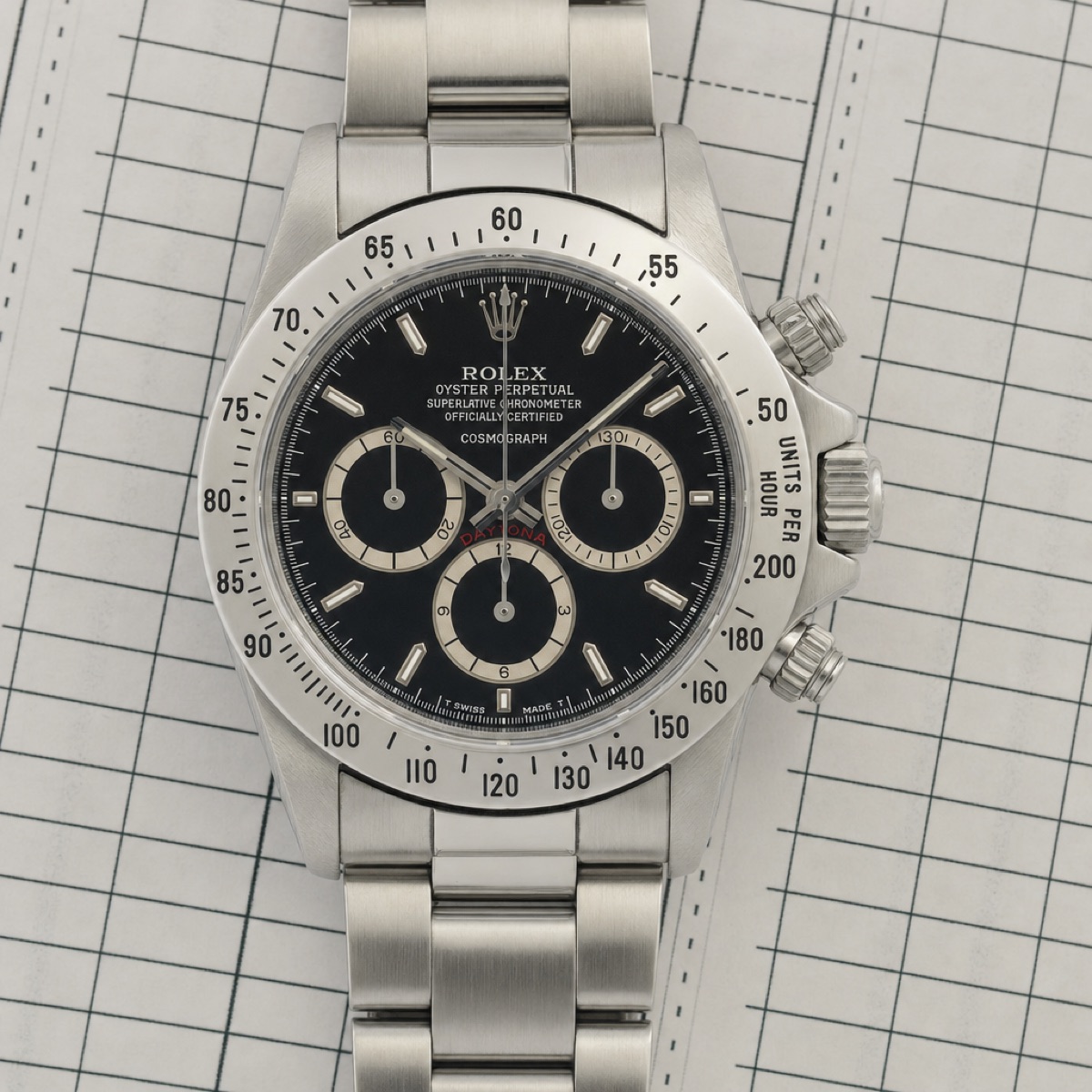
AI-generated illustration.
Some of the earliest dials have a glossy finish that collectors call porcelain. It's lacquer, though. Phillips says the glossy effect "is rendered with layers of paint granting superb depth" (Phillips). Monaco Legend ties these to the earliest R-serial watches with a floating dial, an inverted 6 and the 200-unit bezel (Monaco Legend). The highest result I found for a 16520 without famous provenance is a white porcelain Mark I, sold at Phillips Hong Kong for HK$1,375,000.
The inverted 6 is a 6 in the hour register printed so it reads as a 9. It runs from the Mark I through the Mark III, and sources disagree on where it stops. Mazzariol's scheme ends it at the Mark IV in 1993, DRSD finds it as late as 1994 to 1995, and Mondani says "until about 1994". I'd call it a pre-1994 feature with stragglers. The four-liner Mark II drops "Officially Certified", and Phillips says it was "only made for a limited period of time" (Phillips).
On the steel watch, black dials have silver rings around the subdials and white dials have black ones. I found no steel 16520 with gold rings. If you see one offered, it's worth asking where the dial came from.
The last change is the lume. Mark V dials of late 1998 to 2000 use Luminova, and the "T SWISS MADE T" at six becomes "SWISS MADE" (Sotheby's). The hands changed with them (DRSD). That gives the simplest originality check on the reference: a "SWISS MADE" Luminova dial on a pre-1998 serial is a service dial or a swap.
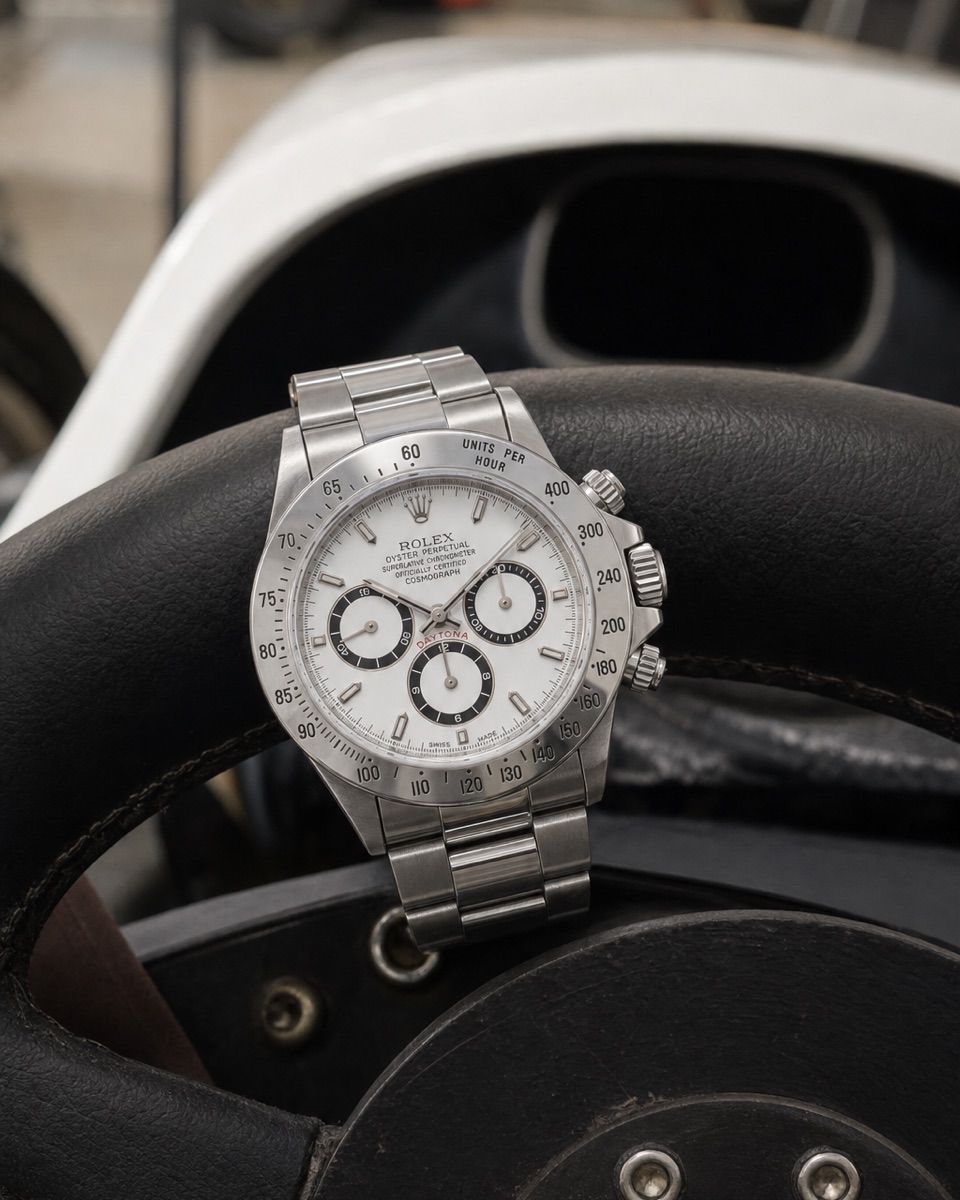
AI-generated illustration.
Bezels
The bezel went through three versions, and they are easy to tell apart. The first stops at 200 units per hour (Phillips). Mondani says it changed "after about a year" to a 400-unit scale with marks at 225 and 250, and "since 1989/1990" to the final layout, which runs to 400 with a mark at 240 and nothing at 225 or 250 (Fratello, Antiquorum). Phillips and Sotheby's number the middle bezel differently on L-serial watches, so describe a bezel by what's printed on it.
Bracelets
The early bracelet is the 78360 with 503 end-links and a plain folding clasp. Commit Ginza dates it from 1988 to 1993, and Sotheby's says "until 1994". The 78390 with 503B end-links follows in the mid-1990s (Sotheby's), but no source I read dates the switch. The last watches of 1999 and 2000 came on the 78390A with solid 803B end-links (Sotheby's, Commit Ginza). You'll sometimes see a 78350 listed for this watch, but no 16520 lot I read shows one.
Co-branded, commissioned and error dials
The "Patrizzi"
Some black dials from the mid-1990s have changed colour. The silver rings around the three subdials have turned beige, camel, brown and, on the strongest examples, close to black, while the subdial centres and the rest of the dial stay black. Sotheby's describes "silver chapter rings on their subsidiary dials" changing "to a tropical brown shade" (Sotheby's). The change keeps going as the watch ages, and no two watches look the same (Monaco Legend). It also shows on only some watches from the affected years (Phillips).
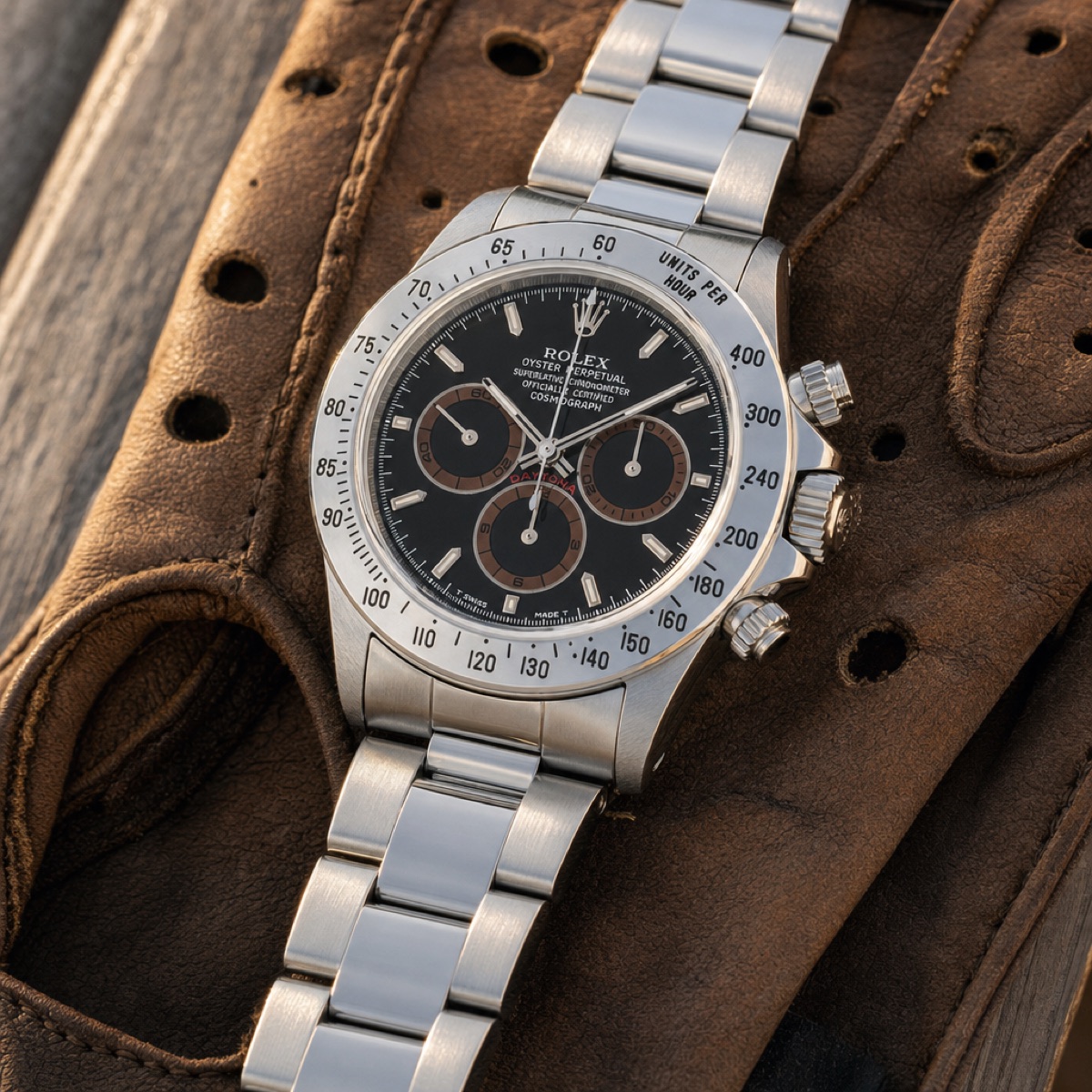
AI-generated illustration.
The affected watches are mostly black Mark IV dials with S, W and T serials. Phillips says the effect "can only be found on examples bearing a S,N,T and W" serial (Phillips), and Bob's Watches, Fratello and Uhren-Muser all put it in 1994 and 1995. The houses also catalogue exceptions on both sides: Antiquorum sold one "Made in 1992" (Antiquorum), Sotheby's titled a circa 1991 watch a Patrizzi, and Sotheby's found camel-coloured rings on a 1999 Mark V, which it called "most unusual" (Sotheby's). Every auction example I read is a black dial. Fratello says white Mark IV dials are affected too, but I couldn't find one.
The accepted explanation is the lacquer. Uhren-Muser says Rolex coated the dials with Zapon, an organic varnish, and "the lacquer did not provide adequate protection" for the silver print underneath (Uhren-Muser). Phillips writes of "some batches of the varnish" showing "chemical instability" under UV and moisture (Phillips), and in another essay of "a specific defective batch of paint" (Phillips). The explanations fit together. None of them comes from Rolex or from a lab, though, so I'd treat it as the best explanation available.
The name belongs to Osvaldo Patrizzi, the founder of Antiquorum. His own house gave the official version in a May 2006 catalogue: these dials "are called "The Patrizzi" by collectors, as Osvaldo Patrizzi was the first person to see and describe this type of change" (Antiquorum). The same lot, a 1995 watch from the Mondani Collection that sold for CHF 44,840, is illustrated in Patrizzi's book Rolex, Collecting Wristwatches, 2001 edition. So a colour-changed 16520 was in print by 2001, and that rules out the claim that he discovered it in 2005. There's also a first-hand version from the Italian watch author Paolo Gobbi, who says he and Guido Mondani noticed that Mondani's boxed W-serial watch had turned brown and chose the name together (Gioielleria Bonanno). The often-repeated story that Patrizzi sold his own collection in 2006 comes hedged with "the story goes" every time (Bob's Watches). I couldn't find that sale, and the Mondani sale of May 2006 fits better.
Collectors now pay well for the defect. Phillips sold one with even "milk-chocolate" rings at Geneva Watch Auction XVI for CHF 122,220 against an estimate of CHF 35,000 to 70,000, and another at Geneva XXIII for CHF 45,720. Nobody has estimated how many exist. One source says Rolex replaces these dials at service and advises owners to ask in writing that the dial be kept (Italian Watch Spotter). That's a single source, but the advice costs nothing to follow.
Fakes are a real problem because the effect can be induced. Two specialists agree on the tell: natural ageing is uneven, with patchy intensity and sometimes lighter spots, while artificial toning, often done with heat, looks "very 'clean,' precise, and uniform" (Gioielleria Bonanno, Italian Watch Spotter). Dials also get moved onto other watches, so the serial has to sit in the affected range.
Tiffany & Co.
Tiffany co-signed dials exist on the steel 16520. Phillips New York sold an N-serial watch of about 1991, with an inverted 6 and "a correct Tiffany & Co. signature", for US$88,900. Phillips Hong Kong sold a white 1994 example for HK$250,000. Sotheby's offered one in 2015 that was "retailed by Tiffany & Co." (Sotheby's). The two dial families do meet. Phillips said in one essay that "only one other white porcelain 16520 with Tiffany signature is known to the public" (Phillips), and Antiquorum Hong Kong sold a porcelain floating dial with the Tiffany signature for HK$1,250,000 in May 2026. Nobody gives a count of Tiffany 16520s overall.
The "No Daytona"
Christie's has sold a circa 1999 white-dial watch printed without the red "Daytona" above the hour register, "the most probable explanation being the result of a printing mistake which eluded Rolex strict quality controls" (Christie's). It's the only documented misprint I found on this reference.
I looked for Cartier and other retailer signatures, commissioned and military dials, and credible prototypes, and found none on the 16520. A "four-line" dial thought to be a Rolex text test turns up only on an auction mirror site with the house's name hidden, so I'd leave it out until a named house catalogues one.
Why it matters
The 16520's best story is about the race it was named for. Rolex gave Paul Newman a steel 16520 after his team won the 1995 Rolex 24 at Daytona, and Sotheby's sold it in June 2023 for $1.1 million. That's a different watch from his famous 6239. The connection lasted to the end of the run: the driver James Weaver consigned his own 16520, engraved "Winner Rolex 24 at Daytona 2000", to Phillips Hong Kong, where it sold for HK$680,400.
My read is that the 16520 matters for the movement more than any dial. It's the reference in which the Daytona became an automatic, and the last in which Rolex started from another maker's calibre, rebuilt to its own standard. Sotheby's calls its introduction "the most important evolution in the history of the celebrated model" (Sotheby's), and I'd agree. Everything from the 116520 on is Rolex's own, and the 16520 is what came before.
What I'd check before buying one
- Dial against serial. The Mark should fit the serial letter in the table above, and a Luminova "SWISS MADE" dial belongs on late U, A and P serials only.
- Which Mark system the seller means, five or eight, before paying for a "Mk" label.
- Patrizzi toning that's uneven and patchy, on an S, W or T serial. Clean, uniform brown is the warning sign.
- Bracelet for the period: 78360 with 503 on early watches, 78390 with 503B in the middle years, 78390A with 803B at the end.
- Hands that match the dial's lume. Luminova hands on a tritium dial are a service replacement, which matters for the price (Commit Ginza).
- Papers, box and the inside caseback. A 16500 stamp is correct on these watches.
Sources
- Antiquorum, Geneva, 14 May 2006, lot 50
- Antiquorum, Geneva, 15 Oct 2006, lot 419
- Antiquorum, New York, 15 Dec 1998, lot 84
- Antiquorum, New York, 7 Dec 2011, lot 335
- Antiquorum, Hong Kong, 31 May 2026, lot 108
- BeckerTime, Rolex Daytona 16520
- Bob's Watches, The vintage Daytona's colour phenomenon
- Bonhams, London Fine Watches, 19 Jun 2025, lot 44
- Bulang & Sons, 16520 white Mk5 dial, W2704
- Christie's, Five reasons collectors love the Rolex Daytona
- Christie's, Hong Kong, lot 2580
- Christie's, Watches Online: The Dubai Edit, "No Daytona"
- Commit Ginza, Daytona bracelet column
- Commit Ginza, no. 412
- Commit Ginza, no. 2370
- DRSD, Daytona 16520 dials
- Fratello, Giorgia Mondani on the Rolex Daytona reference 16520
- Gioielleria Bonanno, Paolo Gobbi on the Daytona Patrizzi
- Grail Watch, How Charles Vermot saved the Zenith El Primero in his own words
- Haute Time, 2015
- Italian Watch Spotter, Patrizzi Daytona: real or fake dial
- Monaco Legend, Exclusive Timepieces, lot 155
- Monaco Legend, Exclusive Timepieces, lot 157
- Monochrome, History of the Rolex Daytona
- National Jeweler, Newman's own Rolex Daytonas sell for $1.1M each at Sotheby's
- Phillips, Five key dates: the Zenith El Primero
- Phillips, Geneva Watch Auction XIX, lot 52
- Phillips, Geneva Watch Auction XVI, lot 128
- Phillips, Geneva Watch Auction XXI, lot 49
- Phillips, Geneva Watch Auction XXIII, lot 164
- Phillips, Geneva Watch Auction XXIV, lot 45
- Phillips, Geneva, lot 137
- Phillips, Hong Kong, lot 885
- Phillips, Hong Kong Watch Auction TWO, lot 28
- Phillips, Hong Kong Watch Auction XIV, lot 915
- Phillips, Hong Kong Watch Auction XV, lot 866
- Phillips, New York Watch Auction X, lot 45
- Phillips & Blackbird, lot 851
- Phillips & Blackbird, lot 852
- Revolution, A movement in history: the Zenith-driven Rolex Daytona
- Sotheby's, Fine Watches 2021, "Inverted 6" Zenith Daytona
- Sotheby's, Fine Watches 2025, reference 16520
- Sotheby's, Important Watches 2015, lot 163
- Sotheby's, Important Watches 2021, "Patrizzi" lot 59
- Sotheby's, Important Watches, lot 10
- Sotheby's, Watches 2019, lot 45
- Sotheby's, Watches 2019, lot 49
- Sotheby's, Watches 2019, lot 123
- Uhren-Muser, 101st auction, lot 304
- Wind Vintage, Collector's guide: the Rolex Zenith Daytona
- WorldTempus, 30 facts about the Zenith El Primero