Rolex Oyster Perpetual Date 15200
- Make
- Rolex
- Reference
- 15200
- Model
- Oyster Perpetual Date
- Variants
- 15210
- Case diameter
- 34 mm
- Calibre
- 3135
- Case material
- Stainless steel
- Water resistance
- 100 m (328 ft)
AI-generated illustration.
Rolex has always sold the Date as the smaller sibling. The Datejust came first, in 1945, with a five-link Jubilee bracelet designed for it (BeckerTime). The Oyster Perpetual Date followed in 1955 by Phillips' account, with the same Cyclops lens over the date. The two lines have run side by side ever since, and the main difference between them, as BeckerTime puts it, "as it has been since the beginning, is in their respective sizes." The Datejust has come in several sizes. The Date "has only ever been a 34mm piece."
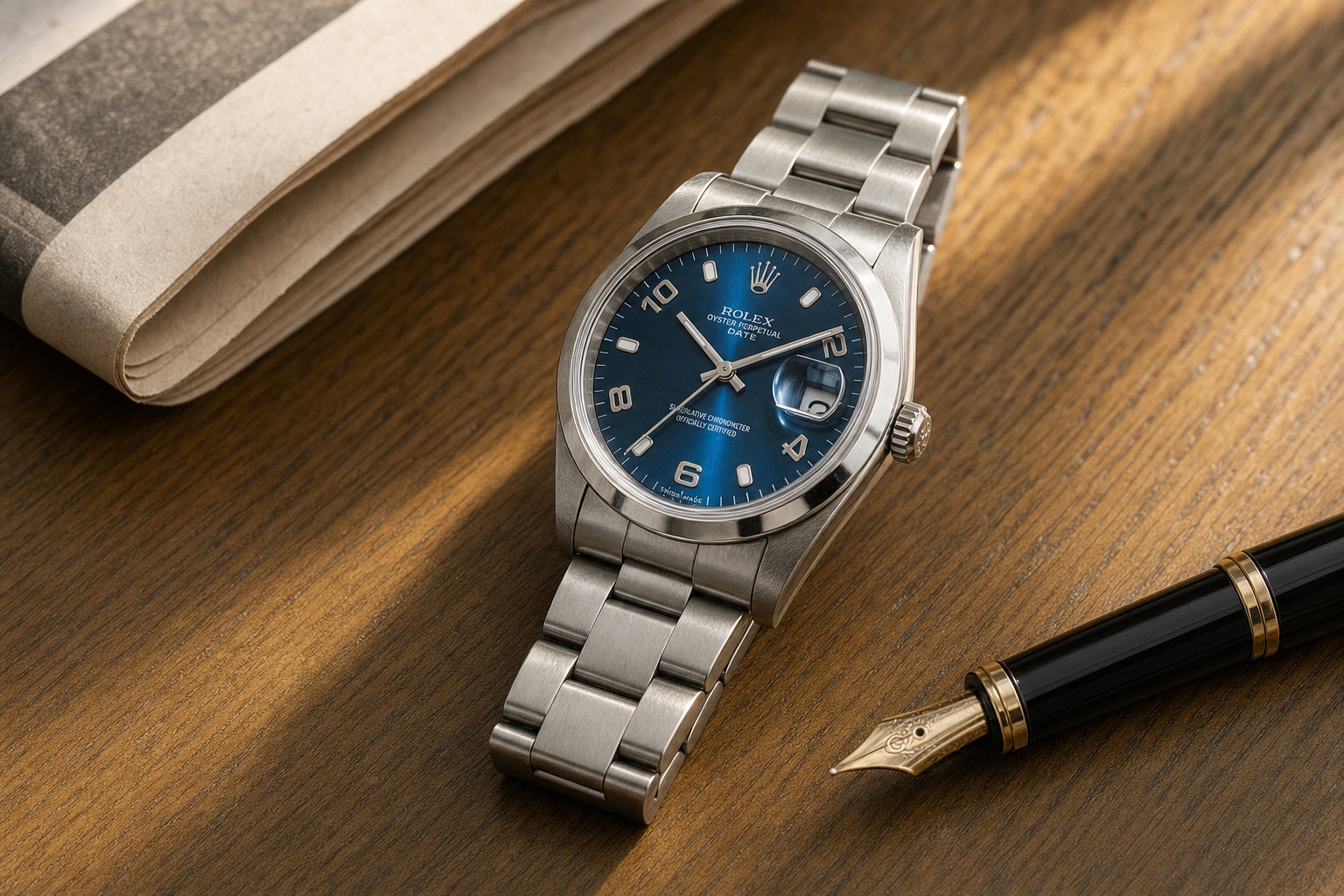
The Rolex Oyster Perpetual Date 15200 is the steel, smooth-bezel Date of the late 1980s to the mid-2000s, and it's where the small Date caught up with the modern Rolex. Its predecessor, the 15000, still had an acrylic crystal. The 15200 arrived with a sapphire crystal and the calibre 3135, the movement Rolex had just put into the Datejust, and it ran with that combination until the six-digit 115200 replaced it in 2005. Early examples still have tritium dials and hollow-link bracelets, so the reference spans the old Rolex and the new one.
It's also a watch I've built. For my sister's 40th birthday I put one together from parts. It has no papers, it's a frankenstein, and it was a very fun project. The 15200 suits that kind of build for reasons that come from how Rolex put the family together, and the same reasons are what a buyer needs to understand before paying for one.
Where it came from
The 15200's story is mostly the Datejust's story, a year or so late. Rolex's date watches spent the 1960s and 1970s on the 15xx family of calibres, in references like the 1500. In the late 1970s the Date moved to the 150xx generation (the smooth-bezel 15000 and the engine-turned 15010) and the calibre 3035, which BeckerTime calls "the first so-called high beat caliber to the Date." WatchGuys credits that generation with the first quickset date in the line (WatchGuys). It kept the acrylic crystal, and it didn't last long. BeckerTime says the 150xx "had only been in production for a few years" (BeckerTime).
The change that ended it happened in the Datejust first. "In 1988, Rolex released the ref. 16200 series of Datejust models upgraded with the firm's new cal. 3135," Phillips' catalogue essay explains, along with "a sapphire crystal replacing its former Plexiglass crystal" (Phillips). The Date followed. BeckerTime's review says "the ref. 15200 arrived in 1988, boasting an improved caliber over its predecessor," and that the 152xx moved to the 3135 "starting in 1988." Bob's Watches puts the 152xx generation at "about 1989 to 2005" (Bob's Watches). I couldn't reach a Rolex catalogue to settle a one-year gap, so I'd call it 1988 or 1989. Either way, the Date and the Datejust picked up the same movement and the same crystal within a year of each other.
That's the logic of the whole family. Rolex built one calibre, then fitted it to the 36 mm Datejust and the 34 mm Date in steel, two-tone and gold, with smooth, engine-turned and fluted bezels. The 152xx generation, as Bob's Watches and WatchGuys list it, ran to the 15200 in steel with a smooth bezel, the 15210 in steel with an engine-turned bezel, the 15223 in steel and yellow gold with a fluted bezel, and the 15238 in yellow gold (WatchGuys). The 15200 is the plainest of them, which is the reason to want it.
No source I read names a designer, and none gives a launch price. For a mid-range steel reference, that doesn't surprise me. My guess is that a new Date in 1988 got a line in a catalogue and little else.
The end of the run is cleaner. Bob's Watches says "the six-digit Date 1152xx family made its debut in 2005," with the 115200 as the steel smooth-bezel model, and that Rolex "discontinued the two remaining references in 2021" (Bob's Watches). Bob's own product page for the 15200 says production ran "until roughly 2000" (Bob's Watches), which contradicts the same company's guide. I'd trust the guide, since the 115200 date matches it, but expect to see both in listings.
The watch
Auction catalogues are the best sources for this reference, so the table leans on them. Where they disagree with the dealers, both values are shown.
| Spec | Value |
|---|---|
| Official name | Oyster Perpetual Date (BeckerTime) |
| Dial text | "Oyster Perpetual Date", "Superlative Chronometer Officially Certified" (Antiquorum) |
| Case | Oyster, steel, screw-down case back and crown |
| Diameter | 34 mm nominal; Antiquorum measured 34.3 mm at the bezel and 35.4 mm across (Antiquorum) |
| Thickness | About 11 mm (WatchGuys); 12 mm on a 1993 example (Antiquorum) |
| Lug width | 19 mm (BeckerTime) |
| Bezel | Smooth, polished steel |
| Crystal | Sapphire, with Cyclops over the date |
| Movement | Calibre 3135, automatic, 31 jewels (Sotheby's) |
| Frequency | 28,800 vph (Grail Watch) |
| Power reserve | 50 hours (BeckerTime) or 48 hours (Grail Watch) |
| Functions | Hours, minutes, centre seconds, quickset date |
| Certification | Chronometer |
| Water resistance | 100 m (Bob's Watches) |
| Bracelet | Oyster (most common) or Jubilee (BeckerTime) |
The movement is the headline. Against the 3035 in the 15000, BeckerTime counts four more jewels, 27 to 31, and a full balance bridge, which holds the balance at both ends, where the 3035 had a cock. It also gives a longer power reserve, "upped to 50 hours rather than 42." Grail Watch lists the 3135 at 48 hours, and I haven't found a Rolex figure to break the tie. My read is that the bridge matters more than the hours, since it's the sturdier way to carry the balance.
The 19 mm lugs are the other number worth remembering. The Datejust of the same years has 20 mm lugs, so Datejust bracelets don't fit a Date, and a 15200 on a 20 mm strap is a quick tell that somebody has made do (BeckerTime).
I've left the steel unnamed on purpose. Rolex now calls its steel Oystersteel, but that name is recent, and I couldn't find a reliable date for when the Date's case moved to 904L. BeckerTime says the whole line had switched to 904L by 2003, which would make late 15200s 904L, but I couldn't confirm it from Rolex or say what came before for this reference.
How it changed
The case, bezel and movement stayed the same for the whole run. What changed was the luminous material and the dial text that records it. The dates in this table are approximate and come from dealer guides that disagree with each other by a few years, The tritium text is what two Antiquorum lots from the early 1990s show; the later two rows are the usual collector reading, which I've only found set out in a brand blog.
| Approx. years | Lume | Usual text at six o'clock |
|---|---|---|
| 1988/89 to mid- or late 1990s | Tritium | "T SWISS MADE T" |
| From 1997 (Bob's) or early 1990s (BeckerTime) | Luminova | "SWISS" |
| About 2000 to 2005 | Super-LumiNova | "SWISS MADE" |
Sources for the table: Bob's Watches, BeckerTime, WatchGuys and Everest Bands for the later dial text. The tritium row is from photographs of the two Antiquorum lots.
The lume changeover is the one collectors care about, and the sources don't agree on when it happened. Bob's Watches says a 152xx can have "tritium, Luminova (from 1997), or Super-LumiNova (from 2000)." BeckerTime puts Luminova in the early 1990s. The dial text is more reliable than either date. Tritium dials carry a "T" either side of "SWISS MADE" at six o'clock, and Luminova dials dropped it, so a dial tells you which material it has whatever year the case says (Everest Bands). That's also why the dial text matters so much on a watch built from parts, which I'll come to.
An Antiquorum lot gives a fixed point: a 15200 with case serial E 876 949, dated about 1990 to 1991 (Antiquorum). Analog/Shift sold one with papers dated 24 June 2000 whose dial reads plain "SWISS MADE" at six (Analog/Shift), which fits Bob's Super-LumiNova date. Its listing also describes tritium markers, which the dial text contradicts. Dealer descriptions of lume are worth checking against the dial itself.
The variations that matter
Dials
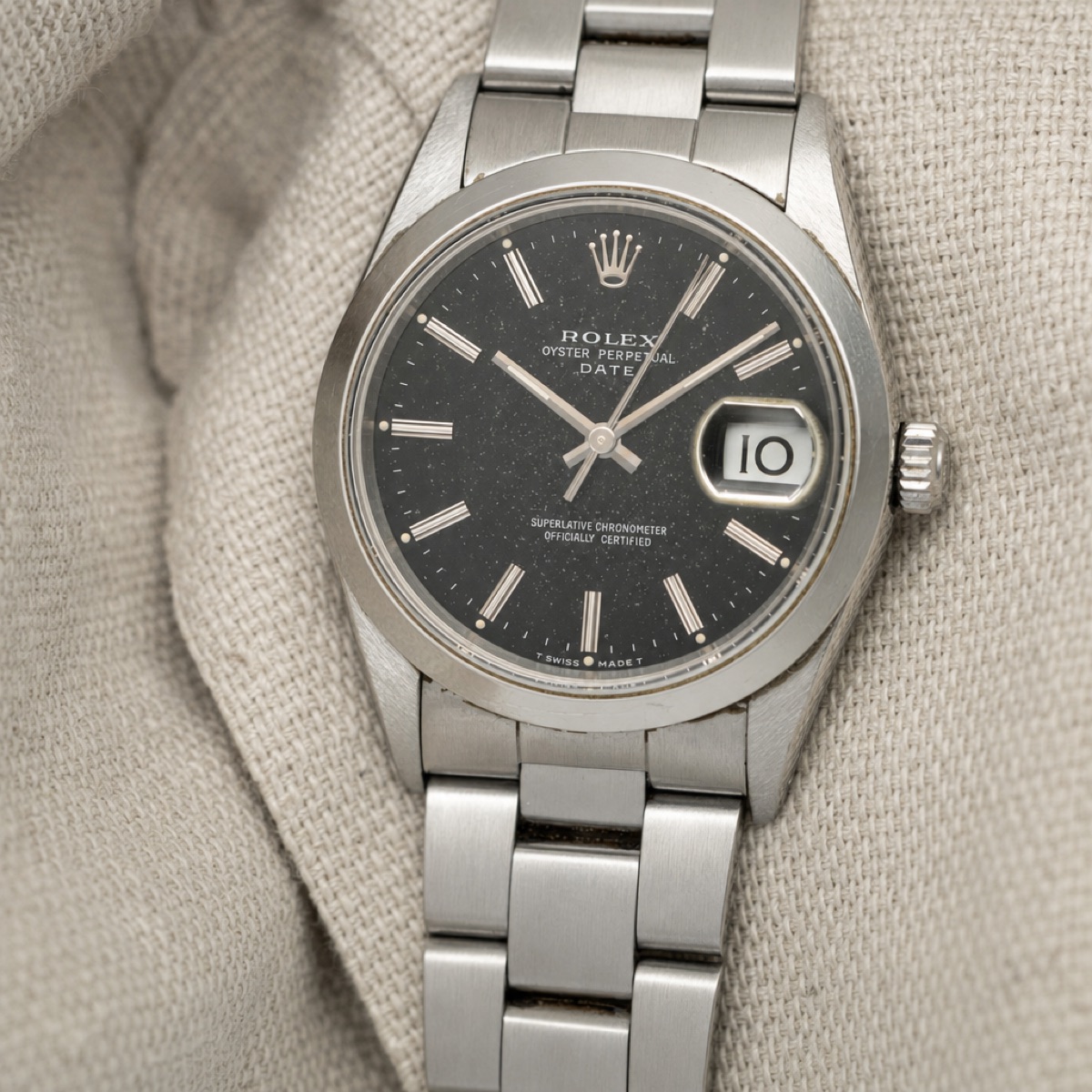
Most 15200s have black or white dials, which BeckerTime describes as the understated norm for the reference (BeckerTime). Blue is documented: Sotheby's offered a blue-dial 15200 from about 2000 (Sotheby's), and Analog/Shift sold one with a sunburst blue dial and a mix of baton and Arabic markers (Analog/Shift). The same Sotheby's listing shows how loose the record is on this reference. Its catalogue essay describes the "reference 1500 in the early 1960s" and "the rarer and early black dial," neither of which matches the blue 15200 in the photographs. It reads like a 1500 essay pasted onto a 15200 listing.
AI-generated illustration.
Salmon is the dial dealers talk up. WatchGuys calls it the most collectible dial in the Date line and says it was made "in limited quantities on the ref. 15200 and 15210" (WatchGuys). That's one dealer guide without a source, so I'd treat it as a claim. I didn't find a salmon 15200 in an auction catalogue.
Bezels
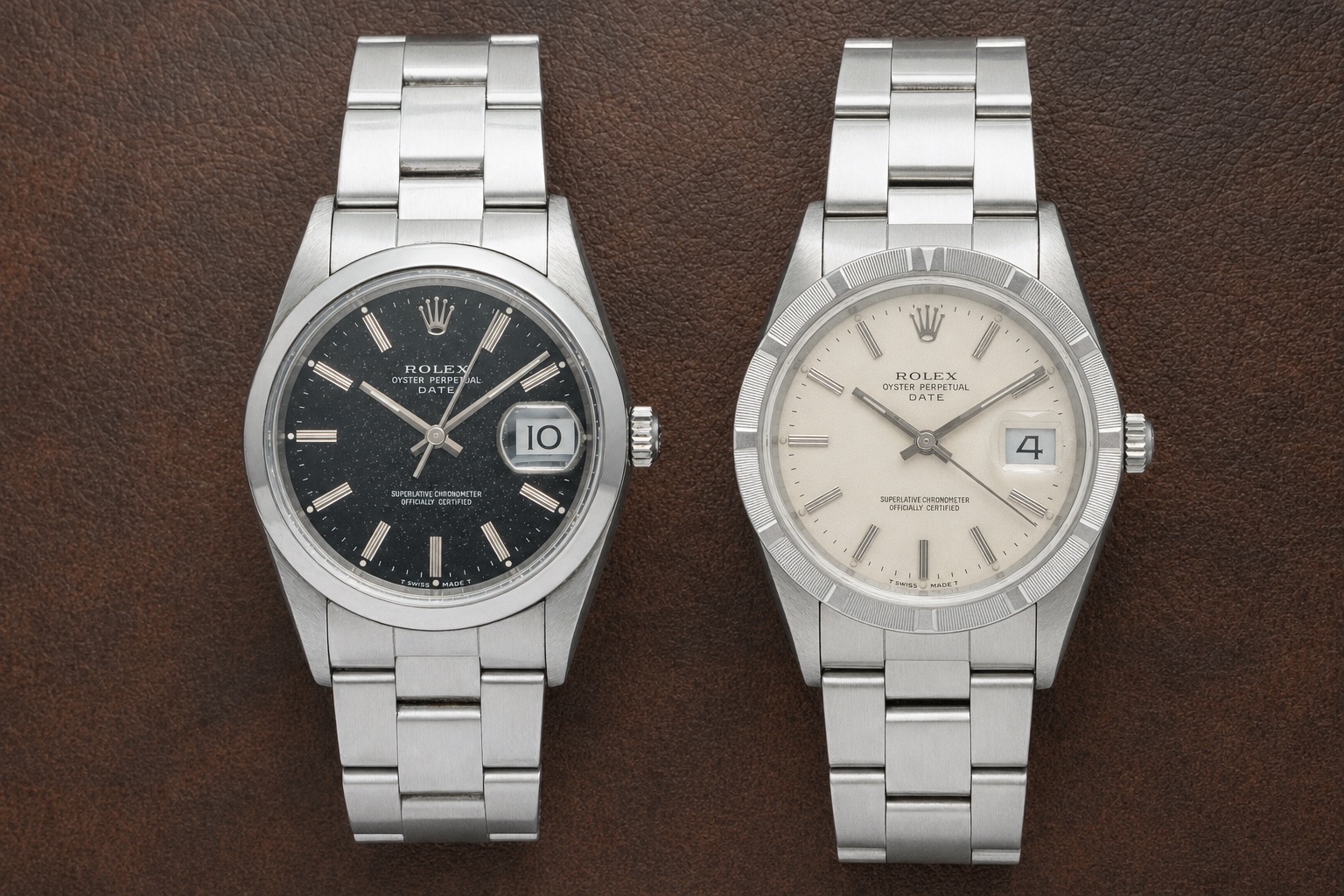
The 15200's smooth bezel is the whole difference between it and the 15210. Antiquorum's note on a 1993 watch is blunt about it: "References 15210 and 15200 are identical with the exception of the bezel." The watch it was describing had 15210 engraved between the lugs and 15200 inside the case back, because "the case bodies and backs were interchangeable at the factory" (Antiquorum). Antiquorum sold it in Geneva in May 2006 for CHF 3,658.
AI-generated illustration.
So a mismatched case back on a Date is something a buyer should expect to see now and then, from the factory. It also means the reference between the lugs is the one that counts, and that the bezel is the only part separating two references. My read is that the bezel is the easiest swap in the family, so on a 15200 or a 15210 I'd check that the bezel matches the number between the lugs.
Bracelets
BeckerTime says the 15200 was offered on two bracelets: the three-link Oyster, which is "the most common band on the ref. 15200," and the five-link Jubilee (BeckerTime). Early Oysters have folded links and hollow end links (WatchGuys), later ones solid links. I couldn't pin the exact bracelet references to this reference by year from a source I'd trust. One Antiquorum lot lists a "Jubilee" with reference 78350, a number other sources give for the solid Oyster, so even the auction houses get this wrong. Check the clasp code and end-link number against the watch's era yourself.
Co-branded, commissioned and error dials
I found none documented on the 15200. Aggregator pages for the reference carry a stock line about a Tiffany & Co. dial, and one listing claims a Bahrain crest dial on a 1989 watch, but I couldn't find either in an auction catalogue or a specialist source. I found nothing at all for the Domino's, Khanjar or Qatar dials collectors know from other Oyster models. If you're offered a signed 15200, the burden is on the seller to show provenance.
Building one from parts
Everything above makes the 15200 a good watch to assemble. One calibre went into a whole family, case bodies and backs were shared across references at the factory, and the bezel is the only difference between two of them. That's the same reason it's easy to fake well, and the difference is disclosure.
The collector's word for a watch like that is frankenwatch. BeckerTime defined it in 2015 as "a single watch made up of parts from many different models" (BeckerTime), and a 2026 dealer primer adds the part that makes it a problem: parts swapped between references or eras and "presented as if it left the factory that way" (5D Watches). A gift built openly from parts, with no papers and no pretence, sits on the honest side of that line. It would sit on the other side if someone later sold it as an original.
Rolex is less relaxed about it than collectors are. Bob's Watches reports that at a service Rolex replaces worn parts with genuine ones and doesn't return a replaced dial (Bob's Watches). For aftermarket parts it goes further: "A Rolex Service Center can also refuse to service the watch until those components are removed" (Bob's Watches). So the practical rule for a parts-built 15200 is to use genuine Rolex parts where you can, and to expect a Rolex service to replace whatever it doesn't like. The same article puts the value hit from replacement parts on collectible Rolexes at "anywhere from 10% to more than 50%." A watch built for a birthday is outside that market, and that's the point of building one.
What I'd check before buying one
- The lume. A "T" on the dial means tritium, and the hands should match it in colour and age. Bright white hands on a warm tritium dial mean service hands at best.
- The reference between the lugs. It's the one that counts. A 15200 case back on a 15210 can be factory; a smooth bezel on a case marked 15210 isn't.
- The lug width. 19 mm. A 20 mm bracelet or strap means Datejust parts.
- The movement. It should be a 3135. A 3035 belongs in a 15000.
- The case edges. Polishing rounds the lugs and the smooth bezel shows it quickly.
- The bracelet era. Folded links and hollow end links on a Super-LumiNova dial, or solid links on a tritium dial, mean the bracelet and head met later.
Sources
- Antiquorum, Mondani Collection, lot 110, Geneva, 14 May 2006
- Antiquorum, ref. 15200 lot 348-209
- Phillips, Hong Kong Watch Auction XII, lot 1090 (Datejust 16233)
- Phillips, Hong Kong Watch Auction XVI, lot 909 (Date 1500)
- Sotheby's, reference 15200, June 2021
- Sotheby's, reference 15200, blue dial, circa 2000
- BeckerTime, "Review: The Rolex Date ref. 15200", Andy Callan, 2019
- BeckerTime, "The Subtle Scam: The Frankenwatch", 2015
- Bob's Watches, "Rolex Date Ultimate Buying Guide", Paul Altieri
- Bob's Watches, Rolex Date 15200
- Bob's Watches, "Here's why servicing your Rolex could lower its value", 2025
- Bob's Watches, "Do Replacement Parts Affect a Rolex's Value?", Paul Altieri, 2026
- WatchGuys, Rolex Date guide
- WatchGuys, Rolex Date 15200 review
- Grail Watch, Rolex calibre 3135
- Analog/Shift, Oyster Perpetual Date AS07050
- Everest Bands, "Comparing every Rolex lume", 2025
- 5D Watches, frankenwatch authentication primer, 2026