Rolex Sea-Dweller 4000 116600
- Make
- Rolex
- Reference
- 116600
- Model
- Sea-Dweller
- Production
- 2014–2017
- Case diameter
- 40 mm
- Calibre
- 3135
- Case material
- 904L steel
- Water resistance
- 1220 m (4003 ft)
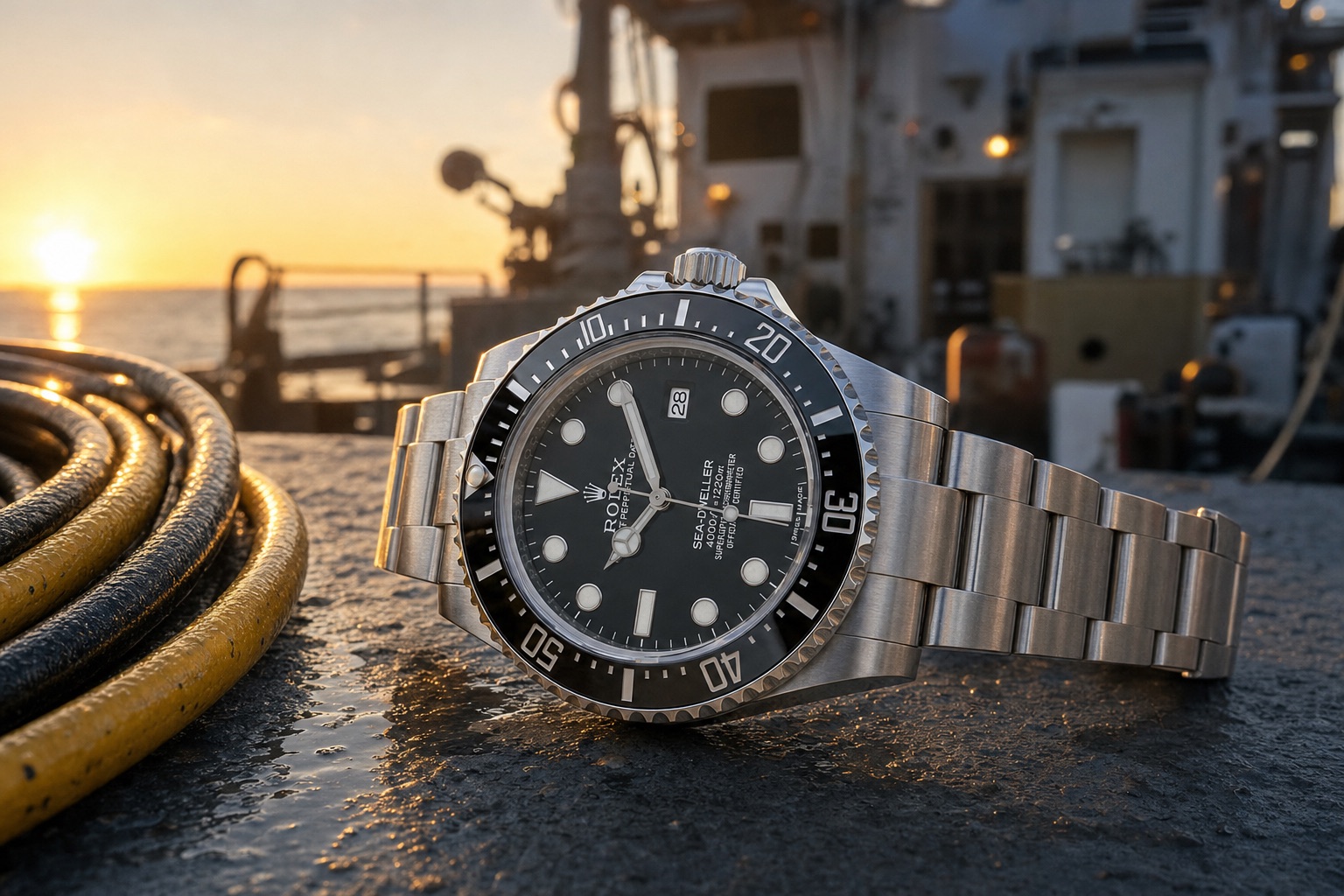
AI-generated illustration.
Rolex's brochure for this watch runs to seventeen pages, and most of them are history: saturation diving, helium, the 1960s underwater habitats that gave the watch its name, Comex divers setting depth records. The specification gets one page. The announcement comes near the end, written in the present tense of the 2014 launch. "In 2014, Rolex is bringing a legend of professional diving back to life," it says, "with a brand new, updated Oyster Perpetual Sea-Dweller 4000" (Rolex).
That watch is the Rolex Oyster Perpetual Sea-Dweller 4000, reference 116600, and it fills a strange slot in the Sea-Dweller story. It's the 40 mm saturation diver Rolex dropped in 2008 for the much larger Deepsea, brought back with the ceramic bezel, blue lume and Glidelock clasp the rest of the sports line had picked up in the meantime. Then, three years later, it was gone again, replaced at Baselworld 2017 by the 43 mm 126600. Collectors call it the SD4K. It's the last 40 mm Sea-Dweller, and the last standard Sea-Dweller without a Cyclops over the date.
I own one, and the reason I bought it is the reason I'm writing about it: it's one of the shortest-lived references Rolex has made. The SD4K reads like an epilogue to the old 40 mm Sea-Dweller line, and short runs are where the interesting questions sit. Why did Rolex bring it back at all, and why did it last such a short time?
Where it came from
The Sea-Dweller exists because of helium. In Rolex's own telling, by the mid-1960s commercial divers had found a way to stay deep for days. They lived under pressure in chambers or habitats breathing helium mixes, then decompressed once at the end of the job. The watches came along for all of it. Helium has the smallest molecules there are, and over days at pressure it "gradually penetrates the watch through the gaskets." On the way back up it leaves the diver faster than it can leave the case, and Rolex says divers "often observed during decompression that the watch crystal could pop out like a champagne cork" (Rolex).
The Submariner couldn't do this job. Rolex's brochure explains that it launched the Submariner in 1953 at 100 metres and doubled that to 200 metres in 1954, which was plenty for divers breathing air, who "rarely descended beyond the 60-metre limit." Mixed gases moved that limit. Rolex cites an open-water dive to 222 metres in Lake Maggiore in 1961, and 313 metres off California the following year, after which "it became obvious that a new generation of divers' watches was required." Comex made its first industrial dive to 160 metres in 1966 and was aiming for 300 metres by the end of the decade, so Rolex decided its next divers' watch would be rated to 2,000 feet (Rolex). Depth was only half of it, though. Saturation divers had turned up a problem nobody had planned for: pressure building up inside the watch.
Rolex's answer was a one-way valve in the side of the case that opens above a set internal pressure and lets the gas out. Rolex says it was "patented in 1967" for a new professional divers' model, and that the model was "developed in 1967, waterproof to a depth of 610 metres (2,000 feet) initially and then to 1,220 metres (4,000 feet) in 1978" (Rolex). Early examples of the first reference, the 1665, carry "Patent Pending" in their gas escape valve caseback engraving (Phillips). The name came from the habitat programmes too: Rolex says "the very name Sea-Dweller" reflects them.
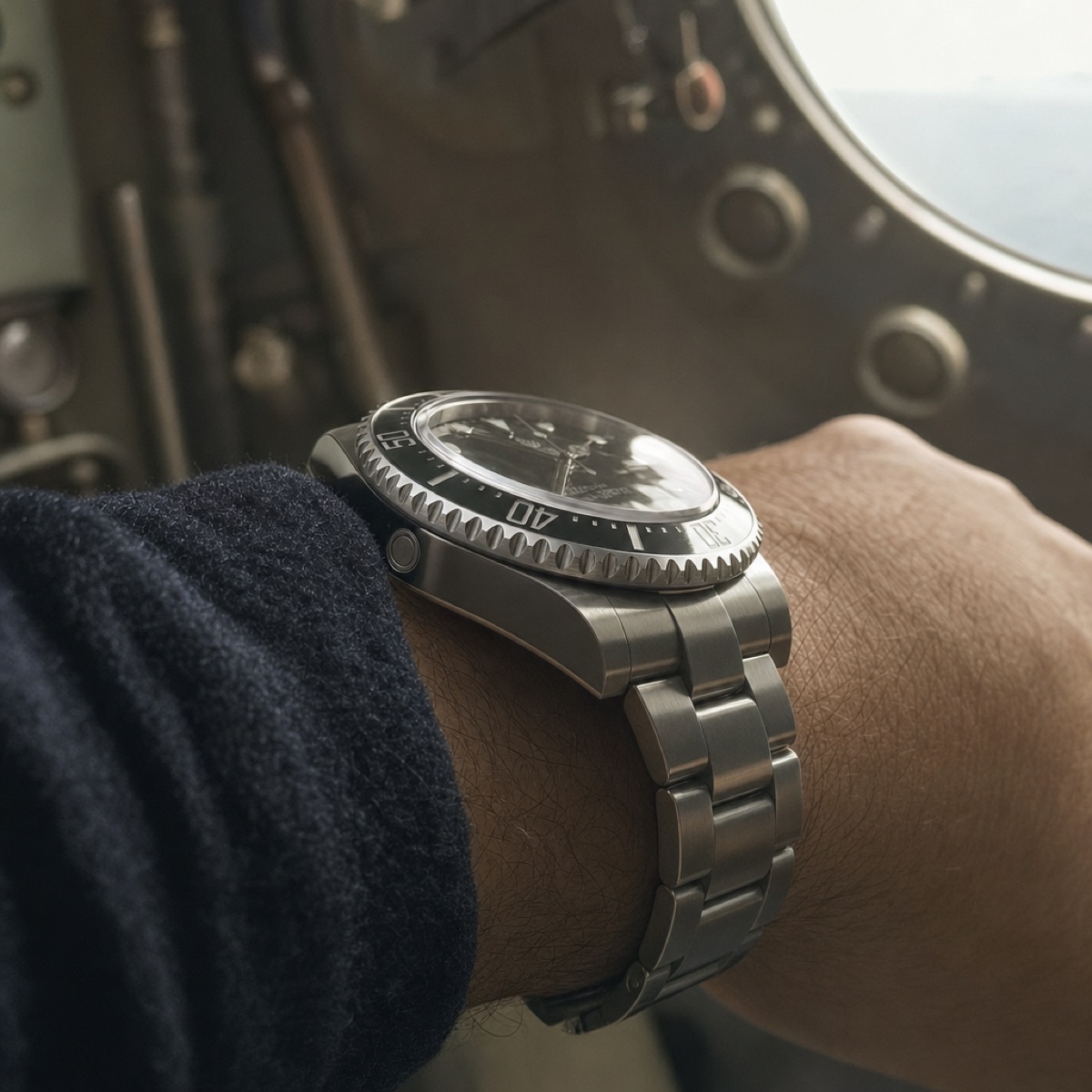
AI-generated illustration.
Rolex's brochure ties the watch to Comex, the French commercial diving company. "Comex swiftly adopted the Sea-Dweller as its official watch," it says, and it says a Sea-Dweller went with the divers on Hydra VIII, the 1988 dive that set the open-sea record at 534 metres, and to a 1992 chamber dive to 701 metres that ended in a 24-day decompression, a record Rolex said still stood. It quotes Comex's founder, Henri-Germain Delauze: "A diver breathing hydrogen can't live without his Rolex" (Rolex). That's the maker's story, and the historians are less tidy. Deployant dates the close Rolex–Comex relationship from about 1971. And a Phillips essay on an early 1665 says the old belief that the valve was developed exclusively with Comex doesn't survive its owner's papers. I'd take Comex as the Sea-Dweller's most important customer, and leave the origin of the valve as an open question.
The 16660 took the rating to 1,220 metres in 1978 (Revolution), and the 16600 carried the same 40 mm, 4,000 ft formula through the 1990s and 2000s. Then, in 2008, Rolex launched the Deepsea, reference 116660 (Phillips), rated to 3,900 metres and 44 mm across (Time+Tide). The standard Sea-Dweller left the catalogue. SJX and Sotheby's both put that in 2008, alongside the Deepsea. Some dealer timelines say 2009, and Oakleigh runs the 16600 to 2011, so expect to see all three.
Not every 16600 owner wanted the Deepsea. Fratello's Robert-Jan Broer, who had worn a 16600 for ten years and found the Deepsea's weight uncomfortable, wrote in 2009 that the reference numbers gave him hope: "they went from reference number 16600 to 116660 instead of using 116600. Will there be a 116600?" In April 2014 he got to quote himself, because there was (Fratello).
Nobody outside Rolex seems to know why it came back. SJX called it "a surprise revival of a classic, perhaps in response to plodding sales of the oversized Deep Sea" (SJX), and that "perhaps" is doing honest work: I found no sales figures and no Rolex statement either way. The launch price was US$10,400, or CHF 9,900. SJX worked out that this was about 50% more than the old Sea-Dweller cost in its last year (SJX). No source I read names a designer.
The watch
Rolex's spec sheet for the 116600, as archived from rolex.com in March 2016 (Rolex), is the source for everything here unless the row says otherwise.
| Spec | Value |
|---|---|
| Official name | Oyster Perpetual Sea-Dweller 4000 |
| Model number | 116600-0003 |
| Case | Oyster, 40 mm, monobloc middle case, screw-down case back and crown |
| Thickness | Not published by Rolex; reviewers give 15.3 mm (Watchprozine) and about 15.5 mm (Bob's Watches) |
| Material | 904L steel, case and bracelet |
| Bezel | Unidirectional, 60-minute graduated, Cerachrom ceramic insert with platinum-coated numerals and graduations |
| Crown | Screw-down, Triplock |
| Crystal | Sapphire, no Cyclops |
| Water resistance | 1,220 m / 4,000 ft, helium escape valve |
| Movement | Calibre 3135, self-winding, 31 jewels (Sotheby's) |
| Hairspring | Paramagnetic blue Parachrom |
| Functions | Hours, minutes, seconds; instantaneous date with rapid setting; stop-seconds |
| Power reserve | About 48 hours |
| Precision | −2/+2 sec/day after casing; Superlative Chronometer (COSC plus Rolex certification) |
| Dial | Black, Chromalight with blue luminescence |
| Bracelet | Oyster, flat three-piece links |
| Clasp | Oysterlock folding safety clasp, Glidelock extension, Fliplock extension link |
| Launch price | US$10,400 / CHF 9,900, 2014 (SJX) |
The "4000" in the name is the depth rating in feet, which the Sea-Dweller had held since 1978. Everything in the case is about that one job: the monobloc middle case, the Triplock crown and the valve at nine o'clock. The 116600 used the same 3135 as the Submariner Date of its day, and the same 1,220 metres the 16600 had promised, so the watch is new mostly on the outside.
On the precision row: launch coverage in 2014 describes a COSC chronometer (Time and Watches), and the −2/+2 Superlative Chronometer wording comes from the 2016 sheet. I couldn't confirm which standard the first 2014 watches were sold under, so read that row as what Rolex said mid-run.
The bracelet is the bigger change from the 16600, and it's the one I'd notice first on the wrist. The Glidelock lets you lengthen the clasp in 2 mm steps up to 20 mm without tools (Time and Watches). On top of that, the Fliplock link folds out to go over a wetsuit. SJX also points out that the new bracelet has solid middle links where the old one was hollow, and reads that as the reason it's much weightier (SJX).
How it changed
Nothing documented changed during the run. I looked for dial marks, bezel variants, clasp revisions and movement changes across 2014 to 2017, and found one reference number with one dial, one metal and one calibre. For a three-year modern Rolex that's what you'd expect. So the useful comparison is with the watches either side of it.
| 16600 | 116600 | 126600 | |
|---|---|---|---|
| Years | to about 2008 | 2014–2017 | 2017 on |
| Diameter | 40 mm | 40 mm | 43 mm |
| Bezel insert | Aluminium | Cerachrom ceramic | Cerachrom ceramic |
| Dial | Standard markers | Maxi, Chromalight | Red "Sea-Dweller" line |
| Date magnifier | None | None | Cyclops |
| Movement | 3135 | 3135 | 3235, about 70 h |
Sources for the table: SJX, Oakleigh, Time+Tide, Bob's Watches, and Rolex for the 116600 column.
Read across the table and the 116600 is the hinge. It kept the 16600's 40 mm, its 1,220 metres, its movement and its flat crystal. It took what the Submariner 116610 and GMT-Master II 116710 already had: a ceramic bezel, Chromalight and thicker lugs (Fratello). The 126600 then changed what the 116600 had kept: the size, the movement, the crystal. Those three changes are the 126600's selling points, which leaves the SD4K as the last of the line before them.
When the 126600 arrived at Baselworld 2017, Time+Tide described it as the watch that "replaces the short-lived reference 116600" (Time+Tide). Sotheby's lot note on a 116600 says the replacement came in 2018 (Sotheby's). I've gone with 2017, since that's when the 126600 launched, but some 116600s will have left dealers' stock later. There's a separate article on the 126600.
The variations that matter
Case
The case is still 40 mm, and it doesn't wear like the 16600's. SJX found "a chunkier case, with wider and thicker lugs," which makes the watch seem "wider and flatter on the wrist" (SJX). The finishing changed too. The 16600 had a polished bevel running the length of the case, widening towards the lug tips. The 116600 has a simple rounded edge in its place, as the other sports models of the period did. SJX thinks that's practical, because the old bevel often disappeared at the first polish. Fratello's Broer liked the result: the 16600 "just appeared to be a bit too small" next to other Rolex sports models, and "the beefy lugs fixed that" (Fratello). He went further and called it "perhaps ... the perfect modern Rolex sports watch again," with "no fancy polished center-links like the GMT-Master II and no cyclops as seen on the Submariner Date model." I'd agree with the second half of that. The plain brushed bracelet and the flat crystal are the two things that make it look like a tool watch next to its siblings.
Dial
The 116600 has a maxi dial, with larger markers and hands than the 16600 (SJX). It's black, and its lume is Chromalight, which glows blue, in place of Super-LumiNova (Sotheby's). The text is the same as the old dial's, but SJX spotted the font change: "Sea-Dweller" is in a serif font on the old model and a simpler font on the 2014 one. That's the fastest way to tell the two apart in a photo if the bezel is out of frame. SJX's close-ups show the full text under the hands: "SEA-DWELLER", "4000ft = 1220m", then "SUPERLATIVE CHRONOMETER" and "OFFICIALLY CERTIFIED" (SJX). So the "4000" that names the watch was printed on the dial from launch.
Reviewers didn't quite agree on the finish. Rolex's launch text, as reposted by Time and Watches, calls it satin-finished, and Bob's Watches says matte, but SJX's first hands-on called the dial "glossy and black" (SJX). Rolex's own spec sheet only says black. SJX's side-by-side found it slightly darker than the 16600's, without being sure whether that was tone or gloss (SJX). Either way, the finish was a choice. Broer wrote that collectors had long preferred the matte dials of the older Sea-Dwellers over the 16600 and the Deepsea, and that "Rolex made sure to have such a dial fitted into the new 116600" (Fratello). Bob's Watches makes the same link, back to the matte 16660 (Bob's Watches).
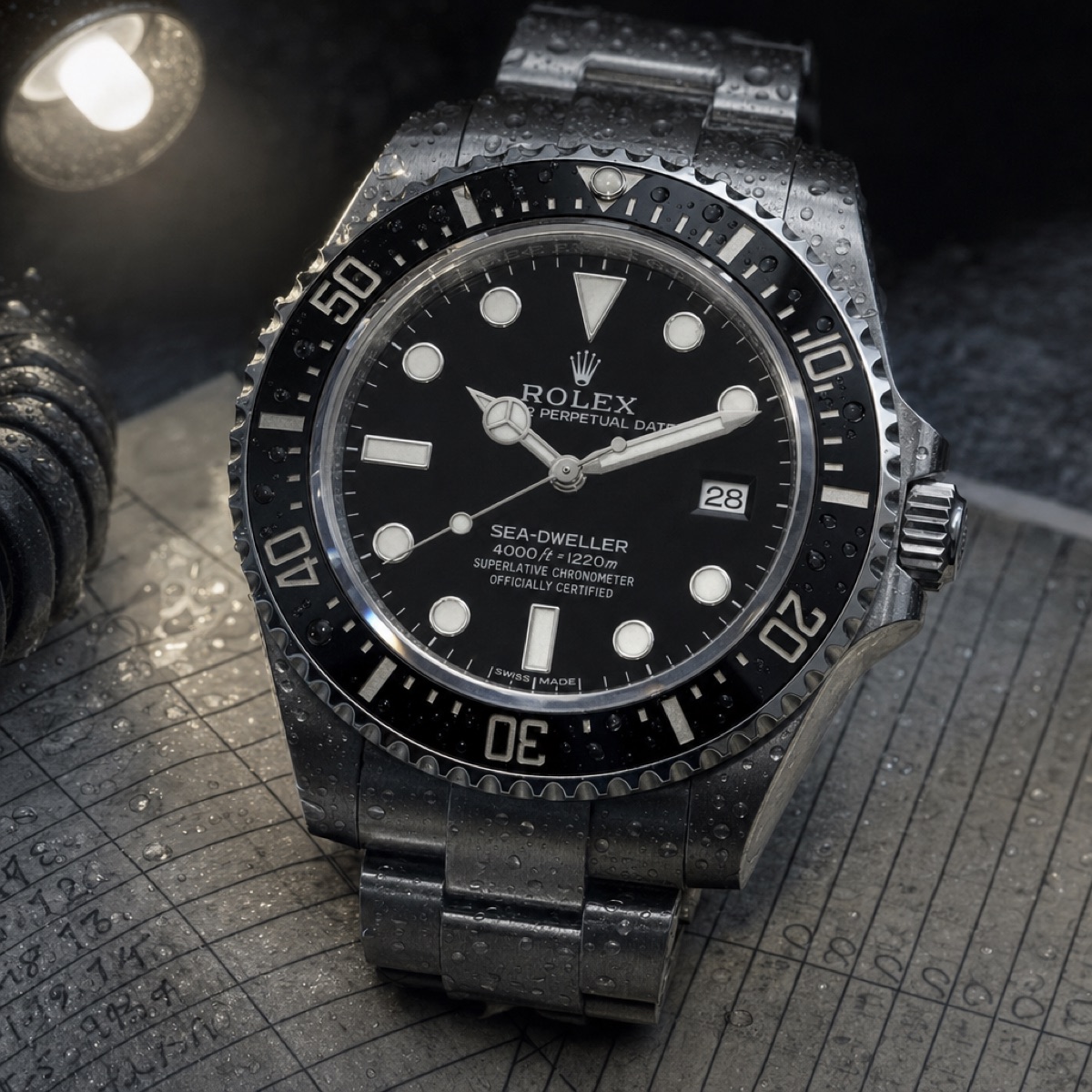
AI-generated illustration.
Two small dial details are unresolved. On the 126600, collectors separate early dials from later ones by a tiny Rolex crown printed between "SWISS" and "MADE" at six o'clock, which arrived around 2018 (Chronocheck). I found no source that shows it on any 116600, and none that rules it out. The same goes for an engraved rehaut, which one dealer listing claims for the 116600 without describing it. If you have a late-2017 example, a photograph of six o'clock would settle the first question.
Bezel
The insert is black Cerachrom, with the numerals and graduations coated in platinum (Rolex). Unlike a Submariner's, it's graduated minute by minute all the way round, "like the Deep Sea and vintage Milsubs" (SJX). Ceramic resists fading, so there are no faded-bezel variants to collect, and I found no font or colour variants either. That's the opposite of the 16600, whose aluminium inserts fade, which SJX notes is where collectors' "tropical" bezels come from (SJX).
Co-branded, commissioned and error dials
None are documented on the 116600. I searched for Tiffany, Comex, military and misprint dials on this reference and found nothing. The Tiffany-signed and Comex Sea-Dwellers I came across were all earlier references.
You may run into an "S8G" or "Steven Gerrard" 116600, which marketplace listings describe as limited to 186 pieces with a PVD-coated case (Watchprozine). The listings don't say who made it, and Rolex's own spec for the 116600 is plain 904L steel. Treat it as an aftermarket customisation of a standard watch, not a Rolex variant.
Why it matters
Sources disagree on how the 116600 sold, and the disagreement is the interesting part. Sotheby's says it "became a instant success." The dealer Oakleigh remembers it differently: buyers found the new chunky sports-watch proportions too bulky, "ADs struggled to sell them," and "ironically, this scarcity has made the 116600 something of a cult favourite today." I can't settle that with sales figures, because Rolex doesn't publish any. Both accounts agree on what happened next. The run was short, Rolex replaced it with something bigger, and that left a modern 40 mm Sea-Dweller with a ceramic bezel that nobody could buy new any more.
That's the case for it, and the case against is fair too. On paper it's a Submariner Date with a valve, a deeper rating and no Cyclops, at a price that rose sharply over the old model's. A dealer's 2026 buying guide puts it between two better options without clearly beating either one (Majestix). For value the 16600 is cheaper, and for the movement the 126600 has the newer 3235. My read is that the 116600 is the one to buy if you want the old 40 mm Sea-Dweller proportions with a modern bezel and bracelet. It's also the one to buy if, like me, you find a reference Rolex only made for three years more interesting than one it's made for twenty.
The market seems to agree, gently. In March 2026 the same guide, working from WatchCharts data, put the 116600 at about $11,000 to $13,000, against $8,500 to $10,000 for a 16600 and $13,000 to $14,500 for a 126600 (Majestix). At auction a like-new full set made HK$112,500 at Phillips in Hong Kong, and a 2016 example hammered at SEK 120,000 at Bukowskis in April 2023. Those are good prices for a recent steel Rolex, and nowhere near record territory.
What I'd check before buying one
- The papers: The warranty card should name the 116600 and carry a date from 2014 to 2017, or a little after for watches that sat in dealer stock.
- The dial font: The 116600's "Sea-Dweller" line is in a simpler sans-serif font. A serif "Sea-Dweller" belongs to a 16600 dial.
- The bracelet: Glidelock should run smoothly through its full range, and the Fliplock link should be there. Owners often remove it, so ask.
- The case edges: The rounded case should still show crisp contrast between brushed flanks and polished surfaces. Soft lug tips mean it's been polished.
- The crystal edge: SJX notes the sapphire sits a little proud of the bezel and can chip at the edge (SJX).
- The valve: It should look factory and undisturbed at nine o'clock, and the seller should be able to show service or pressure-test history.
Sources
- Rolex, Oyster Perpetual Sea-Dweller 4000 116600 spec sheet and launch text (PDF), rolex.com, archived 23 March 2016
- Rolex, Sea-Dweller 4000 m116600-0003 product page, archived 2 January 2016
- Sotheby's, Watches online 2019, lot 64, Sea-Dweller 116600 circa 2016
- Phillips, Phillips & Blackbird Sports, lot 874, Sea-Dweller 4000 116600
- Phillips, Geneva Watch Auction FIVE, lot 233, Sea-Dweller 1665
- Phillips, Hong Kong Watch Auction XIII, lot 990, Deepsea 116660
- Bukowskis, Important Timepieces spring 2023, lot 126
- SJX, Comparison: Sea-Dweller 4000 16600 vs 116600, July 2014
- SJX, Up close with the Sea-Dweller 4000 116600, June 2014
- Fratello, Robert-Jan Broer, Rolex Sea-Dweller 4000 reference 116600, April 2014
- Time+Tide, Andy Green, Hands-on: the Rolex Sea-Dweller 126600, October 2017
- Time and Watches, Rolex Sea-Dweller 4000 ref. 116600, March 2014
- Revolution, History of the Rolex Sea-Dweller
- Deployant, Peter Chong, August 2017
- Oakleigh Watches, Sea-Dweller comparison: 16600, 116600 and SD43
- Bob's Watches: Sea-Dweller 4000 116600 review, editorial
- Watchprozine, Sea-Dweller 116600: the last of the 40 mm dive watches, October 2020
- Watchprozine, "S8G" 116600 marketplace listing
- Majestix Collection, Rolex Sea-Dweller buying guide, April 2026
- Chronocheck, Rolex 126600 market value
- Research dossier:
~/Projects/notebook/personal/research/watches/2026-10-29-rolex-sea-dweller-116600-dossier.md