Rolex Cosmograph Daytona 6263
- Make
- Rolex
- Reference
- 6263
- Model
- Cosmograph Daytona
- Production
- 1969–1988
- Case diameter
- 37 mm
- Calibre
- 727
- Case material
- Steel
- Water resistance
- 50 m (164 ft)
AI-generated illustration.
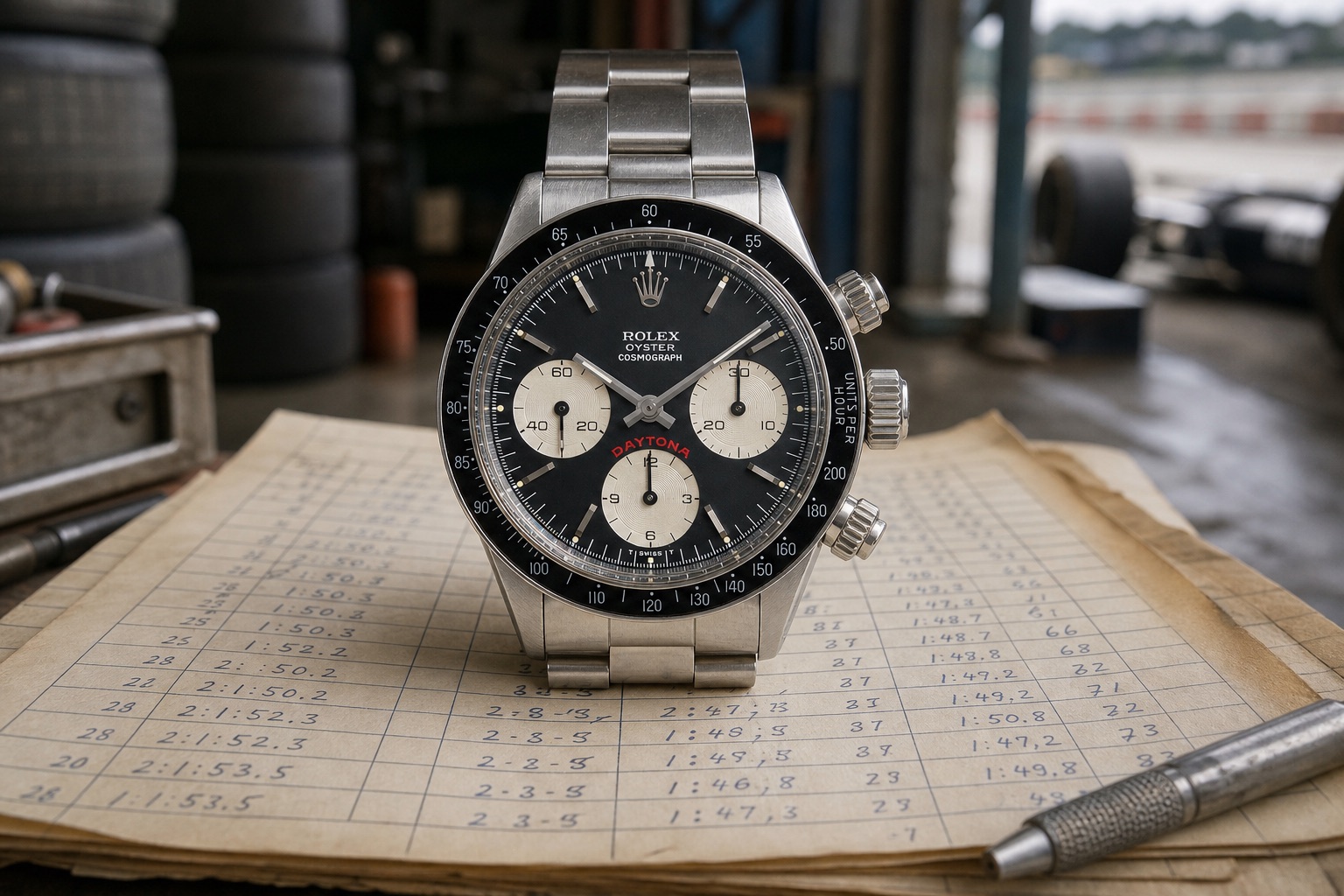
The black bezel came first. When Rolex gave the Cosmograph screw-down pushers in 1965, the new reference 6240 also got "a bezel with black acrylic insert rather than the metal bezel" of the pump-pusher 6239, and dials that could carry the word "Oyster" for the first time. It took Rolex until 1969 to make that combination its standard. That year it unveiled the Rolex Cosmograph Daytona 6263 alongside its steel-bezel twin, the 6265, and the pair carried the hand-wound Daytona to the end of its life in 1987 or 1988, depending on which auction house you ask.
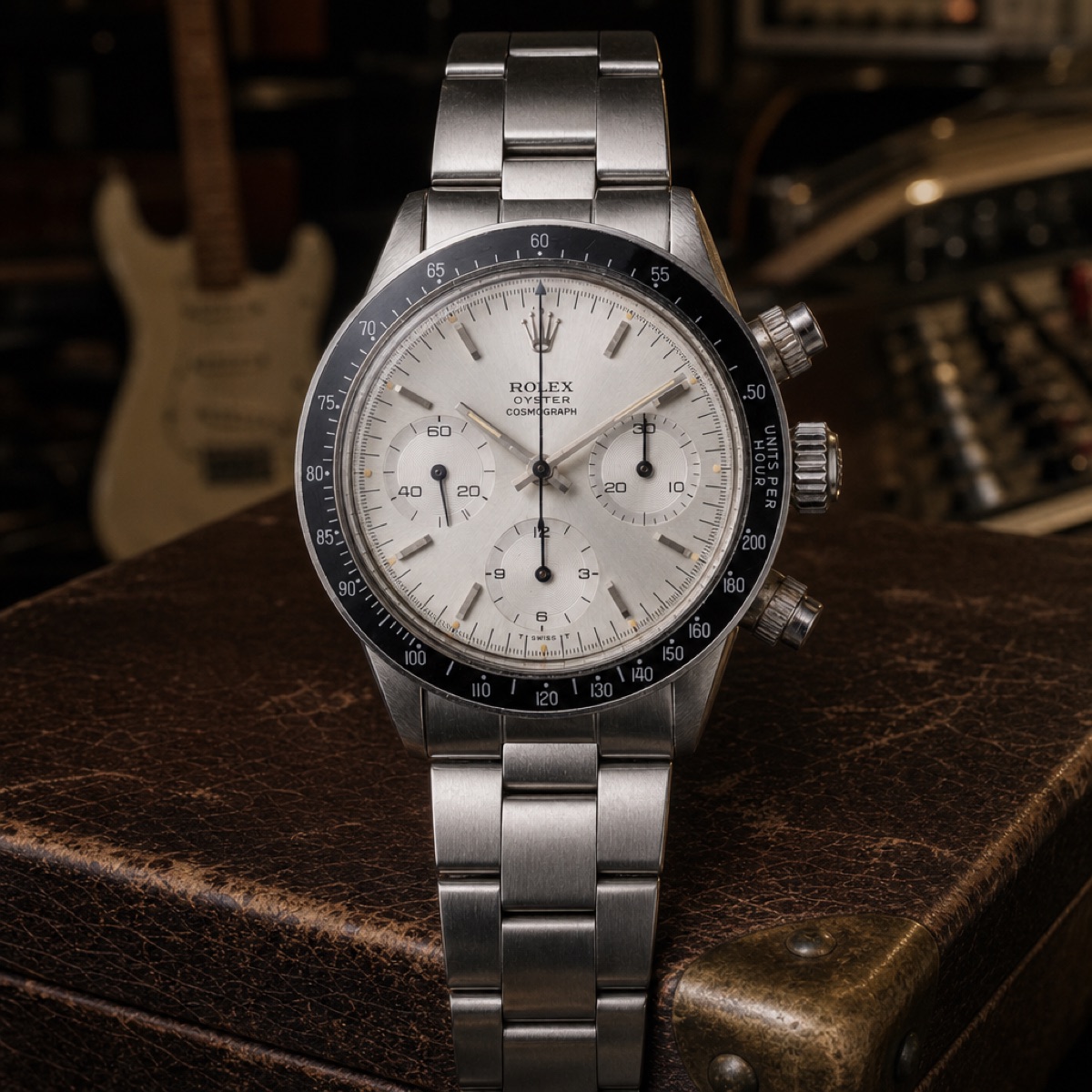
Phillips rates the 6263, with a careful "arguably", the defining manual-wind Daytona, and it pins that on two parts: the watch is "defined by the screw pushers and the bezel with black acrylic insert". Everything else, the Valjoux-based calibre 727, the 37 mm case, the dial that grew a red "DAYTONA" in the late 1970s, it shares with the 6265. It's also the watch Paul Newman wore for 25 years. His second Daytona was a plain black Big Red 6263, and it sold for $5,475,000 in 2020.
I'd like to own one, and I haven't handled one. What follows comes from auction catalogues and specialist write-ups, and where they disagree I've said so.
Where it came from
The family tree depends on who's drawing it. Phillips says the 6263 and 6265 were "both launched in 1969, replacing the first Oyster Cosmograph model, reference 6240". Sotheby's calls their screw-down pushers "an evolution from earlier Daytonas, such as the 6239 and 6241". And a Phillips essay on a 6264 says the pump-pusher 6262 and 6264 were "discontinued to make way for the two last references of the manually wound Daytona era, refs. 6263 and 6265". All three hold at once, because Rolex ran overlapping families and sold them in pairs: a metal bezel and a black acrylic one. The 6239 had metal and the 6241 acrylic; the 6262 had metal and the 6264 acrylic. The 6265 and 6263 were the last pair, the first with screw-down pushers on both, and Phillips says they were "soon overtaking" the pump-pusher pair in popularity. I found no source that explains why Rolex kept offering both bezels.
The start date is tangled too, and Christie's untangles most of it in one sentence: the 6263 and 6265 were unveiled in 1969, "which will only be available for purchase in late 1970". That's why catalogues variously say 1969, "the early 1970s" or 1971. On the end date the catalogues I read split six to four. Phillips says in one place that both references ran "until 1988, when they were replaced by the first automatic Cosmograph Daytona, the reference 16520", and in another that the 6263 "ceased production in 1987". I've used 1988, the majority. The 16520 that replaced it was a different kind of watch, the first automatic Daytona.
Nobody outside Rolex knows how many were made, and the houses' estimates don't line up. Christie's puts the first series at "around 900 pieces for the 6263 and 1300 for the 6265", and the 20-year total at 24,000 in steel with ten times fewer in gold. Phillips gives the same 24,000 in steel for both references and "only 2,400" in gold, while another Phillips essay says "no more than 2000" 6263s alone were cased in gold. Sotheby's has said 25,000 in steel in one article and 40,000 in total in another. None of them shows its working.
What's clear is that they cost about a serviceman's monthly pay, and they sold slowly. I couldn't find a Rolex price list, but one Antiques Roadshow appraisal makes a fair snapshot. An Air Force veteran who bought his 6263 in the early 1970s paid "roughly $346", with a 10 percent discount at his base post exchange, and the appraiser's auction estimate was $500,000 to $700,000. Phillips says the Daytona "was not an immediate commercial success upon release", and that it was the late 1980s and 1990s before these watches "gained significant traction". One small piece of evidence: the earliest known gold 6263 with a chronometer dial, a case made around 1970, carries a guarantee from a Caracas jeweller dated December 1975.
The traction came, in Phillips' telling, "in no small part" from Paul Newman, and the Newman watch everyone knows is his 6239, sold for $17,752,500 in 2017. His second Daytona was a 6263. Phillips, quoted by Monochrome, described it as a "black, non-exotic dial Cosmograph Daytona, reference 6263" that "was bought for Newman once again by Joanne Woodward", with "Drive slowly Joanne" engraved on the caseback. She bought it in 1983, and Monochrome calls it the watch he wore longest and was most often photographed in, until he gave it to his daughter Clea in 2008. Phillips sold it in New York on 12 December 2020 for $5,475,000 with fees, which SJX counted as the third most valuable Rolex ever sold at auction at the time. So the man collectors named the exotic dial after spent a quarter of a century wearing a 6263 with a plain one. I find that the best thing about the reference.
The watch
| Spec | Value |
|---|---|
| Case | Stainless steel Oyster, screw-down caseback, crown and pushers; also 14k and 18k yellow gold |
| Diameter | 37 mm or 37.5 mm, depending on the catalogue (none says how it was measured) |
| Lug width | 19 mm |
| Crystal | Acrylic |
| Bezel | Metal ring with a black acrylic tachymeter insert, graduated to 200 units |
| Crown | Screw-down; 700-series crown on the first batches, Triplock later |
| Movement | Calibre 727, manual-wind chronograph on a Valjoux 72 base, 17 jewels, 21,600 vph |
| Chronometer | Gold examples certified from the early 1970s; steel examples not |
| Water resistance | 50 m |
| Bracelet | Steel: folded 7835 early, solid-link 78350 with 571 end-links later. Gold: riveted Oyster or Jubilee |
I couldn't reach any Rolex document for this reference, so the figures come from auction catalogues, mostly Phillips and Christie's. The 19 mm is the end-link width printed in Phillips' bracelet specs. The water resistance is better sourced than it was for my 6265 article. Phillips says that thanks to the screw-down pushers and a redesigned crown "these models were now guaranteed water resistant for 50 meters", and Christie's agrees, "guaranteed waterproof to 50 meters". That guarantee is more than fifty years old, and a watch that old has usually been opened many times since, so I'd still keep one dry.
The 727 is the end of a long line: Phillips calls it "a Rolex upgrade of Valjoux caliber 72 and the final evolution of this movement". It's the same calibre as the last pump-pusher 6262 and 6264, and Christie's gives its rate as "21,600 alternations per hour". I found no reliable figure for power reserve and no source saying whether it hacks, so I've left both out.
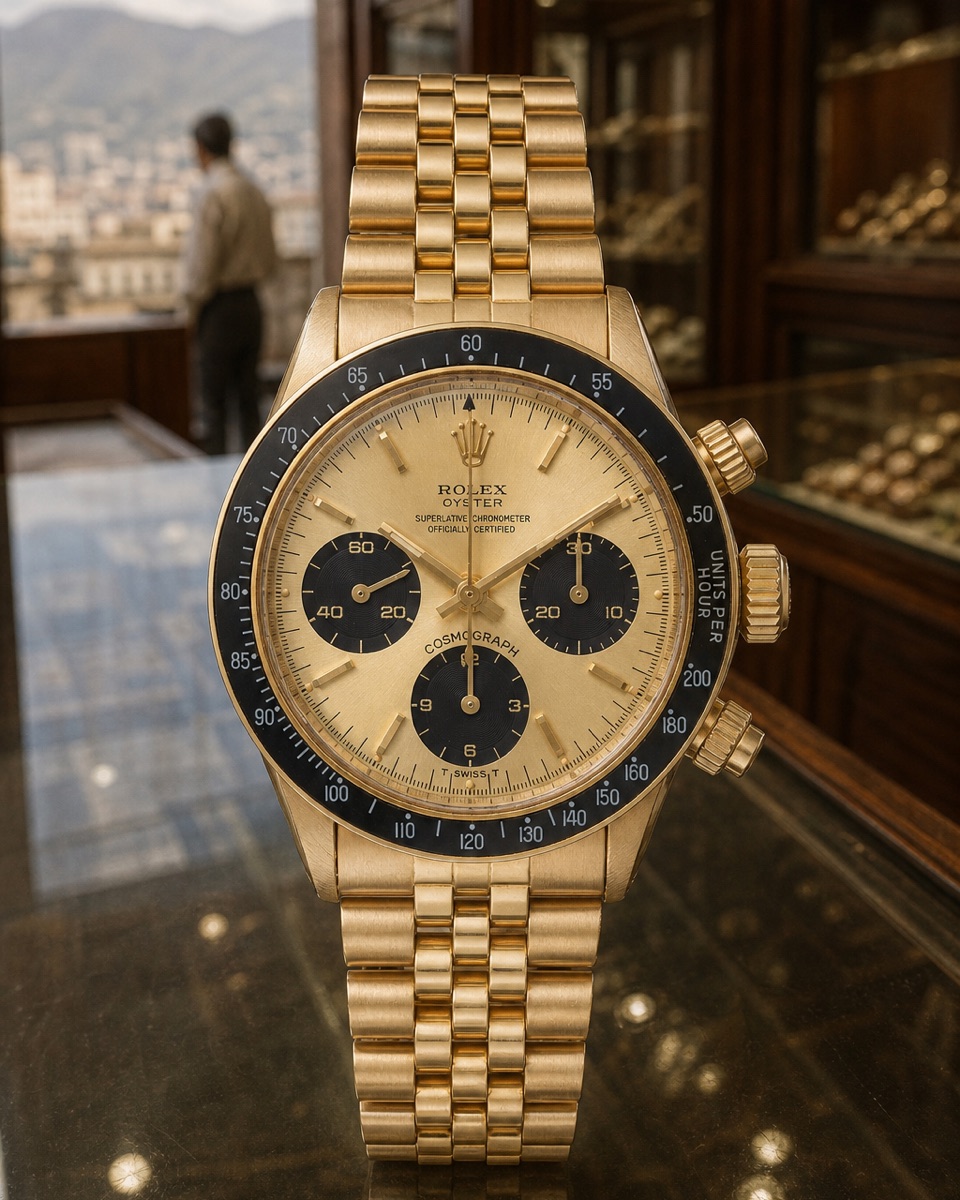
Gold was a small part of the run, and Rolex treated it differently. Phillips says the company decided to seek "chronometer certification for all gold Daytona models beginning in the early 1970s" and printed "Superlative Chronometer Officially Certified" on the dials, while steel Daytonas "were not certified by COSC". Both 14k and 18k cases exist, with the 14k ones "believed to be mostly delivered to the American market". The gold watches carry no suffix and are catalogued as plain 6263s. I found no white gold 6263, which is worth knowing, because the one-off white gold 6265 "Unicorn" tends to get mentioned in the same breath.
AI-generated illustration.
How it changed
Rolex never published serial tables, so the dating below rests on about 45 individual 6263s that auction houses have catalogued. Houses date the same serial range a year or two apart, so read every year as approximate.
| Years | Case no. seen | Dial | Bezel, pushers, crown | Steel bracelet |
|---|---|---|---|---|
| c.1969–71 | 2.08M to 2.87M | "Rolex Oyster Cosmograph", no "Daytona"; Paul Newman exotic dials, Oyster Sotto first | Mark 1 insert; "millerighe" pushers; 700-series crown | 7835 folded, 271 end-links |
| c.1972–75 | 3.0M to 4.1M | Sigma dials; some still without "Daytona" in 1974 | 7835, then 78350 by about 1975 | |
| c.1976–78 | 4.4M to 5.6M | "Daytona" arrives; sigma with red Daytona and Big Red both seen in 1978 | Mark II pushers; one 1978 watch catalogued with a Mark III bezel | 78350, 571 end-links |
| c.1979–85 | 6.0M to 8.8M | Big Red, floating and standard | Mark II details on a 1981 watch; Triplock crown | 78350, 571 end-links |
| 1987 | R-prefix | Gold: "Officially Certified Chronometer" |
The anchors: Christie's dates its Mark 1 Oyster Sotto dial to watches "made in 1969 within the 2'085'5** serial number range". Phillips catalogued a sigma dial at 3'048'154 and managed to date it 1971 in the essay and 1972 in the fields beside it. Sotheby's sold a sigma with no "Daytona" anywhere at 3'731'534, circa 1974, and a sigma dial with a red Daytona at 5'503'267, circa 1978. The first 78350 bracelet I found is on 4'028'195, which Phillips dates 1975 in one place and 1976 in another. At the end, Phillips sold an 18k watch with case R'328'716 from 1987.
Read down the dial column and the 6263 tells the same story as its twin, a dial that kept getting louder. The first watches said "Rolex Oyster Cosmograph" and nothing more. Through the middle of the decade sigma marks came and went, and the Daytona name arrived. By the late 1970s "DAYTONA" was printed big and red above the six o'clock register, and that Big Red is the 6263 most people picture.
The variations that matter
Dials
Christie's puts the arrival of the name plainly: "the "Daytona" designation is found on examples from the mid-1970s onwards". Before that the dial said "Rolex Oyster Cosmograph" and stopped, and Sotheby's catalogued a sigma 6263 from about 1974 that "does not include the "DAYTONA" name anywhere on the dial".
Sigma dials put a small Greek σ either side of "T SWISS T" at six o'clock, marking solid gold hour markers under a scheme from APRIOR, the Swiss gold promotion body (my 6265 article has the detail). On the 6263 they run from the early 1970s to at least 1978. The start is disputed: Christie's says APRIOR was formed in 1973, while Phillips dates a sigma 6263 to 1971 or 1972. Sotheby's says the mark was "phased out after a few years" because it was too cryptic.
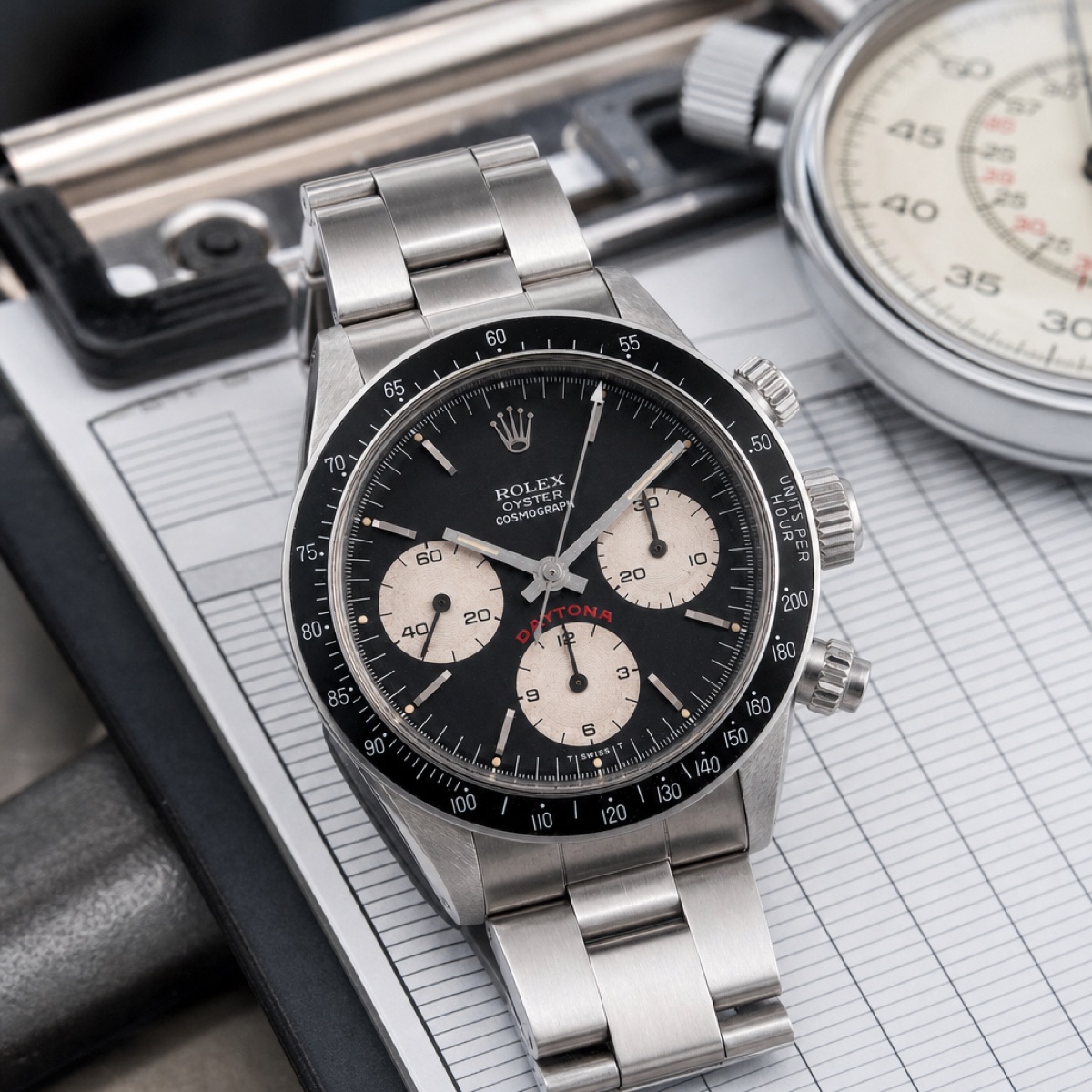
"Big Red" is the collectors' name for the red "DAYTONA text above the sub-dial at 6 o'clock", on black or silver dials. Phillips says it "started to appear in 1975", though the earliest plain Big Red I found catalogued is from about 1978. Sotheby's splits it three ways. The "floating" Big Red has a bigger gap between the register and the word, and Sotheby's calls it "the most sought-after one". The standard Big Red sits closer. "Small Red" is a smaller print "generally found on the last production batch or as service pieces", and Sotheby's describes later service dials as "Little Red". A small red Daytona on a 6263 is a reason to ask about its service history.
Gold watches came with champagne or black dials, Phillips says, and the chronometer text changed their layout. The earliest known gold 6263 with "Superlative Chronometer Officially Certified", a case from around 1970, has the "Oyster Split" layout, named for "the gap between the four lines of text on the dial". By 1987 Phillips says the gold dials read "Officially Certified Chronometer".
Bezels
The insert is the 6263's whole identity and its weak point. Antiquorum describes "a metal bezel with an acrylic 'epoxy' insert", and Christie's has the scale "calibrated for 200 units". Acrylic cracks. Sotheby's catalogued a 1975 watch with its original insert "with some cracks at 4 and 7 o'clock and light bubbling throughout", and an insert that has survived fifty years is part of what a buyer pays for.
AI-generated illustration.
Auction houses grade inserts and pushers as Mark I, II and III. Phillips calls the Albino's "MK1 pushers and bezel" correct for 1971, and a Wind Vintage listing says the Mark 1 insert has a "hooked 2" in 200. Later dates conflict. Phillips described a 1981 watch with a Mark II insert and Mark II pushers as one of the last before these details were "upgraded to the Mark III version in the early 1980s". Phillips Hong Kong, though, described a Mark III bezel on a 1978 watch as correct, "as expected" for the late 1970s. No published scheme defines the Marks, so I treat them as house shorthand.
The bigger problem is that the bezel is a poor guide to which watch you're looking at. Phillips sold a 1981 6263 that "features the metallic bezel insert of the 6265", explaining that "These inserts were easily interchangeable" and that "buyers could request a bezel change when the watch was originally purchased". Bob's Watches says the black insert makes a 6263 worth significantly more than an otherwise identical 6265, so the incentive to swap runs one way. The reference engraved between the lugs is the real answer. When Sotheby's catalogued Clapton's Albino, it noted that "The numbers between the lugs are 6263 and 2874334".
Case and crown
Look inside the caseback of an early 6263 and you may find almost any reference. Lots I opened were stamped 6238, 6239, 6240, 6262 and 6265, as well as 6263. Rolex used up old parts, and the houses sell these watches as correct. Christie's says the Oyster Sotto watches "are fitted with 6239 casebacks stamped C.R.S for the maker C.R. Spillmann S.A.".
Christie's also describes the first fittings: "The very first batches mount the 700 series crown", and early steel watches had screw-down pushers "in nickel-plated brass" with fine vertical ridges, "the so-called millerighe". Later watches have the Triplock crown, which Phillips catalogued on a 6263 from about 1980. When it changed is unclear. Monaco Legend described a 1971 watch with "the new 7 mm Triplock winding crown", which sits awkwardly beside Christie's 700-series crown on the first batches.
Bracelets
Early steel 6263s came on the folded-link 7835 Oyster, and a Christie's 1969 lot has its bracelet "stamped 7835 19, 2 71 and 261 to the end links". From the middle of the decade the steel watches are on the solid-link 78350 with 571 end-links; Phillips' 1986 example is typical. I found no source dating the switch. Gold watches wore riveted gold Oysters (end-links stamped 71 on 18k, 57 on 14k) or a gold Jubilee, and Phillips calls a steel Jubilee on a 6263 rarely seen.
Co-branded, commissioned and error dials
Paul Newman dials
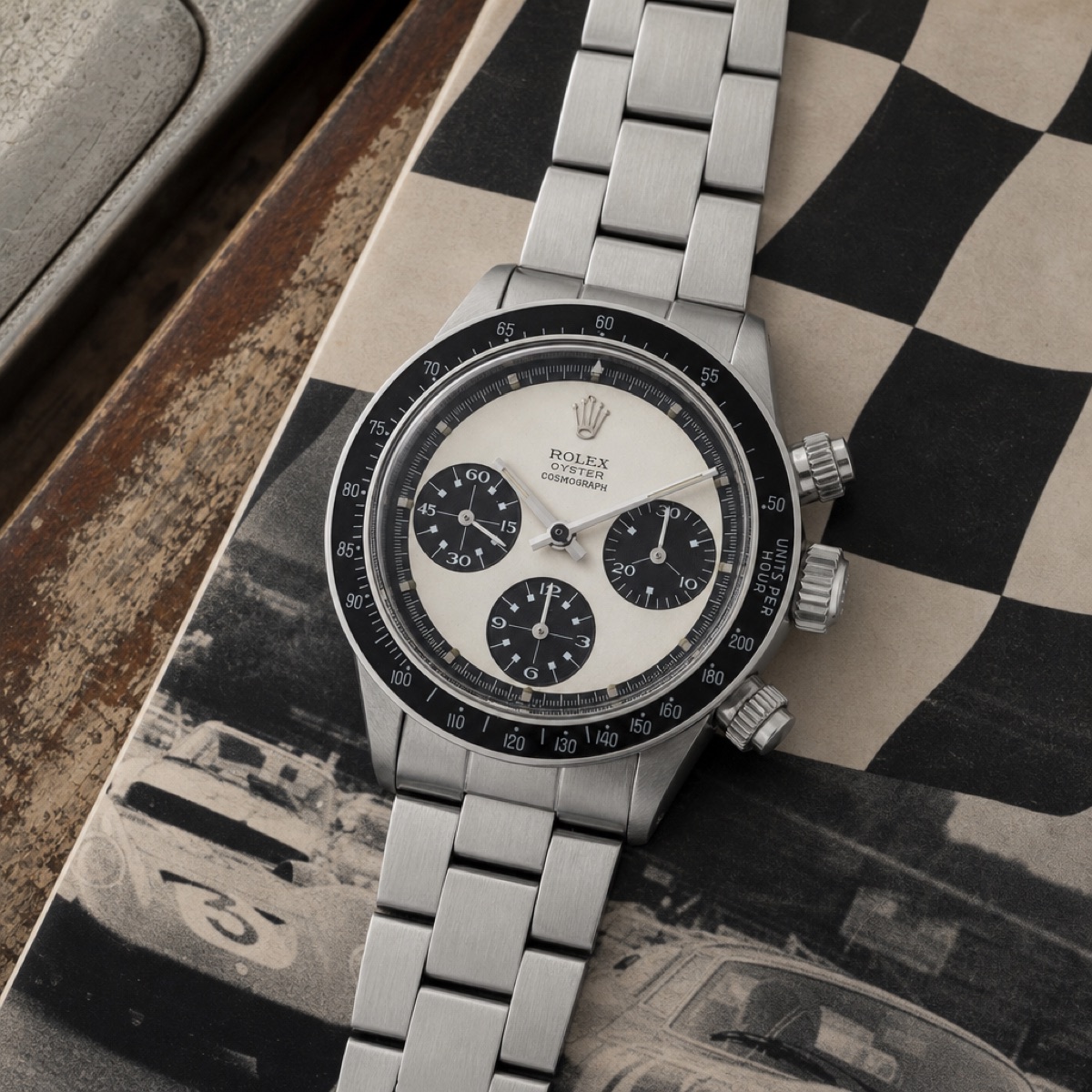
The exotic dial collectors now name after Newman reached the 6263 in two forms. Phillips sums them up: a 6263 Paul Newman usually has either an "Oyster Sotto" dial, black with white registers and a red outer track, or a white "Panda".
Oyster Sotto ("Oyster Underneath") belongs to the earliest 6263s. A correct one, Phillips says, "displays "Rolex Cosmograph Oyster" rather than "Rolex Oyster Cosmograph"", with "Oyster" on its own line below. Christie's explains how that happened: the dials "were originally intended for the non-waterproof references such as 6262 and 6264", and "a small number of the already printed current non-Oyster dials were adapted" for the screw-down watch. Counts differ. Phillips quotes scholars at "less than 25 examples", and Christie's says fewer than 20. Phillips sold one from about 1969 for CHF 504,000 in 2022.
The Panda is the white version with black registers, named for the bear's face. Phillips says "Panda dials can be found exclusively on screw-down pusher references 6263 and 6265", and on those two references the dial "loses the red outer scale and retains only the white and black color scheme". It also changed through the run: Phillips counts "four subtly different dial configurations in accordance to the serial number, the MK2 being a version with sharp serifs on all the letters", and sold that 1972 Mark 2 example for CHF 444,500. Phillips' explanation of why so few exist is that the Panda "was not an immediate success - this forced Rolex to reduce and cease production quite rapidly".
AI-generated illustration.
There are gold Paul Newman 6263s too. One, a yellow gold watch with a lemon-yellow dial known as "The Legend", made CHF 4,168,640 with fees at Phillips in Geneva in May 2017, reported at the time as a record for any Daytona at auction. It held the record until Newman's own 6239 sold that October. Revolution noted it had earlier sold at Antiquorum for CHF 841,300.
Prices like these are why fake Paul Newman dials get fitted to ordinary Daytonas. Bob's Watches lists what a real one has, among them a seconds register numbered 15-30-45-60 where a standard dial reads 20-40-60, and a small step between the centre of the dial and the outer minute track. A forger has to get every one of those right.
The Albino
Eric Clapton's 6263 has subdials in the same silver as the rest of the dial. Phillips describes it as "one of only four known examples of white dialled Cosmographs where the subsidiary dials are not in black with white printing but in the same silver finish as the dial plate", adding that "the market and scholars have named the all-white Cosmographs "Albino"". It dates to 1971 and carries a 6262 stamp inside the caseback. Its history is unusually well documented. Clapton bought it in the late 1990s and sold it at Christie's New York on 5 June 2003; in 2008 Sotheby's New York sold it for $505,000, five times its estimate and a record for any Cosmograph at that point. At Phillips in Geneva on 10 May 2015 it made CHF 1,325,000.
AI-generated illustration.
A second Albino surfaced at Sotheby's in December 2025, case 2'648'447, also from about 1971, estimated at $500,000 to $1 million. Sotheby's said there are "only a handful of known "Albino" examples", that this one had never been on the market, and that "The origins of the "Albino" dial are unknown and it was never part of regular commercial production." I couldn't see what it sold for. Nobody has explained where these dials came from, and I'd want an explanation before I paid Albino money for one.
Tiffany & Co.
Tiffany is the only retailer name I found printed on a 6263 dial. On a steel watch from 1980, Phillips described the signature "printed in black" beneath "Oyster Cosmograph" at twelve, and sold it for CHF 137,000. Sotheby's offered a 14k gold Tiffany 6263 from about 1974 on a Jubilee "made in the U.S.A.", calling it "only the second example of a 14k yellow gold Daytona 6263, retailed by Tiffany & Co., to come to market". There are Tiffany Big Reds too, and Sotheby's admits on one from 1981 that "The exact number of Tiffany dialed Rolex's from this era is unknown". A printed signature is easy to add, so the paperwork matters more than the print.
Oman, Dubai and the Arabian Knight
Rolex made 6263s to order for Gulf rulers. At Phillips' Daytona Ultimatum sale in Geneva in May 2018, two steel 6263s from about 1974, with case numbers eight apart, sold for more than a million francs each. "The Red Sultan" has the Khanjar dagger of the Sultanate of Oman at twelve o'clock, and Phillips says it "was ordered through Asprey and made upon special request by His Majesty Qaboos bin Said Al Said, the Sultan of Oman". It made CHF 1,212,500. "The Arabian Knight" has no applied markers at all. "In lieu of white gold markers are white Arabic-Indic numerals printed directly on the black dial", and Phillips calls it "one among a batch of known watches delivered to the Middle East", very likely for a royal. It made CHF 1,932,500.
The Khanjar turns up later in the run too. Phillips sold a steel 6263 from about 1980 with a green Khanjar and a Big Red, on which Rolex moved its own name "higher than standard production dials, making room for the Green Khanjar". Phillips says such watches were "presented as gifts to his closest dignitaries and officials", and that this is the only known example with both the green emblem and a Big Red. It made $381,000. From Dubai, Monaco Legend sold a 1976 steel 6263 with the Quraysh hawk of the UAE in colour and the signature of Mohammed bin Rashid Al Maktoum above six, "part of a very small order", for €306,250 with premium.
How many of these exist is anyone's guess. Phillips says only that "a very small number" made for Oman have resurfaced, and the counts I found elsewhere, from three to nine, don't agree on what they're counting.
Why it matters
The 6263 is the most complete version of the hand-wound Daytona: the screw-down pushers the 6240 introduced, the black bezel the 6240 and 6241 pioneered, and the 727 it shares with the last pump-pusher watches, all in one case for nearly two decades. Rolex then replaced it with a different kind of watch.
The objection is that its value now sits in the part most likely to be wrong. The bezel insert is what separates a 6263 from a 6265, it cracks, it was interchangeable from new, and it carries a price premium. Add a market driven by special dials and one man's wrist, and a buyer can pay a lot for a story. My pick would be the honest one: a steel sigma or early Big Red with its original insert, cracks and all.
What I'd check before buying one
- Reference: 6263 engraved between the lugs. The caseback stamp may be 6238, 6239, 6240, 6262 or 6265 on an early watch, and that's period.
- Bezel insert: black acrylic, 200 units, with no deep chips through to the metal (WatchGuys), and a Mark that suits the serial.
- Dial against the case number: no "Daytona" early, sigma in the first half of the 1970s, Big Red later. Small or "Little Red" print often means a service dial.
- Pushers and crown: millerighe pushers on the earliest watches, Triplock on later ones.
- Lume: if some plots are bright white and others cream, WatchGuys says parts were probably replaced.
- Paul Newman, Albino, Tiffany and Middle Eastern dials: provenance that matches the print.
Sources
- Phillips, round-up of manual-wind Daytonas, Geneva Watch Auction XX, 2024
- Phillips, Paul Newman's ref. 6263 "Big Red", Racing Pulse, lot 38
- Phillips, Paul Newman's ref. 6239, New York, lot 8
- Phillips, ref. 6263 "Albino", The Watch Auction: One, lot 214
- Phillips, ref. 6263 "Oyster Sotto", Geneva XVI, lot 162
- Phillips, ref. 6263 "Paul Newman Panda MK II", Hong Kong XV, lot 1015
- Phillips, ref. 6263 "Paul Newman Panda", Geneva EIGHT, lot 215
- Phillips, ref. 6265 "Paul Newman Panda", New York X, lot 123
- Phillips, ref. 6265 "Paul Newman", Hong Kong NINE, lot 853
- Phillips, ref. 6263 "The Red Sultan", Daytona Ultimatum, lot 27
- Phillips, ref. 6263 "The Arabian Knight", Daytona Ultimatum, lot 21
- Phillips, ref. 6263 "Green Khanjar", New York XI, lot 123
- Phillips, ref. 6263 retailed by Tiffany & Co., START-STOP-RESET, lot 16
- Phillips, ref. 6263, Geneva FOUR, 1986
- Phillips, ref. 6263 yellow gold "Oyster-Split", STYLED, lot 120
- Phillips, ref. 6263 yellow gold, Geneva SIX, lot 146, 1987
- Phillips, ref. 6263 14K yellow gold sigma, 2021 New York, lot 125
- Phillips, ref. 6263 yellow gold, Hong Kong XV, lot 852
- Phillips, ref. 6264 "Paul Newman", Hong Kong XIII, lot 845
- Phillips, ref. 6265, Geneva XVIII, lot 180
- Phillips, ref. 6265 yellow gold, 1980
- Phillips, ref. 6263 "Big Red" with 6265 insert, 1981
- Phillips, ref. 6263 with Mark II details, Geneva XIII, lot 150
- Phillips, ref. 6263, Hong Kong NINE, lot 910
- Phillips, ref. 6263 sigma, 1971/72
- Phillips, ref. 6263 sigma, c.1975
- Phillips, ref. 6263 "Big Red", c.1978
- Phillips, ref. 6263 "Big Red", Geneva XVIII, lot 14
- Phillips, ref. 6263 "Big Red" on Jubilee, lot 10
- Christie's, ref. 6263, Rolex Daytona "Lesson One", lot 19
- Christie's, ref. 6263 retailed by Tiffany & Co., lot 35
- Christie's, ref. 6263 Paul Newman "Mark 1 Oyster Sotto"
- Christie's, Deconstructed: the Sigma dial ref. 6263
- Christie's, ref. 6265 "Oyster Split"
- Sotheby's, ref. 6263 N.O.S. "Big Red", December 2025, lot 62
- Sotheby's, ref. 6263 "Albino", December 2025, lot 340
- Sotheby's, ref. 6263/6262 "Albino", Important Watches, 2008, lot 166
- Sotheby's, ref. 6263 retailed by Tiffany & Co., 14k gold, 2018, lot 85
- Sotheby's, ref. 6263 "Big Red" retailed by Tiffany & Co., 2024, lot 78
- Sotheby's, ref. 6263 sigma, The Drivers Collection, 2019
- Sotheby's, ref. 6263 sigma, Fine Watches, 2024
- Sotheby's, ref. 6263 sigma "Big Red", Fine Watches, 2025, lot 311
- Sotheby's, ref. 6263 "Big Red", Fine Watches, 2025
- Sotheby's, ref. 6263 "Big Red" floating, Fine Watches, 2023, lot 353
- Sotheby's, ref. 6263 sigma, London 2019, lot 125
- Sotheby's, How the Rolex Daytona Became a Collector Favourite
- Sotheby's, Vintage Rolex Daytona: The Gold Standard
- Antiquorum, ref. 6263, Monaco 2022, lot 362
- Monaco Legend, ref. 6263 UAE Quraysh Hawk dial, Exclusive Timepieces 35, lot 293
- Monaco Legend, ref. 6263, 1971, Exclusive Timepieces 28, lot 258
- Monochrome, Paul Newman's Rolex "Big Red" Daytona ref. 6263 sells for USD 5,475,000
- SJX, Paul Newman's Rolex Daytona 6263 "Big Red" sells for US$5.48m
- Quill & Pad, Phillips' inaugural One auction
- WatchCollectingLifestyle, "The Legend" sells for 4.18 million USD
- Revolution, Phillips spring 2017 auction, night two
- Gear Patrol, An Air Force veteran paid $346 for this Rolex Daytona
- Bob's Watches, Rolex Daytona 6263 guide
- Bob's Watches, spotting a fake Paul Newman dial
- Wind Vintage, Rolex Daytona sigma reference 6263
- WatchGuys, Rolex Daytona 6263 review